- Two minutes a day is enough to get more flexible. Guidelines ask for about 60 seconds of stretching per muscle group on at least two to three days a week [1][2]. Four 30-second exercises give two muscle groups that full dose every day, and seven days of it is 14 minutes a week, nearly three times the five-minute weekly mark a 2018 review found for gains in range [3].
- One 30-second hold does the job. In a six-week trial of adults with tight hamstrings, one 30-second stretch a day improved range as much as 60-second holds or three sessions a day [4].
- Short is what lasts. A new daily habit took an average of 66 days to feel automatic [5][6], and simple actions got there fastest [6]. Two minutes sails through 66 days. Twenty rarely does.
- You feel it early. The first gains come from your nervous system allowing more stretch [7], which is why a little every day beats an occasional long session.
- The routine is four moves, about 30 seconds each: Hamstrings Warm Up, Basic Posture, Dynamic Rolling and Relax The Neck. Mild tension is the target. Sharp pain, tingling or numbness means stop and shorten your range.
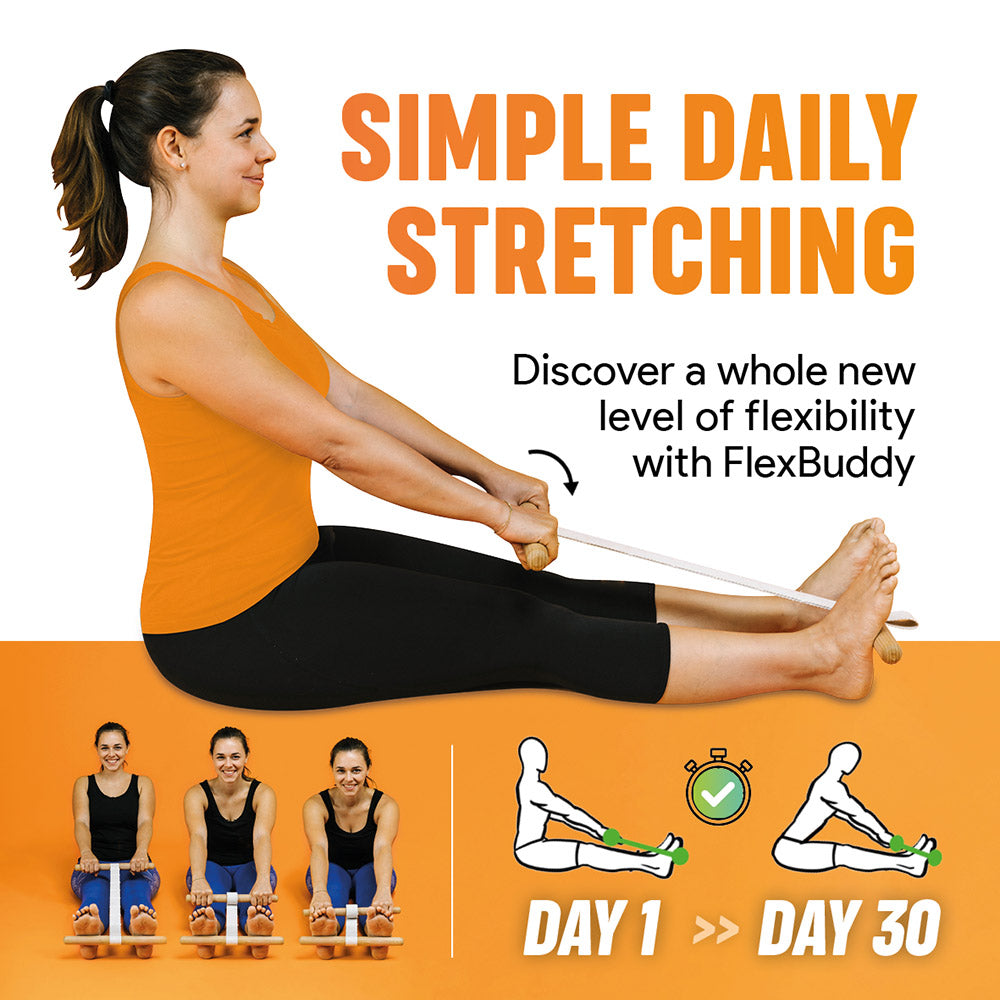
- FlexBuddy® makes the two minutes count. Hook it under your feet and you are in position in five seconds, spine tall, with the stretch landing in your hamstrings and calves.
Why two minutes a day is enough
Here's a secret the fitness industry doesn't love: for most stiff people, the best stretching routine isn't the best routine, it's the shortest one you'll actually repeat. Two minutes, done daily, beats twenty minutes done twice and then abandoned. This is that routine, and it is the promise FlexBuddy is built on: only two minutes a day can improve your flexibility and posture. That is not a marketing number. It is what the stretching guidelines add up to.
The guidelines ask for less than you think
The American College of Sports Medicine recommends flexibility exercises for each of the major muscle-tendon groups, "a total of 60 s per exercise", on at least two days a week [1]. Harvard Health gives the same target: 60 seconds per exercise in total, at least two to three times a week [2]. A review for physiotherapists adds the hold: 10 to 30 seconds is sufficient for most adults, most of the change happens between 15 and 30 seconds, and older adults do well holding up to about 60 seconds [8].
What counts is your week, not your session. A 2018 review of 23 long-term studies found that range grew once stretching reached about five minutes a week, that more days per week went with more range, and its authors suggested at least five days a week [3]. A 2024 meta-analysis of 77 studies found that calm static stretching beat bouncing for long-term range, and that the gain did not depend on piling on volume or intensity [9]. In plain words: do it often, do it calmly, and stop worrying about doing it for long.
The clearest experiment: adults with tight hamstrings stretched five days a week for six weeks, holding 30 or 60 seconds, once or three times a day. Every stretching group gained range, and 30 seconds once a day did as well as any of them [4]. Thirty seconds. Once a day.
The maths for a two-minute routine
Now put four 30-second exercises next to those numbers.
- Four exercises at 30 seconds is 120 seconds. At the guideline dose of about 60 seconds per muscle group [1][2], that is two muscle groups fully covered every day.
- Each 30-second hold sits at the top of the 10-to-30-second range where the most change happens [8], and matches the hold that delivered the full gain in the six-week hamstring trial [4].
- Seven days of two minutes is 14 minutes a week, nearly three times the roughly five-minute weekly mark for range gains [3].
The two groups are the ones a sitting day shortens most: the back of the body, mainly the hamstrings, which get the first three exercises, and the neck, which gets the fourth. The FlexBuddy Stretching Guide asks for "at least 2 minutes daily". The guideline arithmetic agrees.
What two minutes does for your body
You will feel the first session. The backs of your legs loosen, your back straightens, your neck lets go. That speed has a reason: the extra range people gain in the first three to eight weeks comes from the nervous system tolerating more stretch [7]. Your body does not have to build anything. It only has to learn that the longer position is safe, and it learns by repetition. Two minutes a day is that repetition.
Why this routine sticks when others fail
Everyone who feels stiff has started a stretching routine. Almost nobody is still doing it. The reason is not willpower and not the exercises: a routine has to become a habit before motivation runs out. Two minutes is built to win that race.
The 66-day finding
In a University College London study, volunteers each picked a new behaviour to do once a day in the same context and rated every day how automatic it felt [5]. The quickest people got there in 18 days [5]; the average was about 66 days [6]. Simpler actions became automatic faster than elaborate routines. And repeating the action in the same context was the whole mechanism: the cue does the work, not the enthusiasm [6].
Twenty minutes is an elaborate routine, and enthusiasm lasts two weeks. Two minutes is a simple action that slips into a slot your day already has. That is why you will still be doing this one next year.
The five-second start
A two-minute routine has no excuses attached. You can do it in work clothes, half-asleep, or while dinner is in the oven. And on good days, nothing stops you from running it twice.
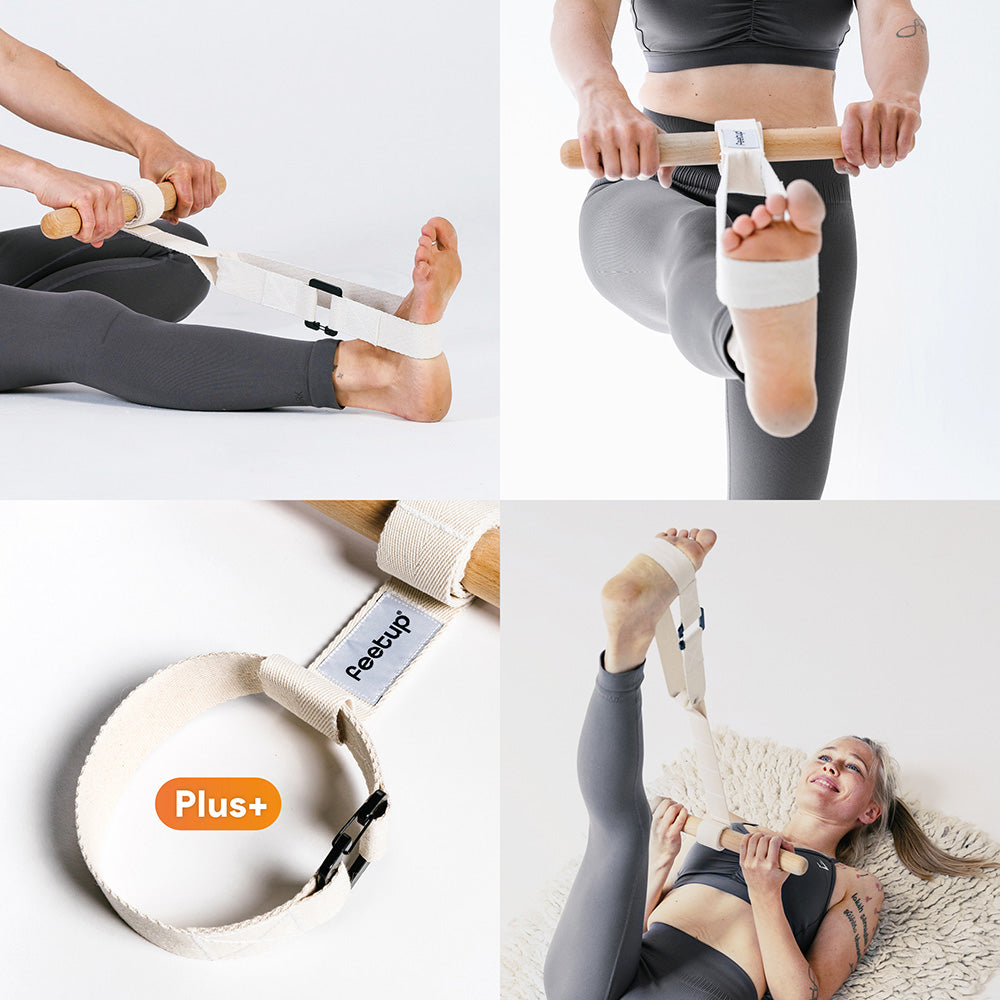
With FlexBuddy there is no setup tax either. Hook the strap around your feet and you are in position: no wrestling into stretches, no wondering whether you are "doing it right". When starting takes five seconds, starting happens. The wooden handles sit comfortably in your hands, so the stretch feels good from the first day, and that counts: the ACSM position stand notes that exercise that is pleasant to do improves adherence [1]. Comfort is what keeps day 40 happening.
Plan when and where
The strongest habit tool is the implementation intention: an "if X, then I do Y" plan that names the cue. A meta-analysis of 94 tests found such plans had a medium-to-large effect on whether people did the thing (d = 0.65) [10]. The habit researchers' advice to GPs says the same: plan when and where, and choose a time and place you meet every day of the week [6].
So attach it to something that already happens daily: laptop closes, kettle boils, toothbrush finishes. "When I close the laptop, I sit down with FlexBuddy" is a plan. "I'll stretch more" is a wish. Keep FlexBuddy in sight, next to the desk or the sofa, never in a cupboard. The object in view is half the cue.
Miss a day? Carry on
Nothing is lost. In the habit study, missing one opportunity did not materially affect habit formation [5]; gains resumed after the missed day [6]. So lower the bar on bad days: even one exercise keeps the chain alive, and the chain is the asset.
The two-minute routine
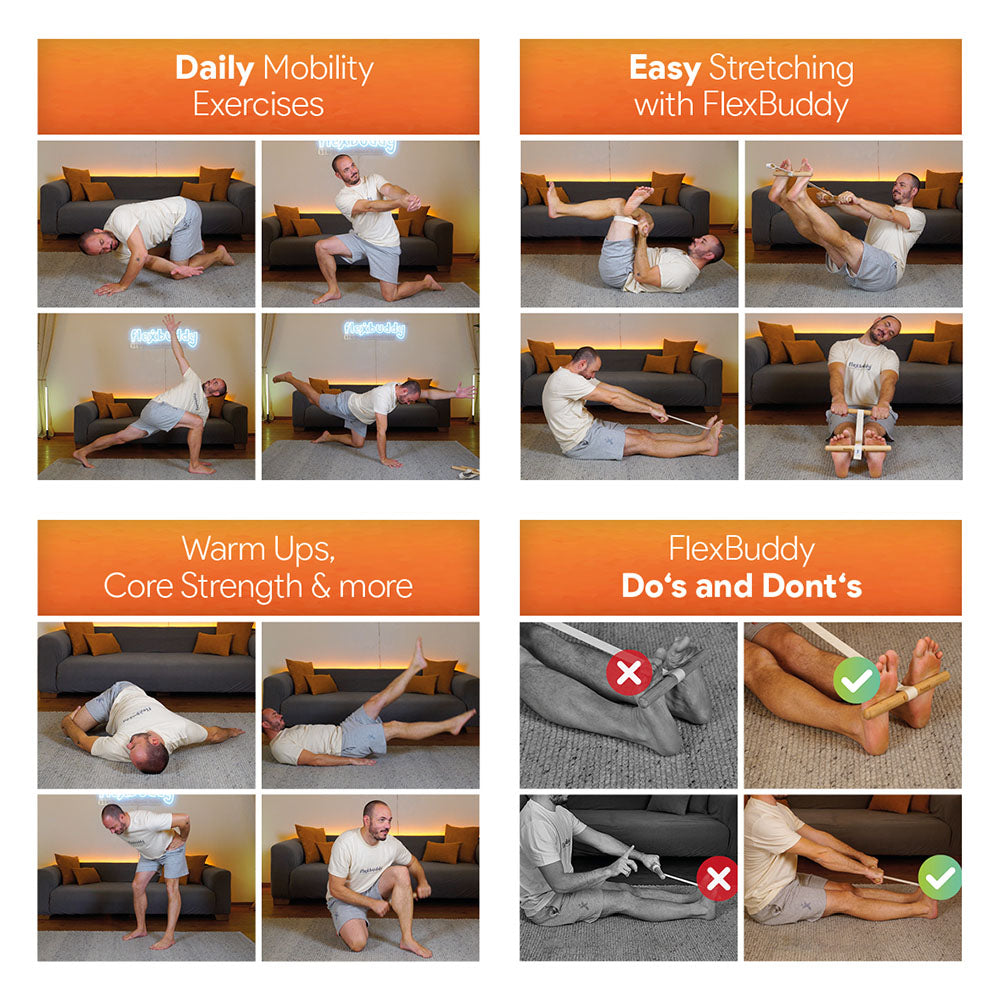
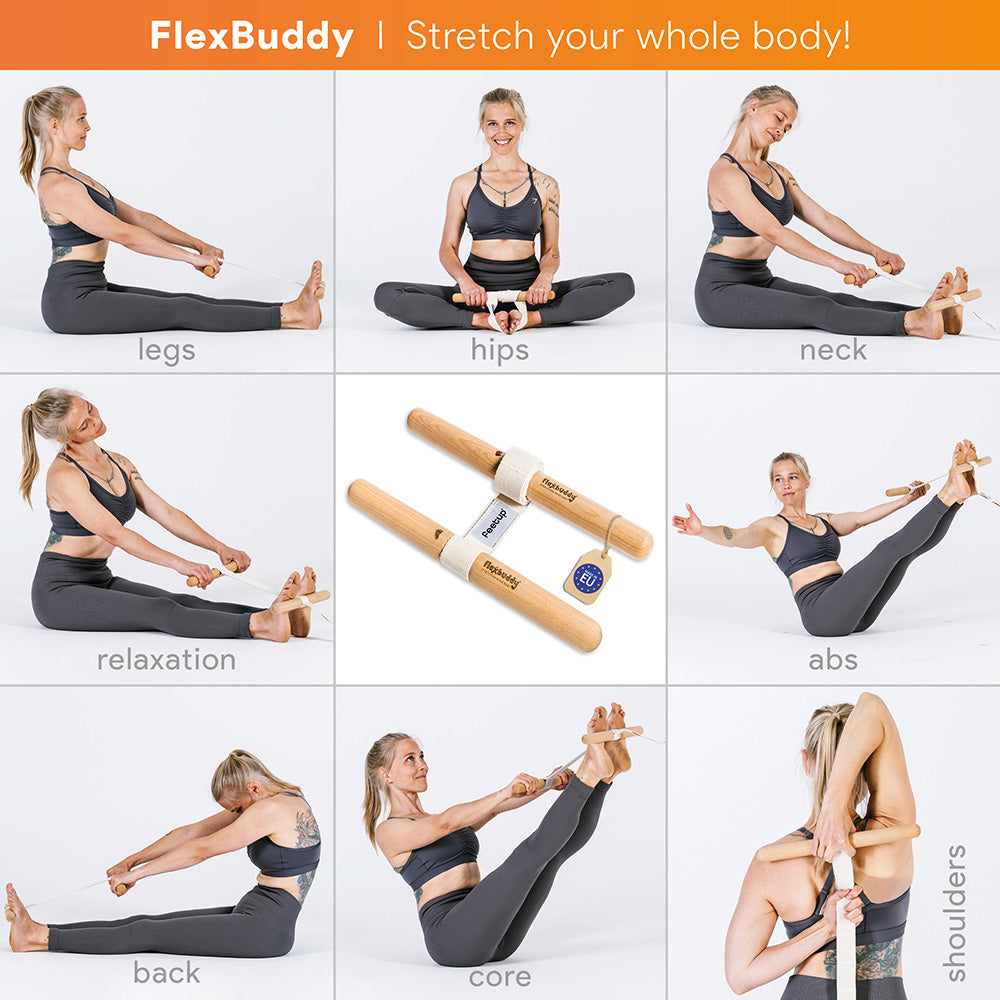
Four exercises from the FlexBuddy Stretching Guide, in the order that suits stiff beginners: a moving warm-up, the posture that teaches the straight spine, a gentle spinal mobiliser, and the neck to finish. Knowledge or abilities required: zero. Shorten the strap to your current flexibility, not the one you would like to have, and FlexBuddy does the rest: your spine stays tall and the stretch lands in your hamstrings and calves.
| Exercise | Targets | With FlexBuddy | Time | What you should feel |
|---|---|---|---|---|
| Hamstrings Warm Up | Hamstrings, lower back | Bar under the soles, rock forward and back | 30 s | A light, moving pull in the thighs |
| Basic Posture | Whole back, hamstrings, posture | Arms straight, lean back, chest lifted | 30 s | Decompression; the day's rounding reversing |
| Dynamic Rolling | Spine, segment by segment | Light tension, roll down and back up | 30 s | The spine moving freely |
| Relax The Neck | Neck, upper traps | One handle weighs the shoulder down | 15 s per side | The upper traps letting go |
1. Hamstrings Warm Up, 30 seconds
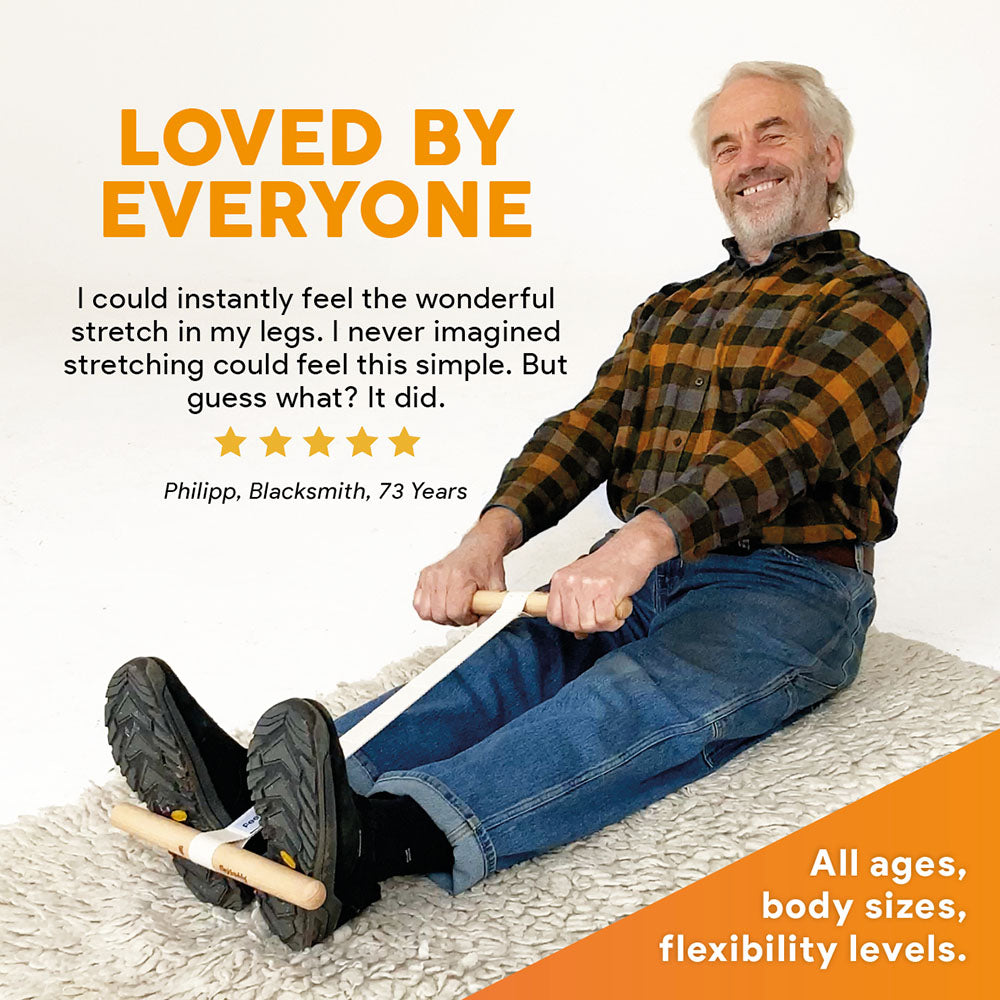
- Sit with legs extended, hook FlexBuddy around the soles of your feet, hold the handles.
- Sit tall and gently rock forward and back in a small, easy range.
- Breathe slowly and let the range grow on its own for 30 seconds.
What you should feel: a light, moving pull along the back of the thighs, a wake-up rather than a workout. Why it's first: rhythmic movement is the friendliest possible greeting for stiff legs, and it sets up everything after it.
2. Basic Posture, 30 seconds
- Bend your knees slightly, keep FlexBuddy hooked, and let your arms straighten on the handles.
- Lean back a touch into the support, lift your chest, and let your spine lengthen.
- Breathe here for 30 seconds, shoulders soft.
What you should feel: decompression, the day's rounding gently reversing. Why it earns its slot: this is the posture half of the promise. It gives your body a 30-second reminder of what tall feels like, and you carry that with you for the rest of the day. Ten slow breaths is about 30 seconds and a better clock than counting.
3. Dynamic Rolling, 30 seconds
- From Basic Posture, keep light tension on the handles.
- Exhale and slowly round your spine backward, rolling down vertebra by vertebra; inhale and roll back up to tall.
- Repeat for 30 seconds, about three to four slow cycles. No momentum.
What you should feel: gentle articulation along the spine; a stuck back starting to feel oiled. Common mistake: rushing. One full breath per cycle is the speed limit.
4. Relax The Neck, 15 seconds per side
- Anchor FlexBuddy under your feet and hold one handle to gently weigh down that shoulder.
- Tilt your head slowly to the opposite side until a soft stretch appears along the neck.
- Hold 15 seconds, switch sides.
What you should feel: the upper traps, concrete by late afternoon, letting go a notch. Why it's the closer: ending at the neck means you stand up feeling lighter where you notice it most.
That is it. Two minutes, and you stand up taller and looser than you sat down. Two rules for all four. Stretch to mild tightness, never pain: a muscle that is being hurt contracts against you. And breathe through every hold; holding your breath is bracing. Tingling or numbness is a nerve, not a tight muscle: stop. New to the device? How to use FlexBuddy covers the strap adjustment and the basic posture.
Morning, desk and before-bed versions
The morning version
Muscles are stiffest first thing, so give the warm-up more time and the holds less: Hamstrings Warm Up for 45 seconds, Basic Posture for 20, the rest as written. If the floor is the obstacle, sit up in bed with your legs straight; FlexBuddy works the same on a mattress. The full wake-up sequence is in stretches you can do in bed and the morning stretching routine.
The desk or after-work version
By the end of a sitting day the hamstrings have been short for longest, so this is the default for most people. Do it the moment you get home, before the sofa: laptop closes, shoes off, two minutes. The longer routine for people who sit all day adds hips, shoulders and wrists for the days you have eight minutes.
The before-bed version
Evening is when most people are warmest, so this is where the holds can grow: ten slow breaths in Basic Posture, Dynamic Rolling at half speed, the neck last, lights low. You go to bed with loose legs and a quiet back. If night cramps wake you, this is your version: in a randomised trial, adults over 55 with night-time leg cramps who stretched their calves and hamstrings every night just before sleep cut their cramps by 1.2 per night within six weeks, and the cramps that remained were less painful [11]. The full bedtime routine is in stretching before bed. Sara F. wrote: "I use it before I go to bed and if I don't, I can really tell a difference in the morning."
How to progress after week 4
Do not add minutes faster than you add days. The first month is for the habit, and the routine already delivers the full guideline dose.
- Weeks 1 and 2: learn the positions. Same four exercises, same cue, every day. Shorten the strap only as far as a long spine allows. Measure something, such as fingertips to floor in a standing toe touch, and write it down.
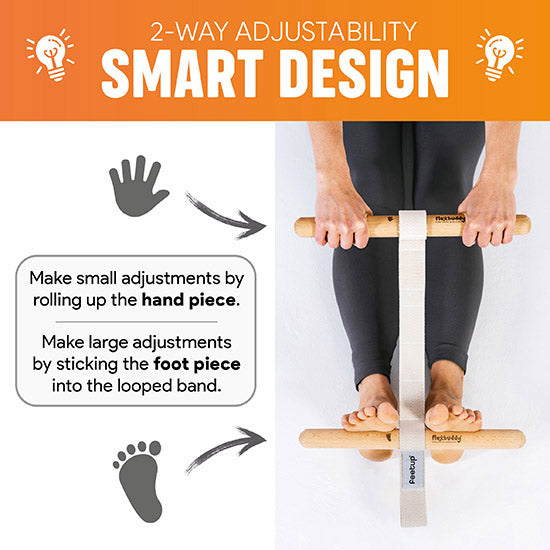
- Week 3: one loop shorter. If the back stays long and the pull stays in the thighs, move the foot bar one loop shorter, or roll the strap a turn around the hand bar for a smaller step. If the lower back rounds, go back a step.
- Week 4: re-test. Repeat the measurement. Most people see a few centimetres.
- From week 5: more holds, not longer ones. Run the routine twice (four minutes, four muscle groups at the guideline dose), or swap Dynamic Rolling for the guide's static stretch: shorter loop, ten deep breaths, pause 30 seconds, three times. Thirty seconds already delivers the full gain of a hold [4], and what adds range is more total time across the week [3], so more rounds on more days is the smart investment; see how long to hold a stretch.
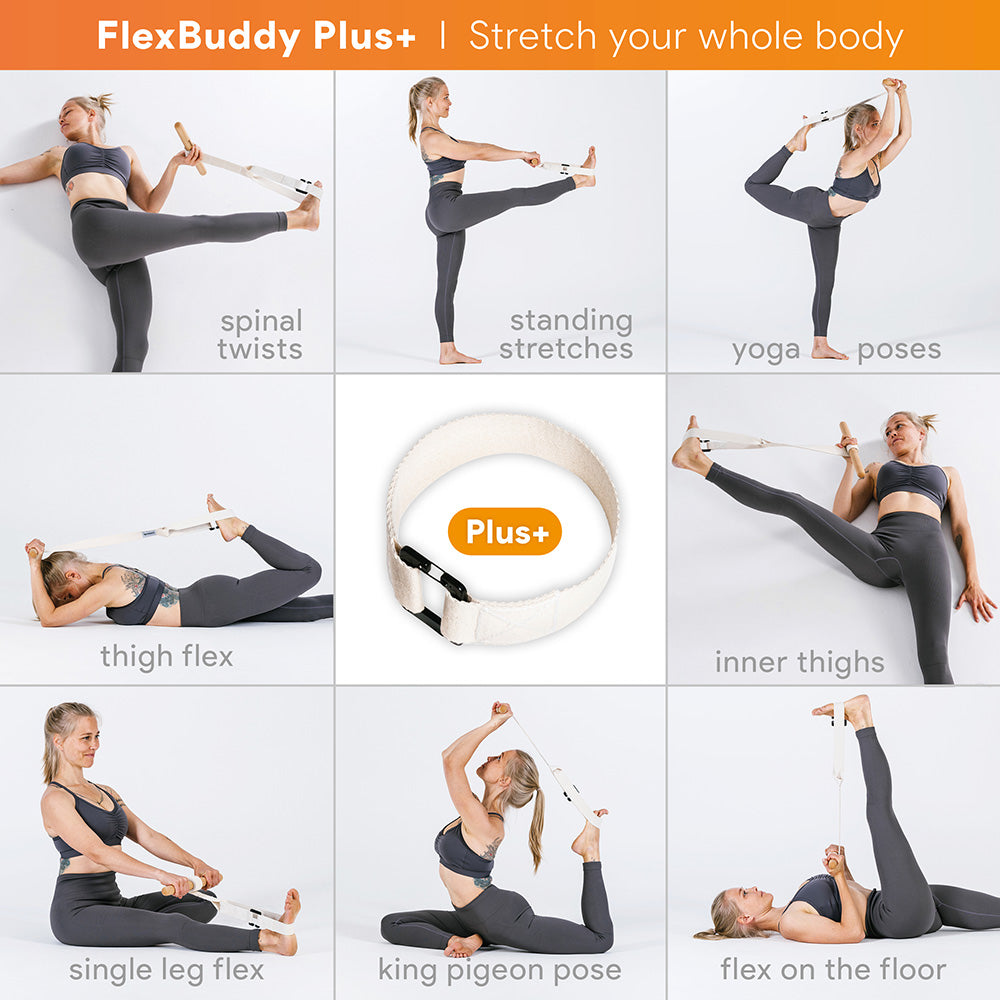
- From week 8: widen the routine. Add hips, shoulders and calves from the full FlexBuddy exercise library, two or three at a time, still anchored to the same cue.
What you will notice, and when
Days: you feel it. From the first sessions the backs of your legs feel different when you stand up, and your neck feels different at four in the afternoon. Give it a week and you will not want to skip it.
Weeks: you measure it. Programmes of three to eight weeks produce measurable range, as your body learns to tolerate more stretch [7]; six weeks was enough in the hamstring trial [4]. Stylianos T. wrote: "I can now bend 15 cm more than before in the space of 6 months." How fast you get there is in how long it takes to get flexible.
Months: the habit sets. Around two months on average [5][6], the two minutes stop being a decision. From then on the range is yours for as long as the habit is, and the habit costs two minutes.

Two minutes a day, done properly, with FlexBuddy
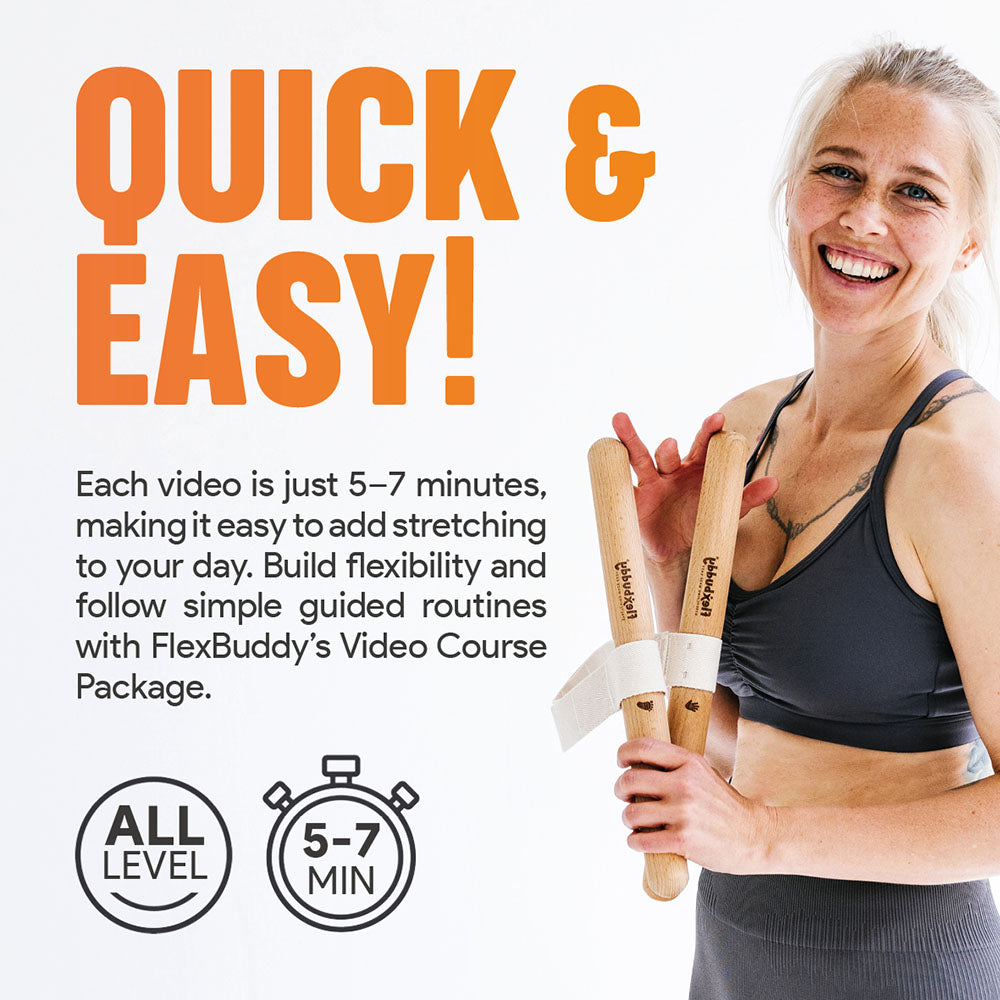
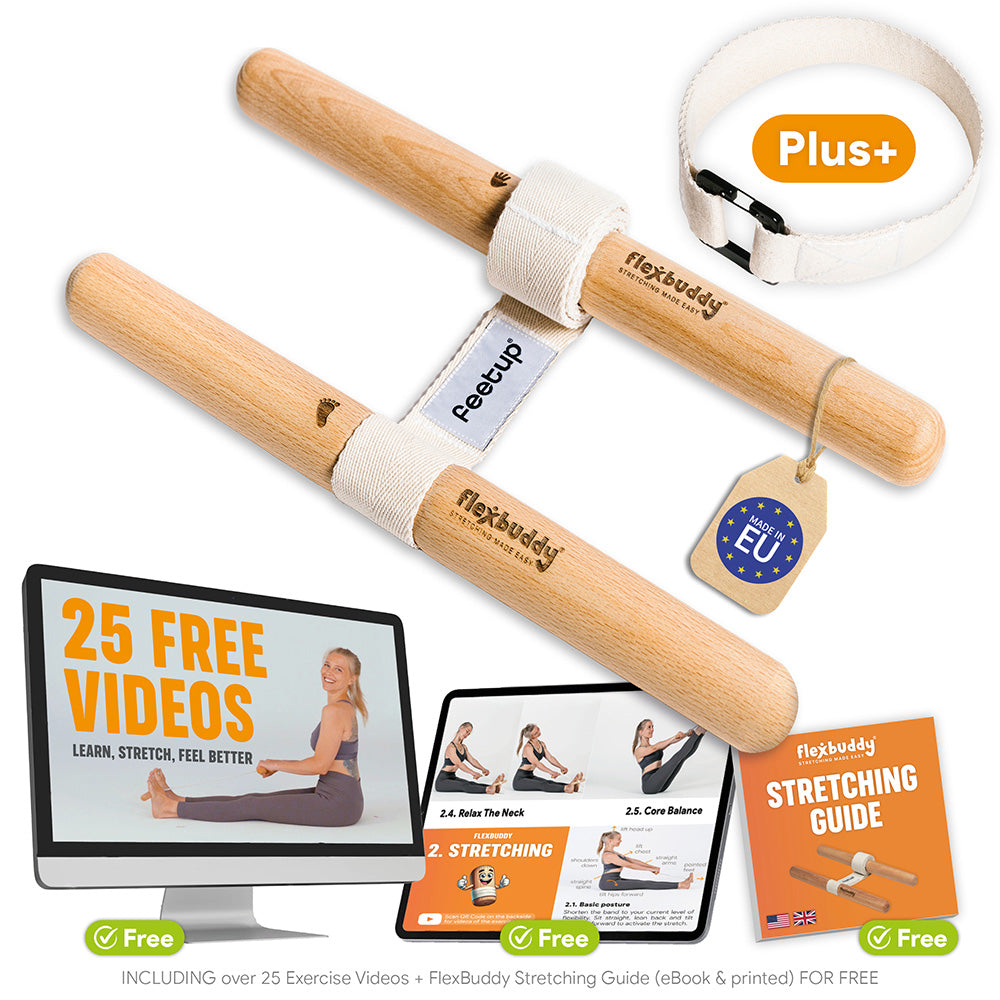
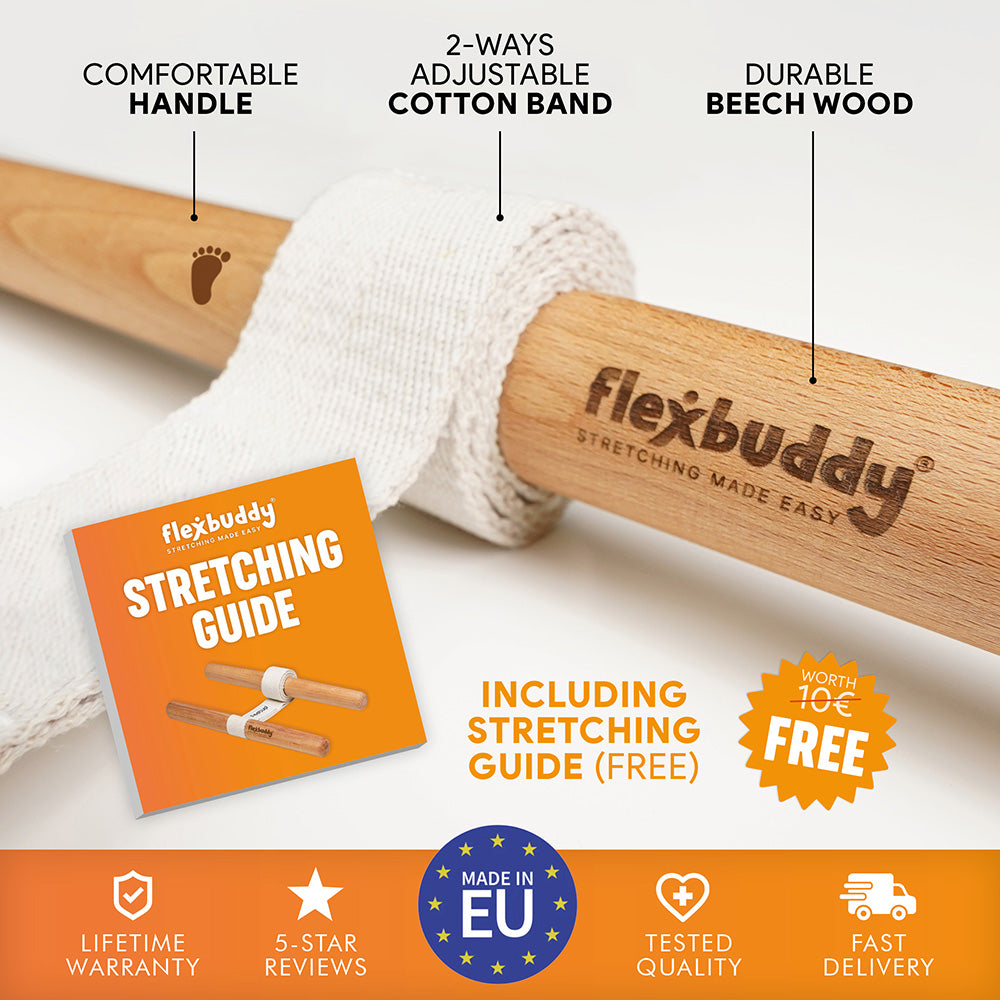
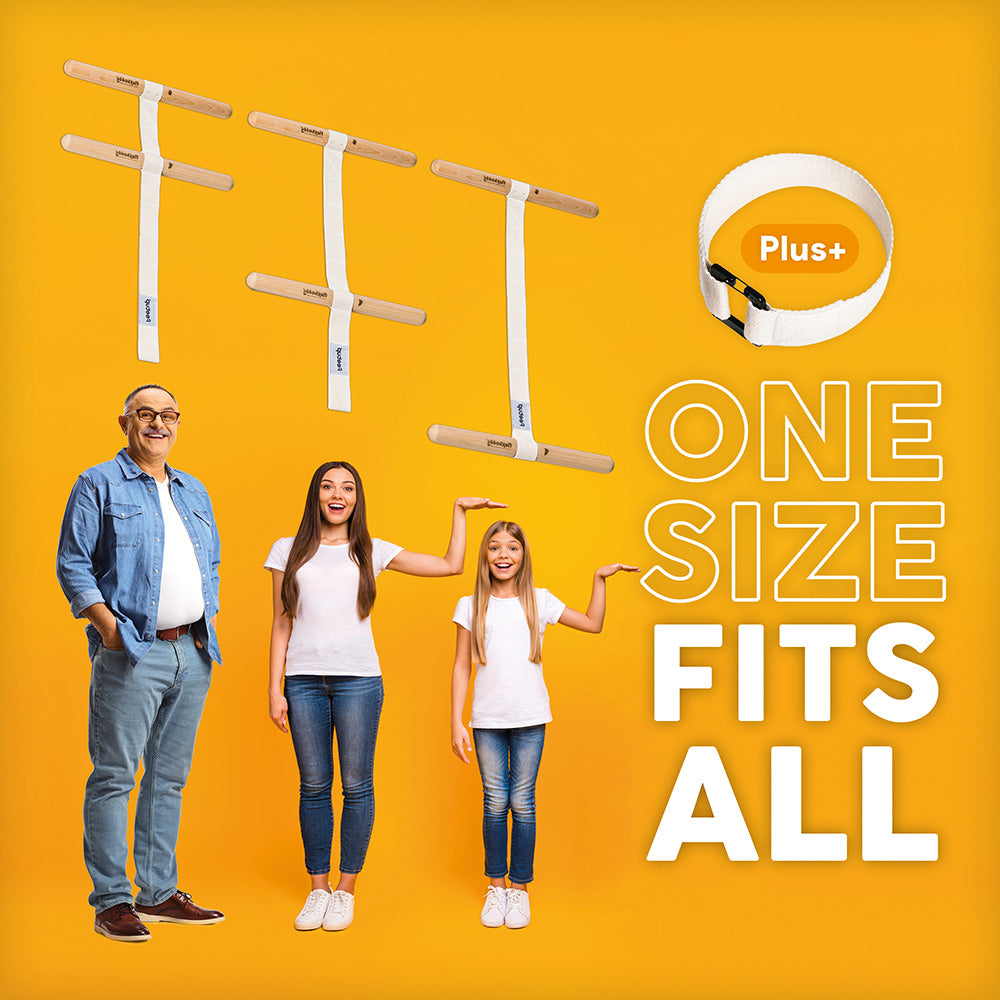
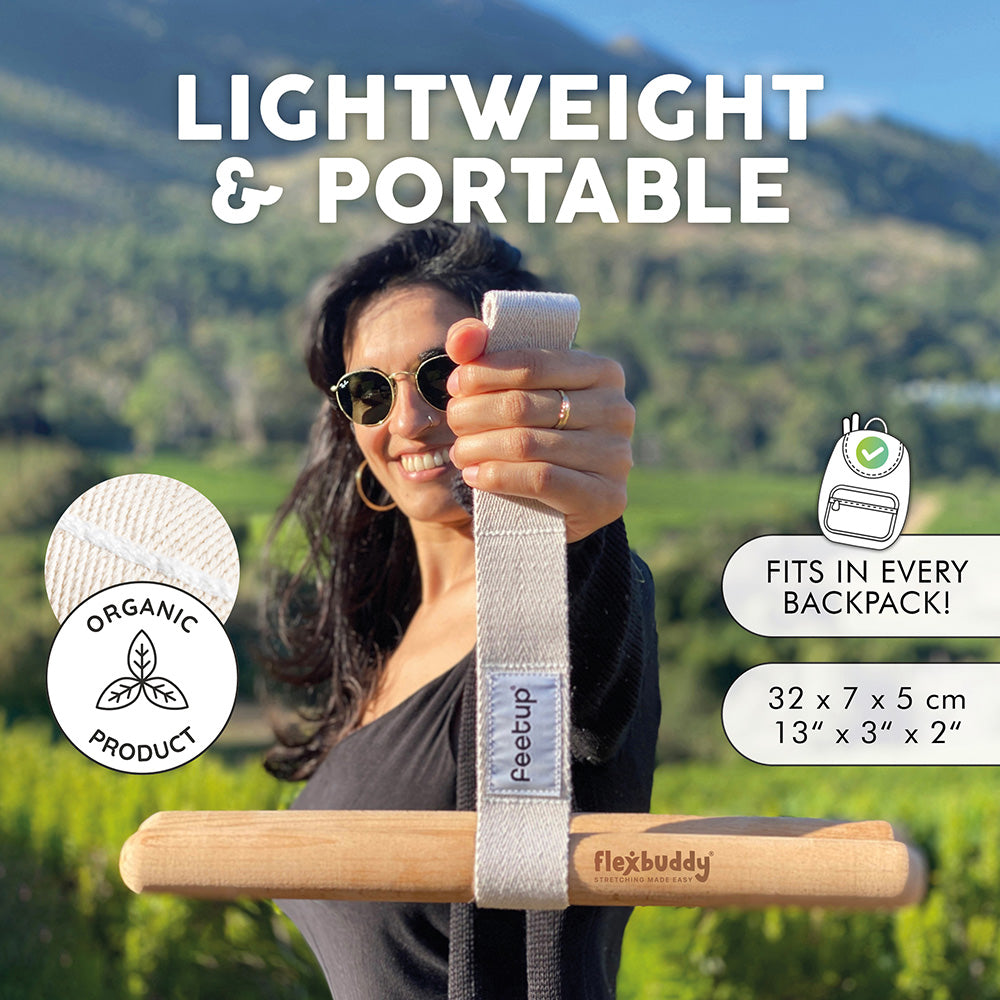
This routine is built on one position: a long spine folding at the hips, legs straight, held for 30 seconds. Stiff people cannot hold it on their own: reach for your feet and your back rounds, and the stretch leaves your legs. FlexBuddy® solves that. It is a patented stretching device made of two beech-wood bars joined by an adjustable natural-cotton strap. One bar sits under the soles of your feet, the other in your hands. You sit tall, lean back and tilt the hips, and the strap carries the pull so the stretch lands in your hamstrings and calves, not in your lower back.
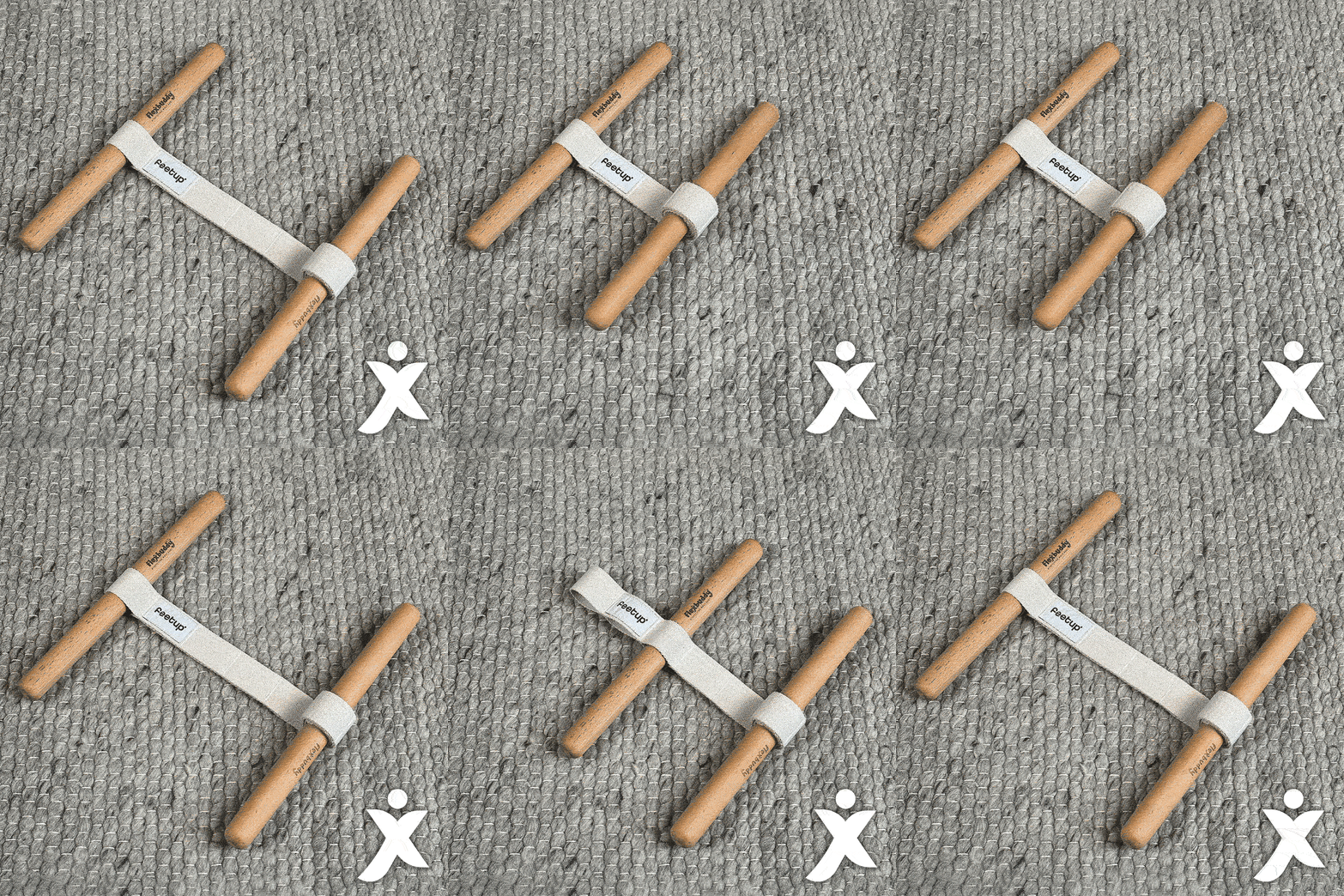
It fits you today and next month: move the foot bar between loops for big steps, roll the strap around the hand bar for small ones. The wooden handles stay comfortable, with no rope burn. It lives next to your desk, and one size fits all. Stephen W. wrote: "Sit at a desk 9 hours a day. My lower back used to ache every evening. Two weeks in, that's basically gone." Only two minutes a day can improve your flexibility and posture: that is the FlexBuddy promise, and the brand puts a date on it: "Flexible in 30 days". It is rated 4.5 by verified buyers and comes with a 30-day money-back guarantee and a lifetime warranty, so all you risk is two minutes. Get your FlexBuddy, or take the two-minute quiz to get the routine for your kind of stiffness.
Frequently asked questions
Is 2 minutes of stretching enough?
Yes. Guidelines ask for about 60 seconds per muscle group on at least two to three days a week [1][2], and four 30-second exercises deliver that to two muscle groups every day. That makes 14 minutes a week, nearly three times the five-minute weekly mark for range gains [3].
Should I stretch every day?
Yes. Daily is the easiest schedule to keep and the one the research favours: a 2018 review linked more days per week with more range and suggested at least five [3], and a 2024 meta-analysis found you do not need long or intense sessions to gain range [9]. Daily also builds the habit: the habit study used a once-a-day cue [5].
Is it better to stretch in the morning or at night?
Whichever you will do every day. Harvard's summary of the ACSM guidance treats morning, after a workout and evening as equally valid [2], and the habit research says the consistent cue matters more than the hour [6]. Mornings are stiffer, so shorten the holds; evenings are more flexible, so let them grow.
Is stretching before bed good?
Yes. It is one of the calmest ways to finish the day: your legs feel lighter and your back settles. For adults over 55 with night-time leg cramps, a randomised trial found that nightly calf and hamstring stretching for six weeks reduced the cramps [11]. Keep it gentle, and never stretch into pain late at night.
What is a good stretching routine for beginners?
Four exercises, 30 seconds each, once a day at the same cue: a moving hamstring warm-up, a straight-spine seated stretch, a gentle spinal roll and a neck release. Stop at mild tightness. Early gains come from tolerating more stretch [7], so a calm position you can repeat beats depth, and FlexBuddy gives you that position from day one. Over 50, the guidance points to holds of up to 60 seconds [8].
Can I do a 2-minute stretch break at work?
Yes, and it counts twice: as stretching and as a change of posture after sitting. Do the four exercises on the floor with FlexBuddy, or, without equipment, a seated hip hinge with a long spine, a chair twist and a neck side-bend. Add a short walk.
This article is general information, not medical advice. Tight muscles usually respond well to regular stretching. If your pain is sharp, radiates down a leg, comes with numbness, weakness, fever, bladder or bowel changes, follows an injury, or keeps getting worse, see a doctor or physiotherapist before you stretch.
References
- Garber CE, Blissmer B, Deschenes MR, et al.; American College of Sports Medicine. Position stand: quantity and quality of exercise for developing and maintaining cardiorespiratory, musculoskeletal, and neuromotor fitness in apparently healthy adults. Med Sci Sports Exerc. 2011;43(7):1334–1359. doi:10.1249/MSS.0b013e318213fefb. PMID 21694556.
- Harvard Health Publishing. The ideal stretching routine. Harvard Medical School, 16 Mar 2026 (reviewed by H. E. LeWine, MD). https://www.health.harvard.edu/staying-healthy/the-ideal-stretching-routine (accessed 4 Nov 2026).
- Thomas E, Bianco A, Paoli A, Palma A. The relation between stretching typology and stretching duration: the effects on range of motion. Int J Sports Med. 2018;39(4):243–254. doi:10.1055/s-0044-101146. PMID 29506306.
- Bandy WD, Irion JM, Briggler M. The effect of time and frequency of static stretching on flexibility of the hamstring muscles. Phys Ther. 1997;77(10):1090–1096. doi:10.1093/ptj/77.10.1090. PMID 9327823.
- Lally P, van Jaarsveld CHM, Potts HWW, Wardle J. How are habits formed: modelling habit formation in the real world. Eur J Soc Psychol. 2010;40(6):998–1009. doi:10.1002/ejsp.674
- Gardner B, Lally P, Wardle J. Making health habitual: the psychology of 'habit-formation' and general practice. Br J Gen Pract. 2012;62(605):664–666. doi:10.3399/bjgp12X659466. PMC3505409. https://pmc.ncbi.nlm.nih.gov/articles/PMC3505409/ (accessed 4 Nov 2026).
- Weppler CH, Magnusson SP. Increasing muscle extensibility: a matter of increasing length or modifying sensation? Phys Ther. 2010;90(3):438–449. doi:10.2522/ptj.20090012. PMID 20075147.
- Page P. Current concepts in muscle stretching for exercise and rehabilitation. Int J Sports Phys Ther. 2012;7(1):109–119. PMC3273886. https://pmc.ncbi.nlm.nih.gov/articles/PMC3273886/ (accessed 4 Nov 2026).
- Konrad A, Alizadeh S, Daneshjoo A, et al. Chronic effects of stretching on range of motion with consideration of potential moderating variables: a systematic review with meta-analysis. J Sport Health Sci. 2024;13(2):186–194. doi:10.1016/j.jshs.2023.06.002. PMID 37301370; PMC10980866.
- Gollwitzer PM, Sheeran P. Implementation intentions and goal achievement: a meta-analysis of effects and processes. Adv Exp Soc Psychol. 2006;38:69–119. doi:10.1016/S0065-2601(06)38002-1
- Hallegraeff JM, van der Schans CP, de Ruiter R, de Greef MH. Stretching before sleep reduces the frequency and severity of nocturnal leg cramps in older adults: a randomised trial. J Physiother. 2012;58(1):17–22. doi:10.1016/S1836-9553(12)70068-1. PMID 22341378.