- Thirty seconds is all it takes. Hold a static stretch for 10 to 30 seconds and repeat it until the muscle has had about 60 seconds in total, on at least two to three days a week. Daily is best [1][2].
- Once a day is enough. In the trials, a 30-second hamstring hold gained as much range as a 60-second one, and once a day gained as much as three times a day [3][4].
- Over 65, a minute works even better. In people over 65, 60-second holds gained range faster than 30 or 15 seconds and kept it for longer [9].
- Progress starts in your nervous system. For the first six to eight weeks a stretch mostly changes how much you tolerate, which is why regular short holds work so well [12][13].
- Before sport, keep it short. Under 45 to 60 seconds per muscle, the effect of static holds on strength and power is close to nothing [6][7].
- Count ten slow breaths. It lands at roughly 30 seconds and it keeps you relaxed in the stretch.
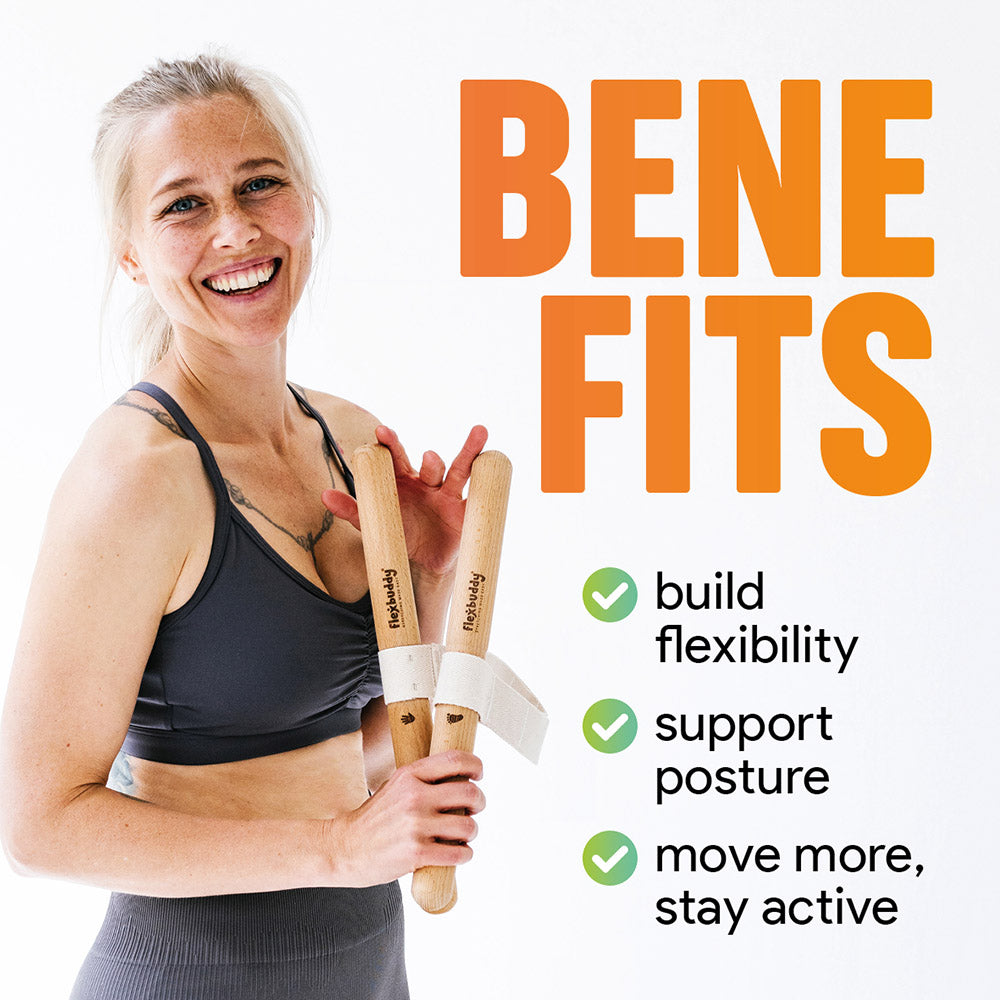
- FlexBuddy® builds the dose in. Ten breaths, three rounds, about two minutes, with your back held straight so every second lands in your hamstrings and calves.
The short answer: how long to hold a stretch, by goal
Good news first: the right dose is small. The American College of Sports Medicine's position stand recommends flexibility exercises for each major muscle-tendon group totalling about 60 seconds per exercise on at least two days a week [1]. The Harvard Medical School summary of the same guidance puts the frequency at two to three times a week and shows how the 60 seconds can be split: a 15-second hold four times, or a 20-second hold three times [2]. Find your goal below.
| Your goal | Hold | Repeats | How often | Notes |
|---|---|---|---|---|
| Increase flexibility | 30 seconds | 2 to 3 per muscle (60 to 90 seconds total) | 5 or more days a week | Static holds, to mild tension. Clear gains by week six [3][4][5]. |
| Warm-up before sport | Under 30 seconds per muscle, or none | 1 | Each session | Prefer dynamic movements. If you hold, keep it short and move afterwards [6][7]. |
| After a workout | 10 to 30 seconds | 2 to 4 | After each session | Ideal for range and for winding down. Do it for how it feels, not for next-day soreness [8]. |
| Beginners | 15 to 20 seconds, building to 30 | 2 to 3 | Daily if you can | Stop at the first clear pull. Form before duration: FlexBuddy keeps your back straight for you. |
| Over 65 | 30 to 60 seconds | 1 to 2 | 5 days a week | Longer holds gained more range at this age [9][10]. |
Two rules sit under every row. Stretch to the point of mild tension, never pain [11]. And warm the muscle first: a few minutes of walking or easy movement before static holds, or do the holds at the end of a session [10][11].
What a stretch changes while you hold it
Two good things happen while you hold, and they run on different clocks.
In the first seconds: the tissue gives
Muscle and tendon are viscoelastic. Under a steady pull they lengthen slightly as the tissue relaxes into the load, which is why a stretch feels easier after ten or fifteen seconds than at the start. The change is real, and its size depends on how long and what kind of stretching you did [12]. On its own, the extra range from a single session lasts under 30 minutes [6]. What makes it last is coming back tomorrow.
Over the first weeks: your nervous system says yes
What lasts is a change in sensation. A 2010 review in Physical Therapy concluded that the gains seen after a single session and after programmes of three to eight weeks are best explained by modified sensation: you tolerate more stretch before your body says stop, so you reach further [12]. A 2018 meta-analysis of 26 studies lasting three to eight weeks found the same thing: tolerance to tension rose [13]. For the first two months you are training your brakes, not your cables. And brakes learn fast.
The time course you can expect
A four-week calf-stretching study that measured people weekly (three sessions a week) found that range of motion had improved by week two, and from week three the muscle itself was measurably less stiff [14]. The classic hamstring trials ran six weeks and found clear gains at that point [3][4]. So: feel it in days, measure it in two to three weeks, judge your progress at six. The longer view is in how long it takes to get flexible. The timeline for a goal like reaching your toes is in why can't I touch my toes.
The range stays as long as the habit does. When young men stopped a five-week calf-stretching programme completely, their range and stiffness were back at baseline five weeks later [15]. So a short daily habit beats a long campaign. Making it stick is covered in how to improve flexibility at home.
The 60-seconds-per-muscle rule and where it comes from
The ACSM figure of a total of 60 seconds per exercise on two or more days a week [1] rests mostly on a pair of hamstring trials from the University of Central Arkansas in the 1990s. They are the reason you can stop counting at 30.
In the first, adults aged 21 to 37 with tight hamstrings stretched once a day, five days a week, for six weeks, holding for 15, 30 or 60 seconds, or not at all. Thirty seconds improved knee extension just as much as 60, and both clearly beat 15 seconds and no stretching [3]. In the follow-up, adults aged 21 to 39 were given different combinations of hold time and repetitions per day. Every stretching group beat the control group, and one 30-second stretch a day did as well as 60-second holds or three stretches a day [4].
That is where "30 seconds" comes from. The 60-second total in the guideline is the practical version: two holds of 30, three of 20 or four of 15, which covers the muscle properly and lets the second repetition reach a little further than the first. A 2012 review of stretching for rehabilitation sums up the same literature as 15 to 30 seconds, repeated two to four times, by which point the muscle has given all the length it will give in that session [10].
Those trials were in healthy adults under 40. Over 65, there is a better number for you.
Thirty seconds is enough (and after 65, a minute is better)
Under 65: thirty seconds does the job
The Bandy trials show that 30 seconds gets you the full benefit of a hold [3][4]. A 2024 meta-analysis of 77 studies found that long-term stretching increases range of motion, that static and PNF stretching beat ballistic and dynamic stretching, and that neither a higher volume nor a higher intensity made a significant difference [16]. A 2018 review of 23 studies found that what mattered was total time per week and how many days you stretched, not the time spent stretching within a single session [5]. Once a hold is long enough to count, you are done.
Over 65: longer holds, faster gains
Later in life a longer hold pays off handsomely. Residents of a retirement complex, average age 85, stretched one hamstring five days a week for six weeks with holds of 15, 30 or 60 seconds. The 60-second group gained range at 2.4 degrees a week, against 1.3 for 30 seconds and 0.6 for 15, and four weeks after the programme ended it had kept 5.4 degrees of the gain [9]. The authors put the difference down to age-related tissue changes [9], and the rehabilitation review points to longer holds than the usual 15 to 30 seconds for older adults [10]. Flexibility after 50 covers what changes with age. Over 65, work in 30 to 60 seconds per hold with fewer repetitions.
Before exercise: short holds keep your power
A 2016 review found that holds under 60 seconds per muscle group were followed by a performance dip of only 1.1%, and when stretching was followed by dynamic activity, no clear effect remained [6]. A meta-analysis of 104 studies found the same pattern, with the smallest effect when total stretch per muscle was 45 seconds or less [7]. So before training, keep a static stretch under half a minute per muscle and move afterwards. If you are about to sprint, jump or lift heavy, warm up dynamically and save the long holds for when you finish: 60 seconds or more per muscle group was followed by a 4.6% drop [6]. The full comparison is in static vs dynamic stretching.
Frequency beats duration
If 30 seconds is enough, the days are where the gains are. In the 2018 review, weekly frequency was positively associated with range gains, and the authors recommended static stretching at least five days a week with a weekly total of at least five minutes [5]. The trials behind the 30-second rule stretched five days a week [3][4]; so did the older-adult trial [9]. Harvard's guidance sets two to three times a week as the floor and every day as the ideal [2].
The arithmetic is kind. Two muscles that matter to you, say hamstrings and calves, at 60 seconds each is two minutes. Five days a week, that is ten minutes, double the review's minimum; daily, it is the top of the guideline. Nobody has to find a 30-minute slot, only the same two minutes most days. That is the logic of the two-minute daily routine, and it is how FlexBuddy is meant to be used: hamstrings and calves in one position, every day. Its guide says it plainly: "At least 2 minutes daily will quickly yield results."
Frequency also protects what you gain. Range fades when stretching stops altogether [15], and a daily habit never gives it the chance. A daily stretch survives a missed week; a Sunday stretch does not.
How to count a hold: breaths, timer, or loops
People who count seconds in their head count fast, especially mid-stretch. "Thirty" arrives in about twenty. Three easy ways to get the full hold:
- Breaths. A slow, relaxed breath in and out takes about three seconds, so ten of them is roughly 30 seconds, the hold the trials used [3][4]. Slow breathing also keeps you soft in the stretch instead of bracing against the pull, so the hold feels better. If you cannot breathe slowly in the position, ease off a little.
- A timer. The reliable way to do a true 60-second hold if you are over 65. Set it, then look away and breathe.
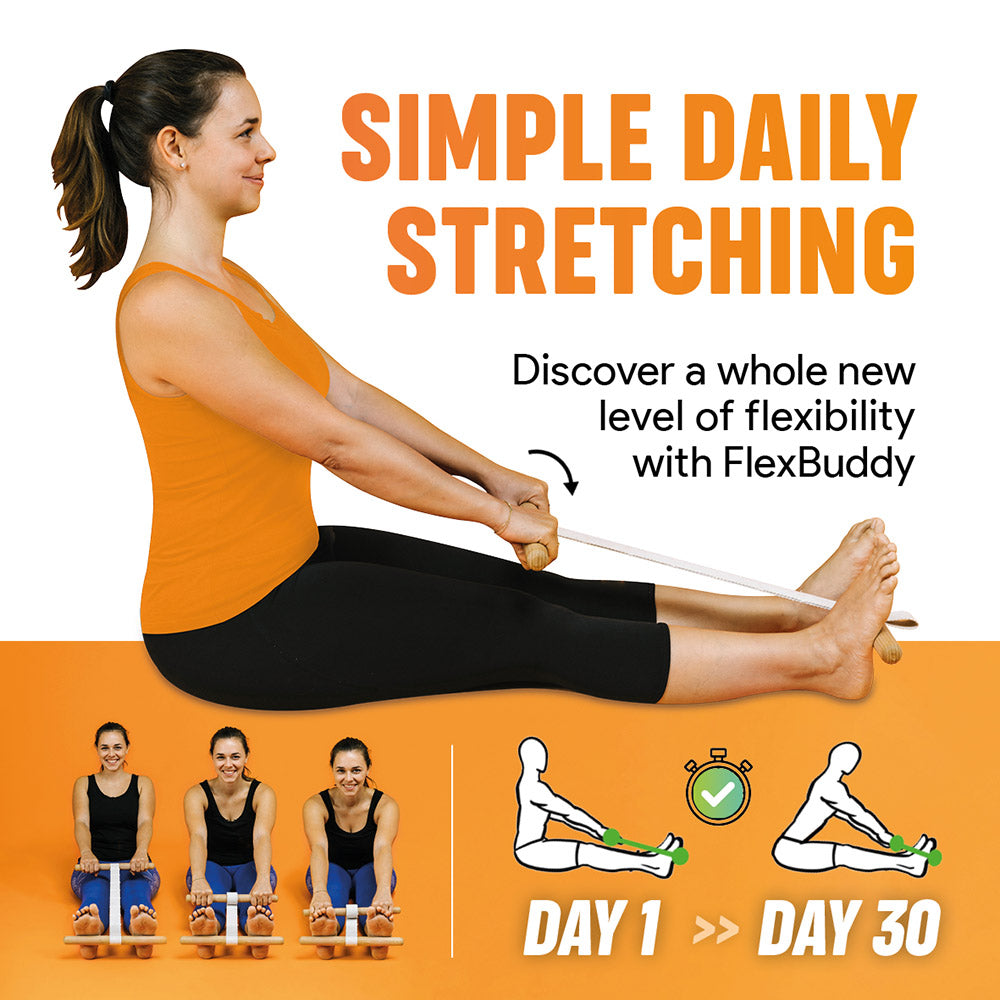
- Loops. The FlexBuddy way, and the easiest of the three. The strap's loops and the roll of the hand bar give you the same position every time. Ten deep breaths, pause, repeat three times. Progress comes from moving to a shorter loop in a later week, not from pulling harder today. Each session is about 90 seconds of hold, comfortably above the guideline's 60-second minimum.
The first hold is a scouting hold: go to the first clear pull, stay, notice where it is. The second and third holds are where the range comes.
Common mistakes with hold times, and the easy fix for each
Stopping at ten seconds
Stay a little longer and the stretch starts to pay. In the first Bandy trial, 30-second holds clearly beat 15-second holds [3]. Ten seconds is a nice movement break. For flexibility, hold for 30, or hold for 15 four times [2].
Holding for three minutes
You are allowed to stop. In a younger adult, 30 seconds gets the full gain of a hold [3][4], and a very long hold tempts you deeper than is comfortable, which makes the muscle tighten against you. If you want more, add a day, not a minute.
Bouncing to get further
Hold still and you gain more: static stretching beats ballistic stretching for range over the long term [16]. Bouncing also sets off the very reflex you are trying to quieten, and it is one of the common stretching mistakes. Harvard's physiotherapist advice is blunt: do not bounce [11].
Stretching for soreness instead of range
The stretch after a workout is the easiest of the day: the muscle is warm and the range comes freely. A Cochrane review of twelve trials put its effect on next-day soreness at about one point on a 100-point scale [8], so do it for the range and for how good it feels.
Rounding the back to reach further
A hold only counts if the stretch lands in the right place. In a seated hamstring stretch the usual error is to curl the spine forward to get the hands nearer the feet; the hamstrings barely lengthen and the lower back takes the load. Fold at the hips with a long spine and accept a shorter reach. This is the mistake FlexBuddy removes: the strap carries the pull, so your back stays straight and the whole 30 seconds goes into your hamstrings and calves. Scott K., a trainer, wrote: "A great tool to help your clients maintain a neutral spine while stretching calves, hamstrings and lower back." The self-test is in tight hamstrings and lower back pain; the exercise basics are in best hamstring stretches for beginners.

The right hold, every time, with FlexBuddy
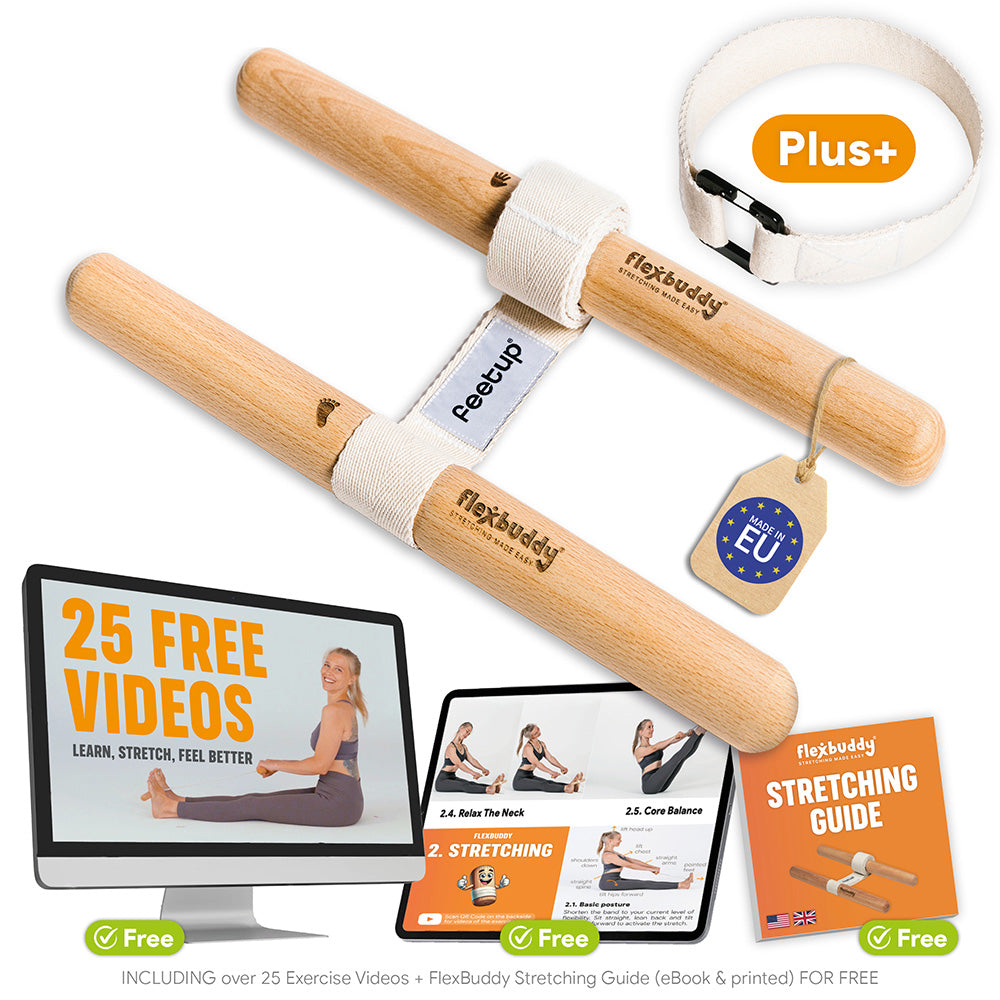
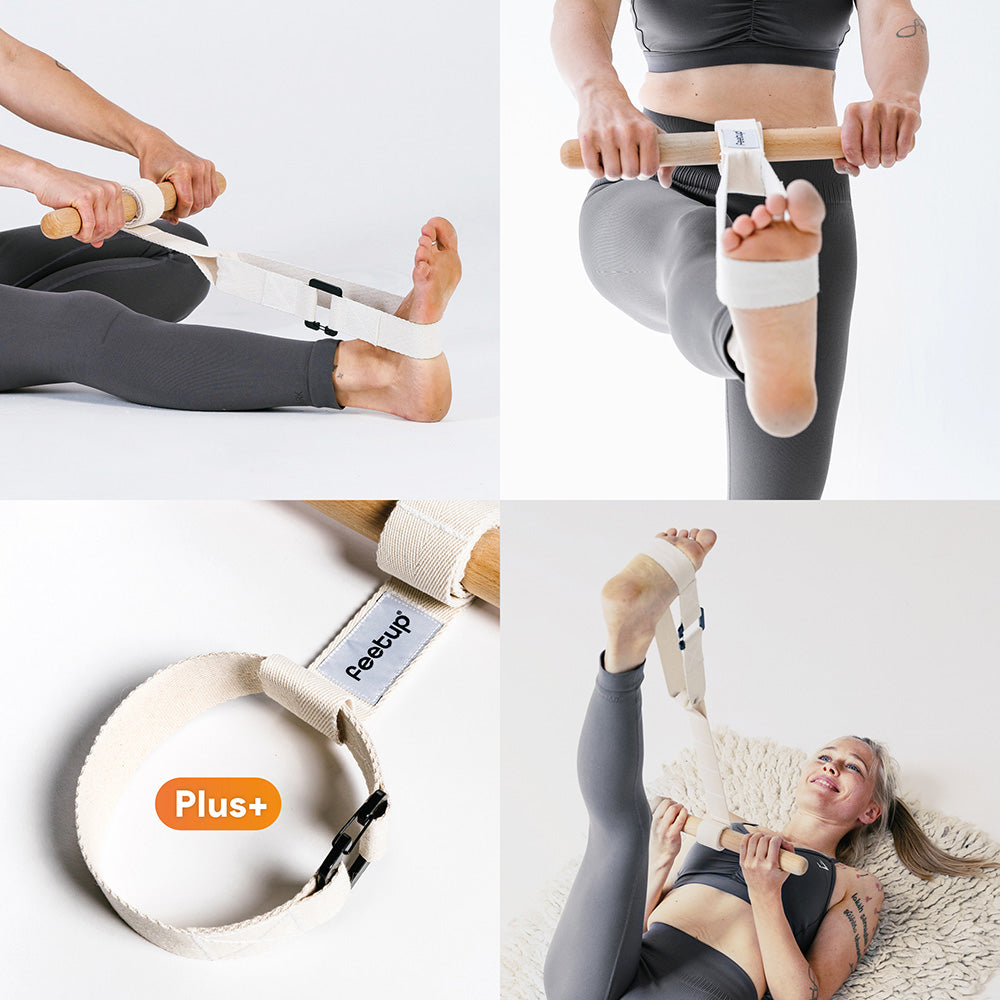
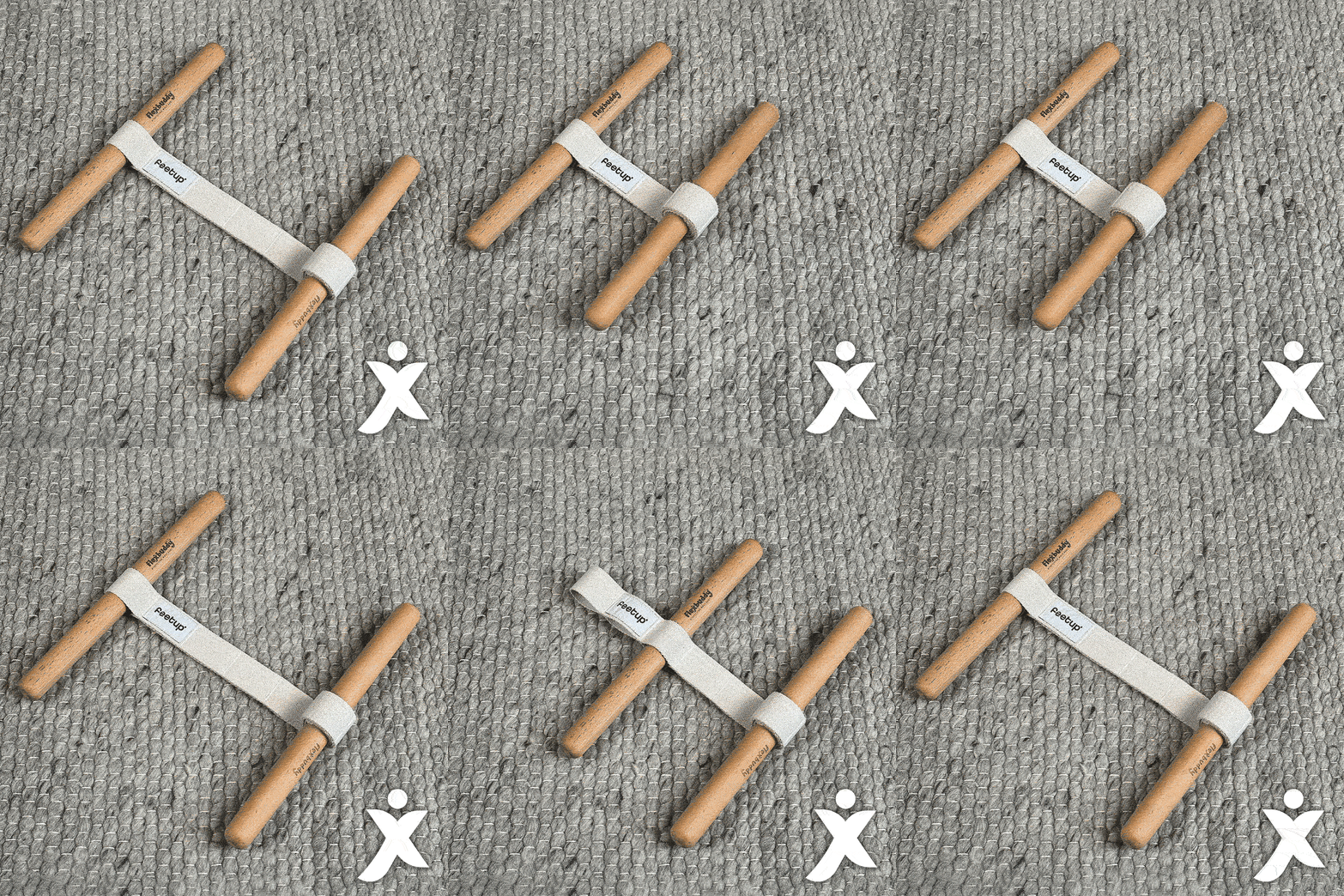
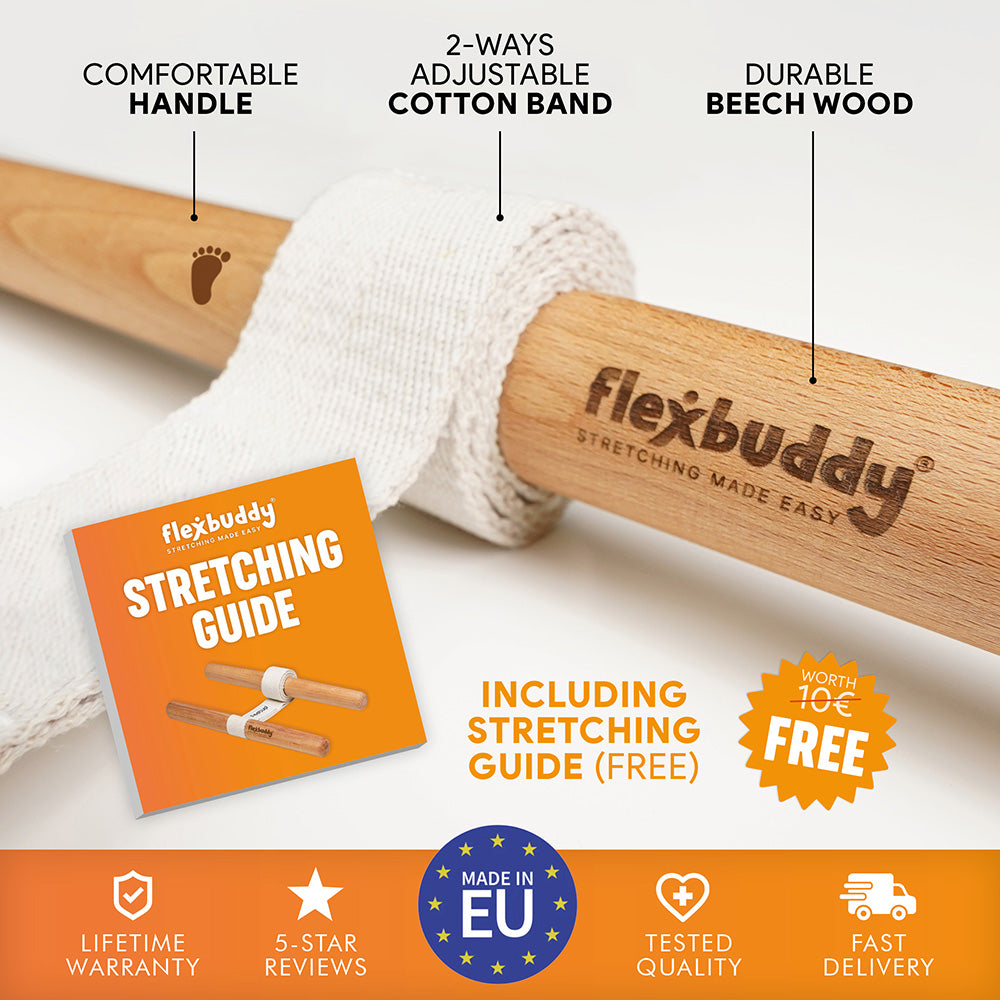
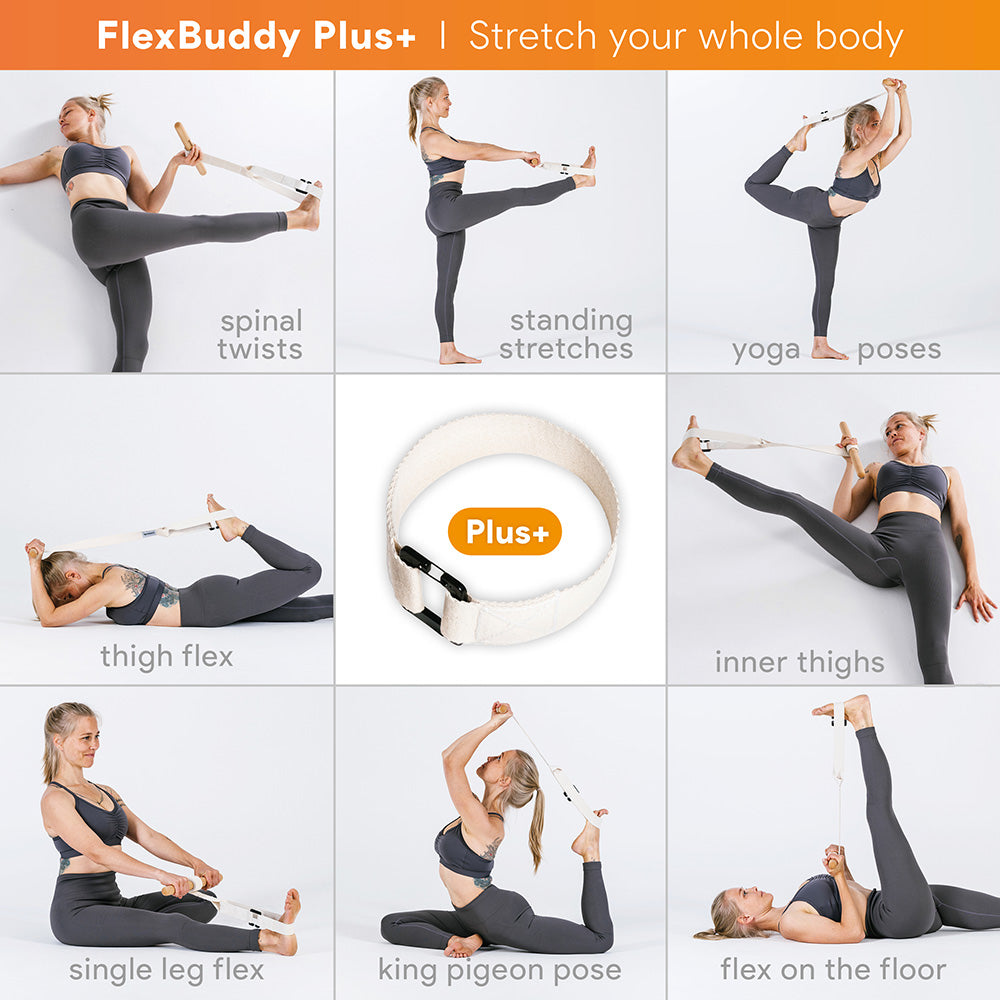
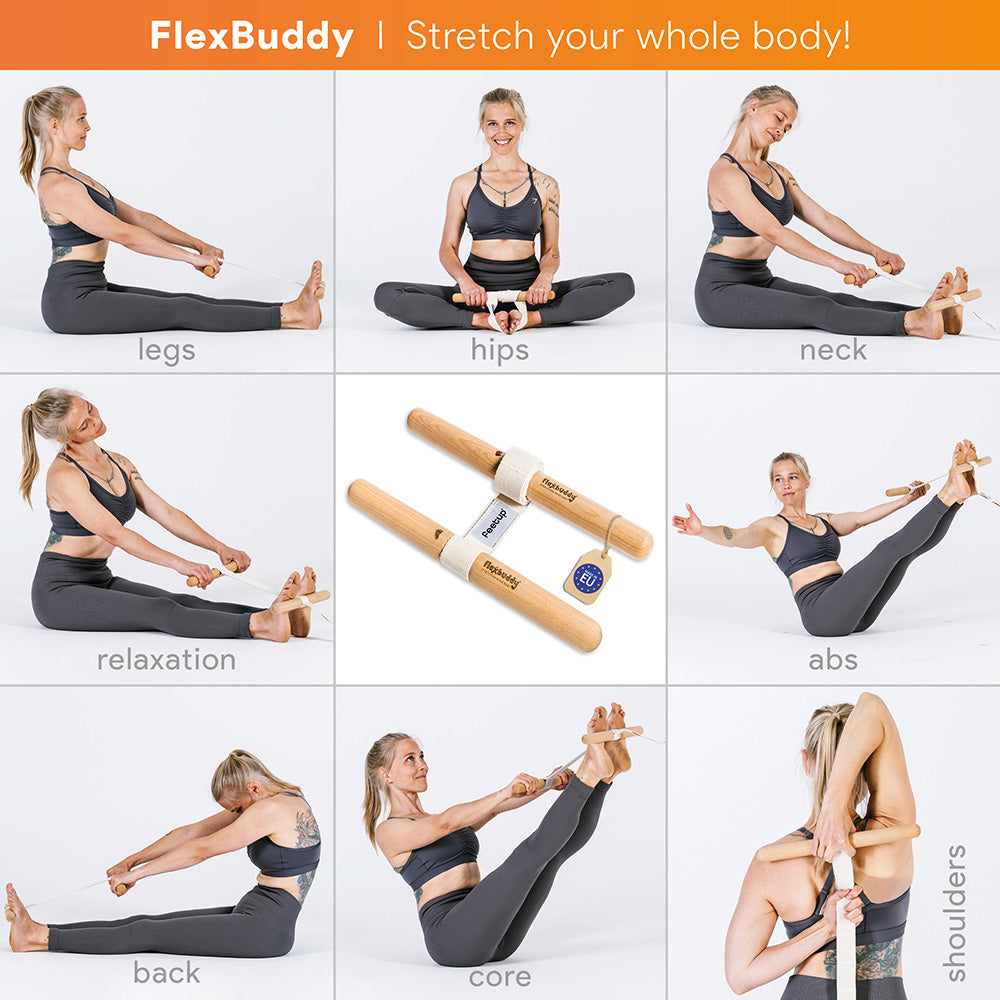
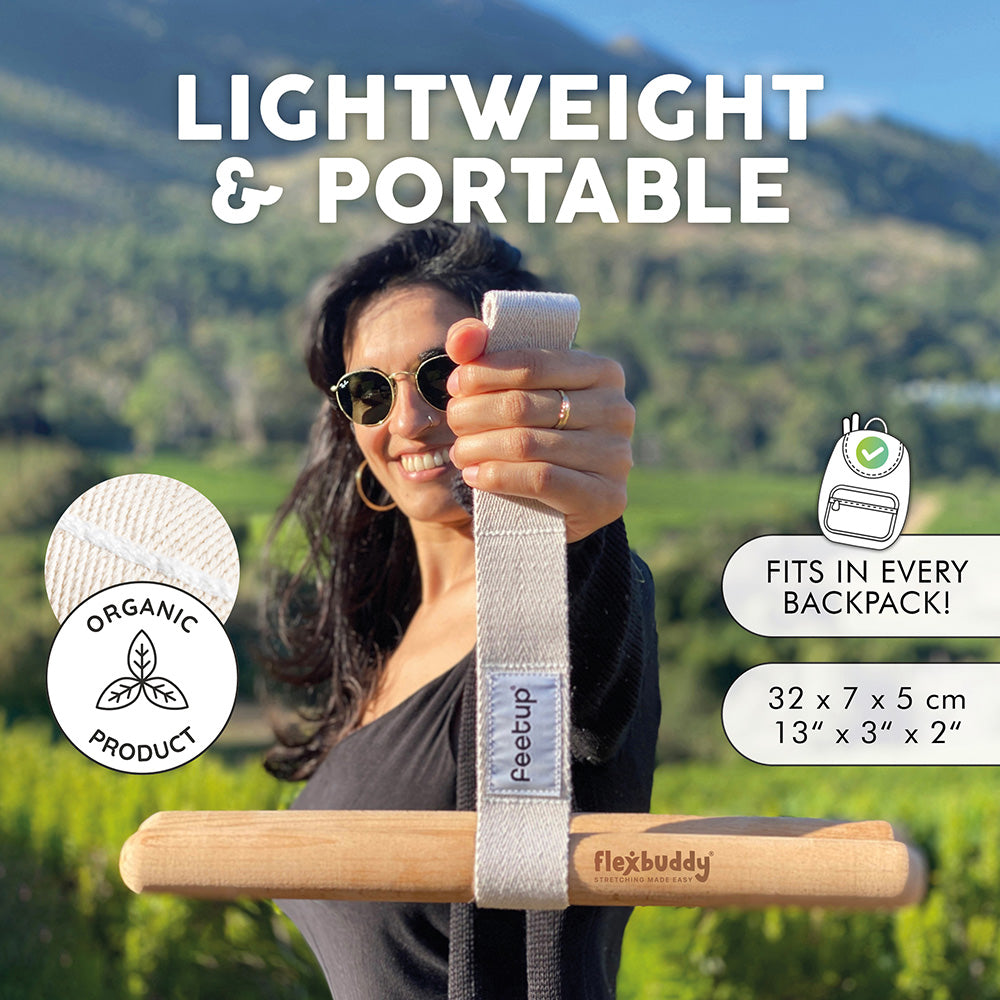
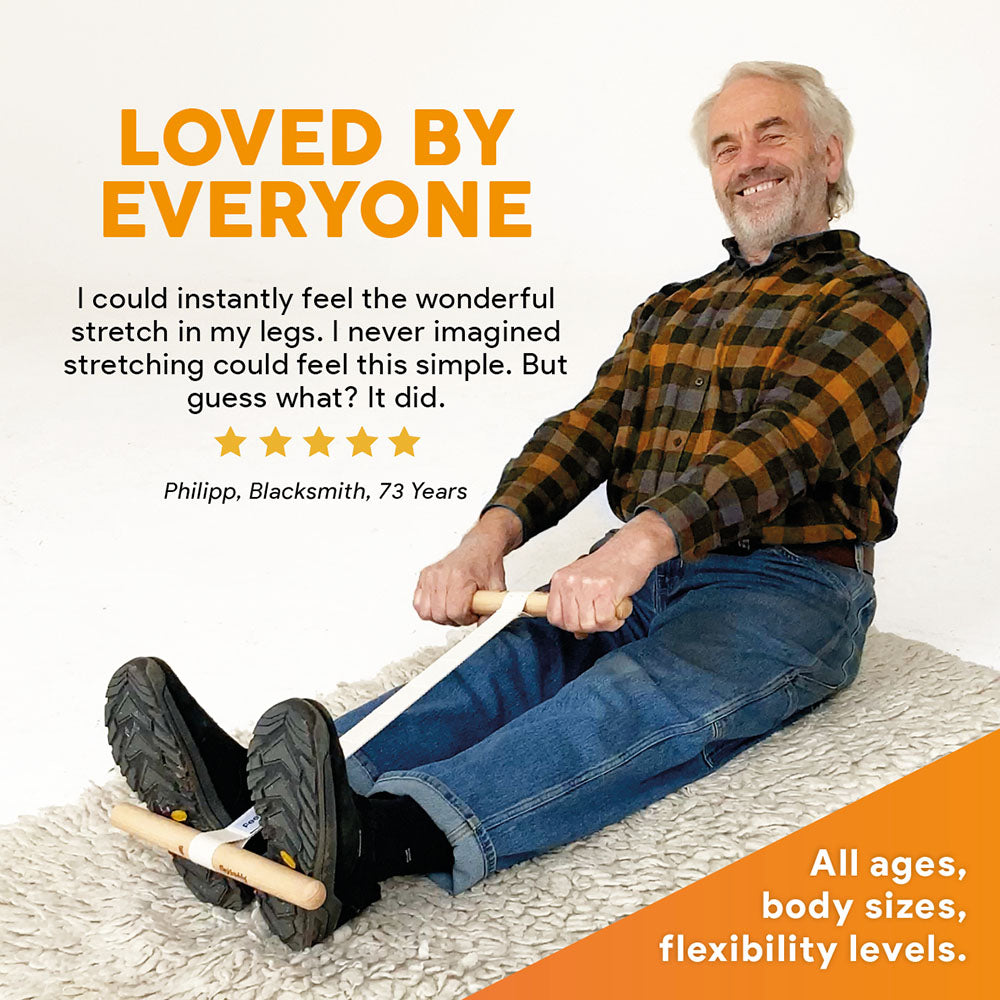
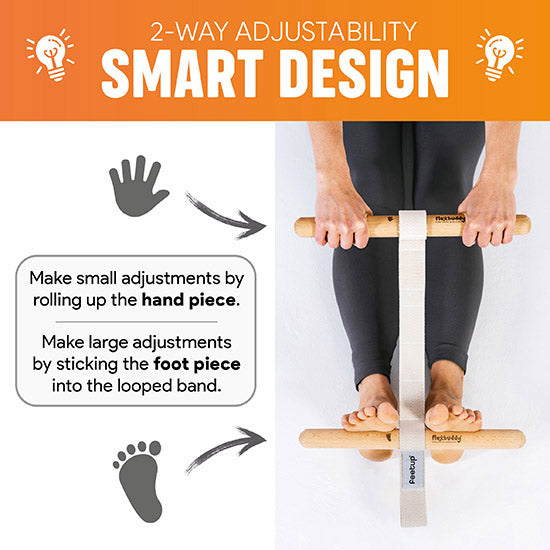
The dose is simple: a 30-second hold, two or three times, with a straight back, most days. FlexBuddy® makes that dose automatic. It is a patented stretching device made of two beech-wood bars joined by an adjustable natural-cotton strap. One bar sits under the soles of your feet, the other in your hands. You sit tall, lean back and tilt the hips, and the strap carries the pull so your spine stays long while your hamstrings and calves let go. Its routine is the guideline made easy: ten deep breaths in the static position, a 30-second pause, three rounds, about two minutes.
Big changes of length come from moving the foot bar to another loop, small ones from rolling the strap round the hand bar. A stiff beginner starts long and shortens a loop a week; someone over 65 simply stays for a second set of ten breaths. The wooden handles are comfortable in the hands, with no rope burn. Bob J. wrote: "I am 64 and have never touched my toes. FlexBuddy changed that in a week!" It is rated 4.5 by verified buyers and comes with a 30-day money-back guarantee and a lifetime warranty, so you can try it without risk. Get your FlexBuddy, or take the two-minute quiz to find your starting point.
Frequently asked questions
How long should you hold a stretch to increase flexibility?
Thirty seconds, two or three times, on five or more days a week. Give it six weeks and you will measure the difference. In the trials that set the standard, 30 seconds gained as much range as 60, and once a day gained as much as three times a day [3][4]. Total weekly time and number of days matter more than the length of any single hold [5].
How long should you hold a stretch after a workout?
Ten to 30 seconds, two to four times per muscle, to mild tension [2][10]. This is the easiest stretch of the day: the muscles are warm, so the holds feel good and you can go closer to the end of range safely. Do it for range and for winding down, not for next-day soreness [8].
How long do you need to hold a stretch for it to be effective?
About 60 seconds per muscle in total within a session, in holds of 10 to 30 seconds [1][2]. Thirty-second holds are the sweet spot: in the trial that set the standard they clearly beat single 15-second holds [3]. If you are over 65, aim for 30 to 60 seconds per hold [9][10].
Is 10 seconds enough to hold a stretch?
Ten seconds is a good start, and repeating it makes it count. The dose that works for flexibility is 30 seconds in one hold, or shorter holds repeated to a similar total [2][3]. On its own, a 10-second hold is a great movement break at a desk, and a few of them in a warm-up will not hurt performance [6].
Can you stretch too long?
You can stretch longer than you need to, which is good news: 30 seconds is enough. Beyond that, in younger adults, the extra time adds nothing measurable [3][4]. Before sport, keep static stretching under a minute per muscle so your strength and power stay with you [6][7]. And ease off any stretch that hurts, tingles or makes you hold your breath: that is too long or too deep, whatever the clock says.
How often should you stretch to improve flexibility?
Daily is best, and it only takes two minutes. The guideline floor is two to three days a week [1][2], and the review evidence favours five or more days a week with a weekly total of five minutes or more [5]. Two minutes a day with FlexBuddy covers all of it.
This article is general information, not medical advice. Tight muscles usually respond well to regular stretching. If your pain is sharp, radiates down a leg, comes with numbness, weakness, fever, bladder or bowel changes, follows an injury, or keeps getting worse, see a doctor or physiotherapist before you stretch.
References
- Garber CE, Blissmer B, Deschenes MR, et al.; American College of Sports Medicine. Position stand: quantity and quality of exercise for developing and maintaining cardiorespiratory, musculoskeletal, and neuromotor fitness in apparently healthy adults. Med Sci Sports Exerc. 2011;43(7):1334–1359. doi:10.1249/MSS.0b013e318213fefb. PMID 21694556.
- Harvard Health Publishing. The ideal stretching routine. Harvard Medical School, 16 Mar 2026 (reviewed by H. E. LeWine, MD). https://www.health.harvard.edu/staying-healthy/the-ideal-stretching-routine (accessed 4 Nov 2026).
- Bandy WD, Irion JM. The effect of time on static stretch on the flexibility of the hamstring muscles. Phys Ther. 1994;74(9):845–850. doi:10.1093/ptj/74.9.845. PMID 8066111.
- Bandy WD, Irion JM, Briggler M. The effect of time and frequency of static stretching on flexibility of the hamstring muscles. Phys Ther. 1997;77(10):1090–1096. doi:10.1093/ptj/77.10.1090. PMID 9327823.
- Thomas E, Bianco A, Paoli A, Palma A. The relation between stretching typology and stretching duration: the effects on range of motion. Int J Sports Med. 2018;39(4):243–254. doi:10.1055/s-0044-101146. PMID 29506306.
- Behm DG, Blazevich AJ, Kay AD, McHugh M. Acute effects of muscle stretching on physical performance, range of motion, and injury incidence in healthy active individuals: a systematic review. Appl Physiol Nutr Metab. 2016;41(1):1–11. doi:10.1139/apnm-2015-0235. PMID 26642915.
- Simic L, Sarabon N, Markovic G. Does pre-exercise static stretching inhibit maximal muscular performance? A meta-analytical review. Scand J Med Sci Sports. 2013;23(2):131–148. doi:10.1111/j.1600-0838.2012.01444.x. PMID 22316148.
- Herbert RD, de Noronha M, Kamper SJ. Stretching to prevent or reduce muscle soreness after exercise. Cochrane Database Syst Rev. 2011;(7):CD004577. doi:10.1002/14651858.CD004577.pub3. PMID 21735398.
- Feland JB, Myrer JW, Schulthies SS, Fellingham GW, Measom GW. The effect of duration of stretching of the hamstring muscle group for increasing range of motion in people aged 65 years or older. Phys Ther. 2001;81(5):1110–1117. PMID 11319936.
- Page P. Current concepts in muscle stretching for exercise and rehabilitation. Int J Sports Phys Ther. 2012;7(1):109–119. PMC3273886. https://pmc.ncbi.nlm.nih.gov/articles/PMC3273886/ (accessed 4 Nov 2026).
- Harvard Health Publishing. Stretching: the new mobility protection. Harvard Medical School, 8 Nov 2016 (archived). https://www.health.harvard.edu/staying-healthy/stretching-the-new-mobility-protection (accessed 4 Nov 2026).
- Weppler CH, Magnusson SP. Increasing muscle extensibility: a matter of increasing length or modifying sensation? Phys Ther. 2010;90(3):438–449. doi:10.2522/ptj.20090012. PMID 20075147.
- Freitas SR, Mendes B, Le Sant G, Andrade RJ, Nordez A, Milanovic Z. Can chronic stretching change the muscle-tendon mechanical properties? A review. Scand J Med Sci Sports. 2018;28(3):794–806. doi:10.1111/sms.12957. PMID 28801950.
- Nakamura M, Ikezoe T, Umegaki H, Kobayashi T, Nishishita S, Ichihashi N. Changes in passive properties of the gastrocnemius muscle-tendon unit during a 4-week routine static-stretching program. J Sport Rehabil. 2017;26(4):263–268. doi:10.1123/jsr.2015-0198. PMID 27632863.
- Nakamura M, Yahata K, Sato S, et al. Training and detraining effects following a static stretching program on medial gastrocnemius passive properties. Front Physiol. 2021;12:656579. doi:10.3389/fphys.2021.656579. PMID 33868026; PMC8049289.
- Konrad A, Alizadeh S, Daneshjoo A, et al. Chronic effects of stretching on range of motion with consideration of potential moderating variables: a systematic review with meta-analysis. J Sport Health Sci. 2024;13(2):186–194. doi:10.1016/j.jshs.2023.06.002. PMID 37301370; PMC10980866.