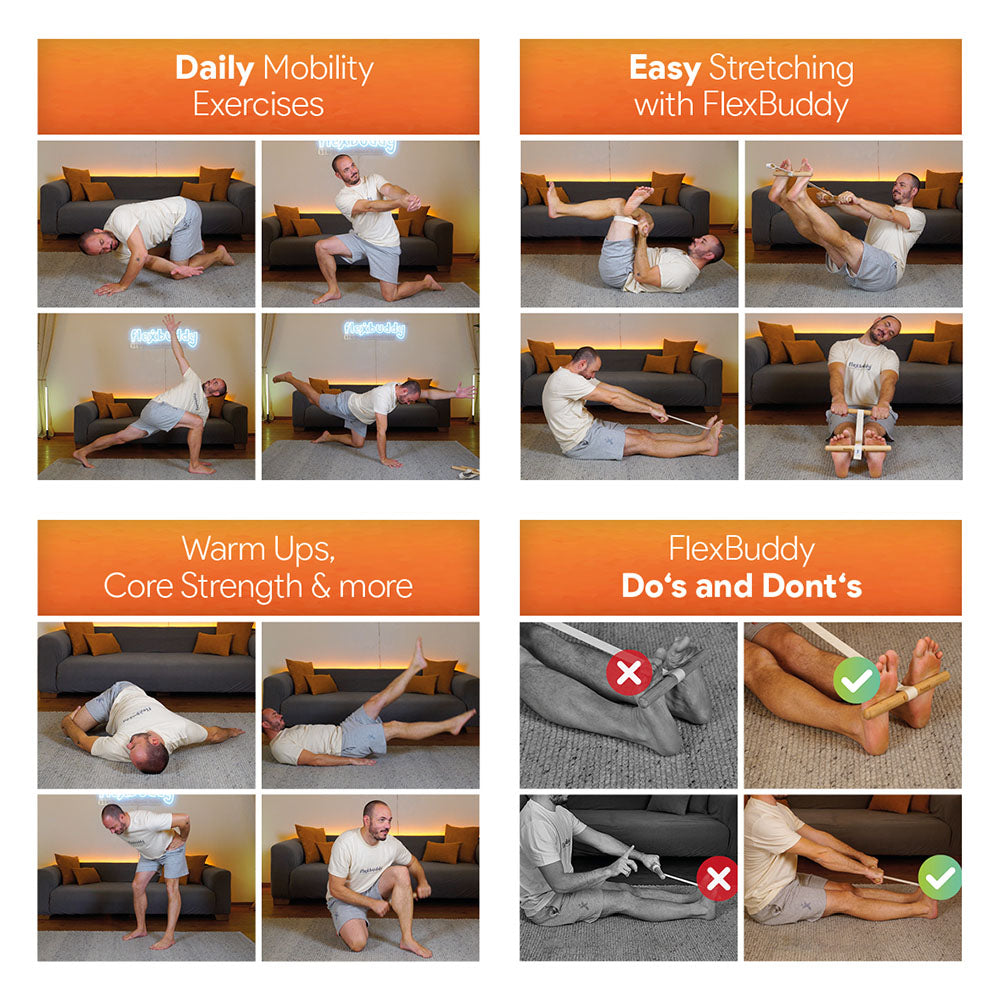
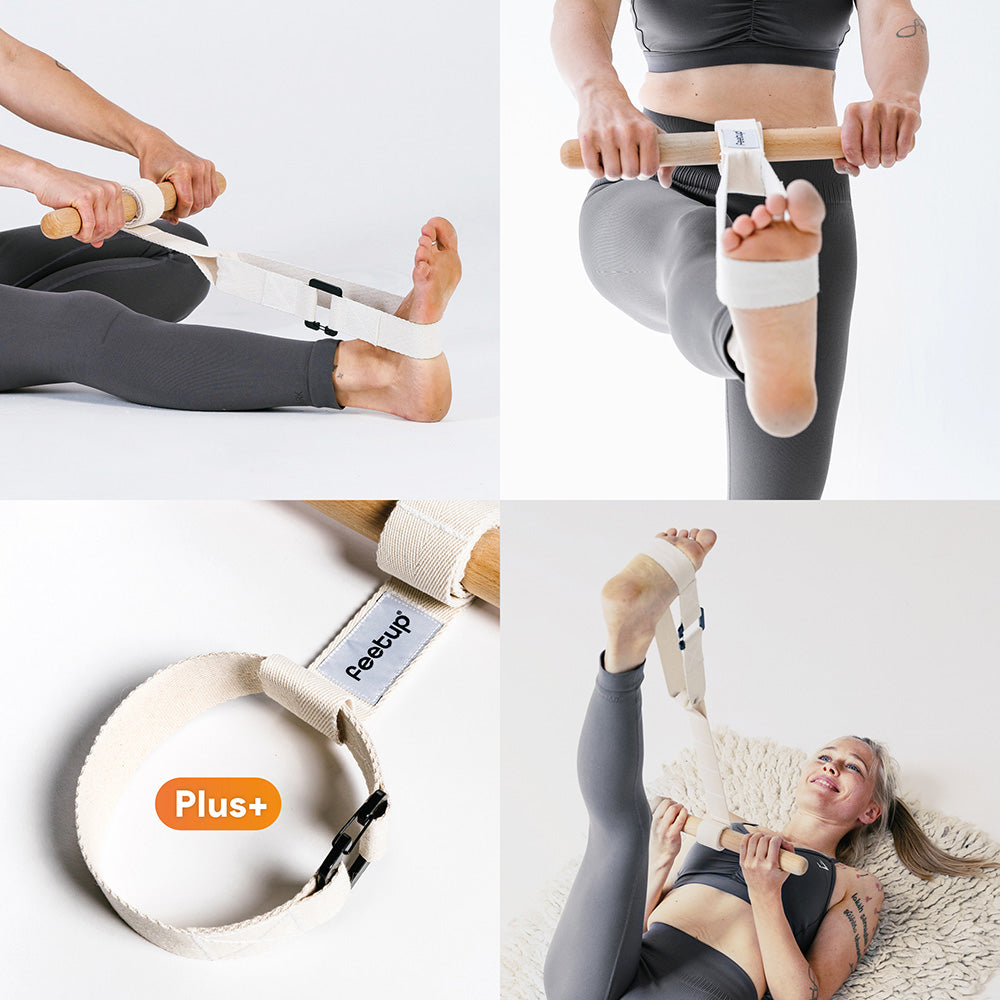
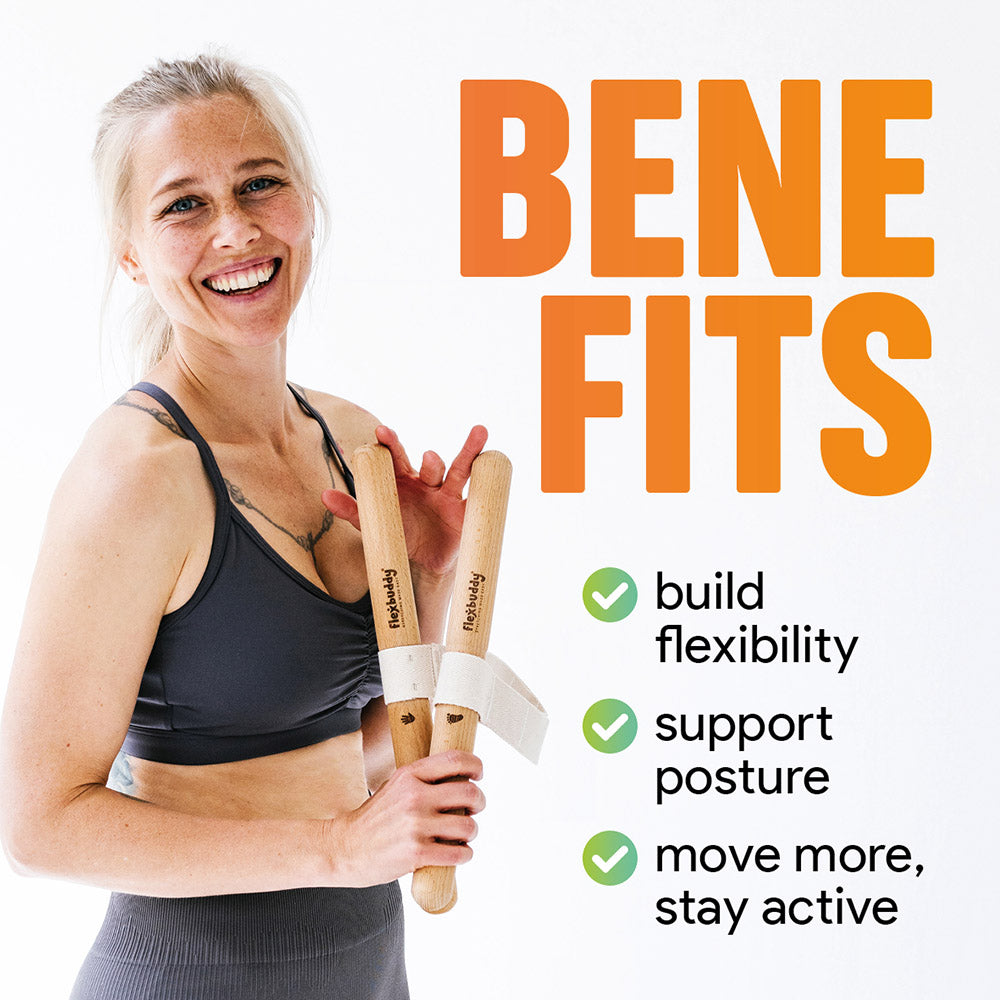
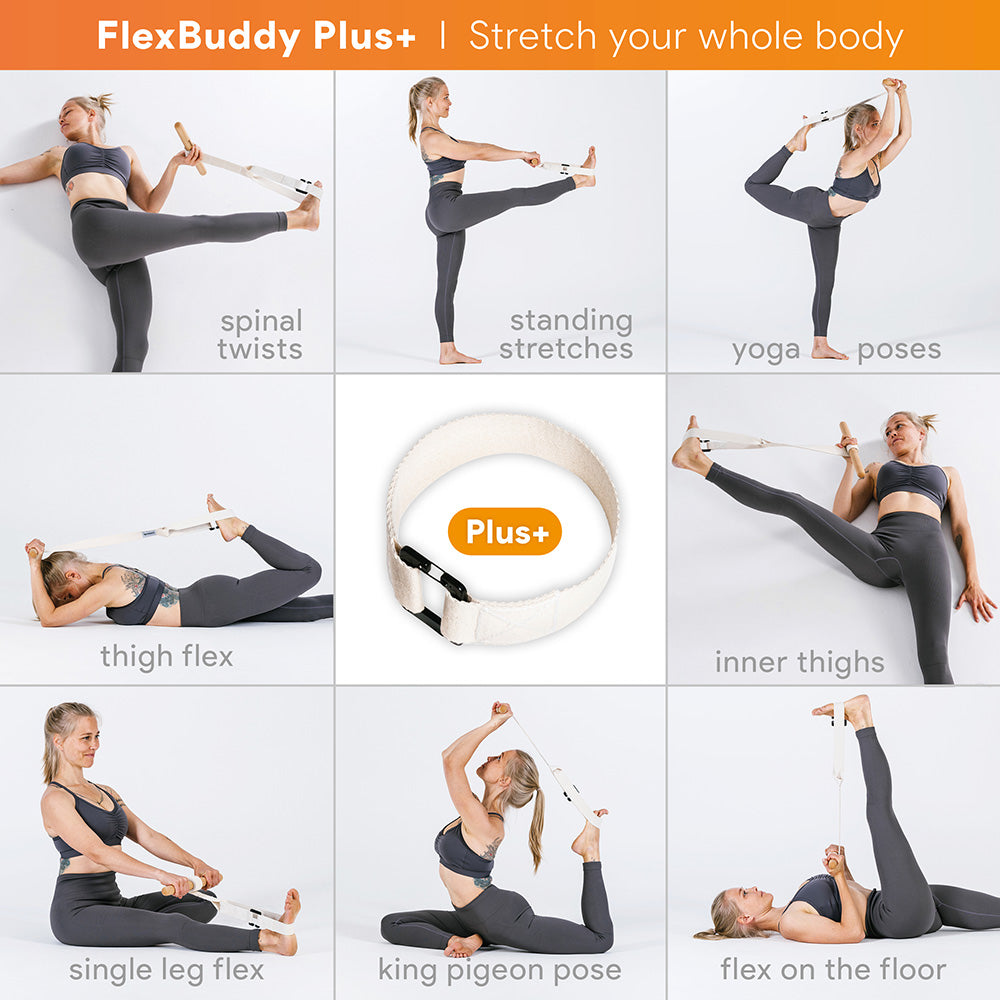
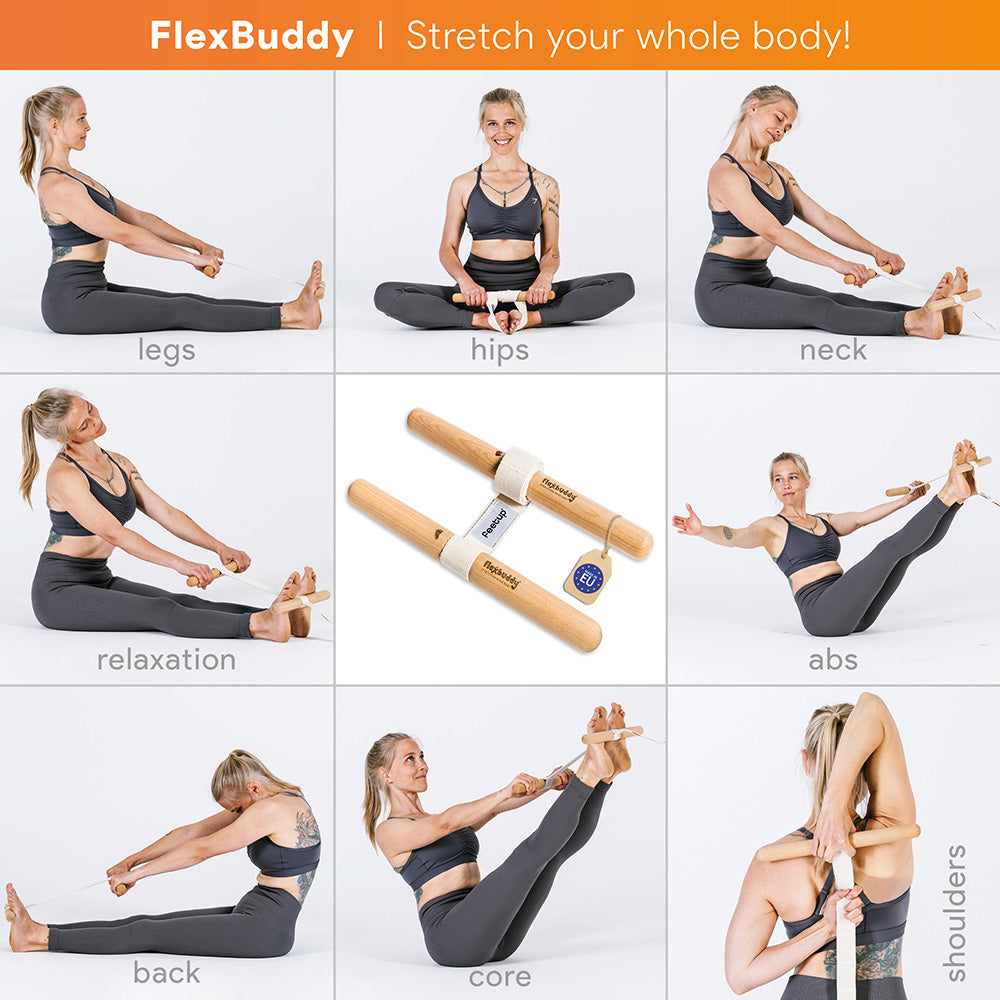
- Four stretches, five minutes, looser legs. Hamstrings Warm Up, Static Stretch, Single Leg Stretch and Lying Thigh Stretch, all from the official FlexBuddy® video library.
- Sit tall and the stretch works. In a stretching trial, hamstring flexibility improved in the group that kept the pelvis tilted forward [1].
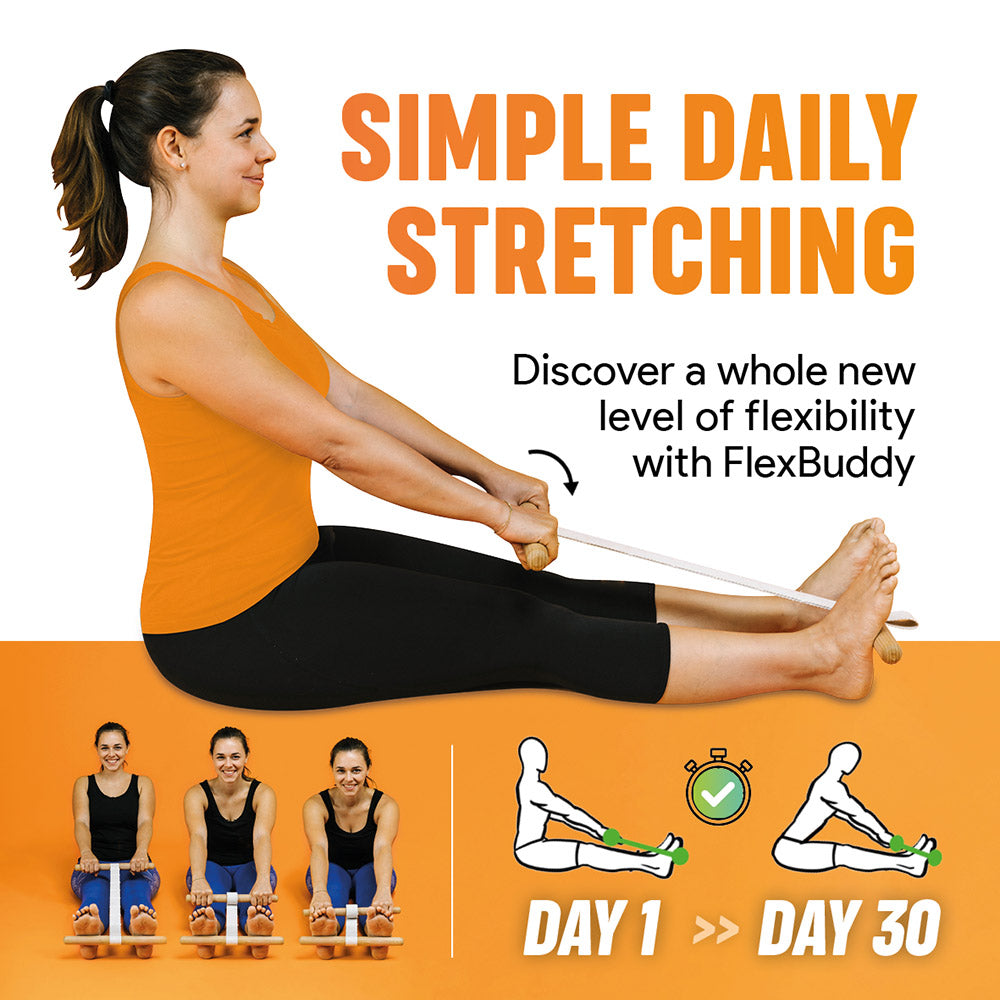
- Short holds are enough. Hold each stretch for 15 to 30 seconds and repeat it 2 to 4 times, after a short active warm-up [2]. That reaches the 60 seconds per exercise that the American College of Sports Medicine recommends on at least 2 days a week [3].
- Thirty seconds does the job. In adults aged 21 to 39 with tight hamstrings, 30-second holds five days a week improved range in six weeks, and they worked as well as 60-second holds [4].
- Bent knees are welcome. A slightly bent-knee stretch done most days beats a straight-leg stretch you avoid.
- Mild tension only. Sharp pain, tingling or numbness, especially behind the knee or down the leg, means ease off and read the last section before you carry on.
- FlexBuddy makes the right position easy. It connects your hands to your feet, so your back stays long and the stretch lands in your hamstrings from the first day.
Why are hamstring stretches so hard for beginners?
If hamstring stretches have always felt like a test you fail (reaching, straining, lower back complaining), the problem was never your effort. It was the setup. Beginner hamstrings need support, not willpower. Fix the setup and the stretch feels good the first time.
The hamstrings are three muscles on the back of each thigh. They start at the bony point you sit on and end in cord-like tendons that cross the knee; they extend the hip and bend the knee [5]. So they reach full length only when the knee is straight and the pelvis tips forward.
To stretch the hamstrings you hinge the pelvis forward over your legs. A stiff person reaching for the feet rounds the spine instead. Motion analysis shows that a full forward bend averages 111 degrees, about 42 from the lumbar spine and 69 from the hips [6]. When the hamstrings will not let the hips supply their share, the back makes up the distance and the hamstrings barely lengthen. Keep the hinge at the hips and the stretch goes where you want it.
In a stretching trial, the group that held an anterior pelvic tilt (pelvis tipped forward, lower back long) gained hamstring flexibility, and the group that stretched with the pelvis tucked under did not. The authors concluded that pelvic position mattered more than the stretching method [1]. The position is the stretch.
Your body lets go when it feels safe
Good news for stiff beginners. A review of the stretching research concluded that the extra range people gain after a single session, and after programmes of three to eight weeks, comes mostly from a change in sensation: how much stretch the body is willing to allow [7]. You do not have to wait for a muscle to grow longer. Muscles let go when the position feels safe, and a calm, supported stretch feels safe from the first breath.
Support fixes both problems at once. FlexBuddy, a strap or a towel between your hands and feet supplies the reach you are missing, so the spine stays long and you choose a depth you can breathe in. If you wonder why tight hamstrings so often travel with a grumbling lower back, we cover that in tight hamstrings and the lower back.
A one-minute check before you start
One quick look shows your starting point and gives you a "before" to beat in a month.
- Sit on the floor with your back and hips against a wall, legs straight out. If your knees pop up or you have to slide your hips away from the wall, your hamstrings do not yet allow an upright pelvis. That is the beginner picture, and it is exactly what this routine changes.
- Reach your arms forward without your hips leaving the wall. A pull in the back of the thighs is right. A pull in the lower back only means you are folding from the spine.
- Compare sides by bending one knee at a time. Most people have a tighter side.
For a version with numbers you can track, use the tests in how to test your hamstring flexibility at home.
How long should a beginner hold a hamstring stretch?
Shorter than you think. A clinical review of stretching gives the working numbers: static stretches after an active warm-up, each held for 15 to 30 seconds and repeated 2 to 4 times [2]. The American College of Sports Medicine recommends a total of 60 seconds per flexibility exercise for each major muscle group, on at least 2 days a week [3]. Two 30-second holds, or four 15-second holds, get you there.
And it works. In adults aged 21 to 39 with limited hamstring flexibility, stretching five days a week for six weeks improved range of motion, and one 30-second hold a day did as well as 60-second holds or three sessions a day [4]. A meta-analysis of 19 controlled trials confirmed it: static stretching increases hamstring flexibility in healthy young adults [8]. A systematic review of 28 studies found gains with a variety of techniques, positions and durations [9]. You only have to turn up.
- Over 65? Longer holds pay off faster. In people aged 65 to 97 with tight hamstrings, 60-second holds five times a week produced faster and longer-lasting gains than 15 or 30 seconds [10]. Build up gradually.
- Little and often wins. A review of 23 long-term studies found that range improved when a muscle received at least five minutes of stretching a week spread over at least five days [11]. That is one minute a day.
The full reasoning is in how long to hold a stretch.
The four stretches at a glance
The routine takes about five minutes. Holds follow the 15 to 30 second range above [2]; the warm-up is movement, not a hold.
| Exercise | Targets | Hold and reps | What it gives you |
|---|---|---|---|
| 1. Hamstrings Warm Up | Hamstrings, lower back | 30–45 s of gentle rocking | Always first: easing in |
| 2. Static Stretch | Both hamstrings | 15–30 s × 2–4 | The main flexibility builder |
| 3. Single Leg Stretch | One side at a time | 15–30 s × 2 per side | The tighter side catching up |
| 4. Lying Thigh Stretch | Front of thigh, hip flexors | 15–30 s × 2 per side | Balancing the pelvis |
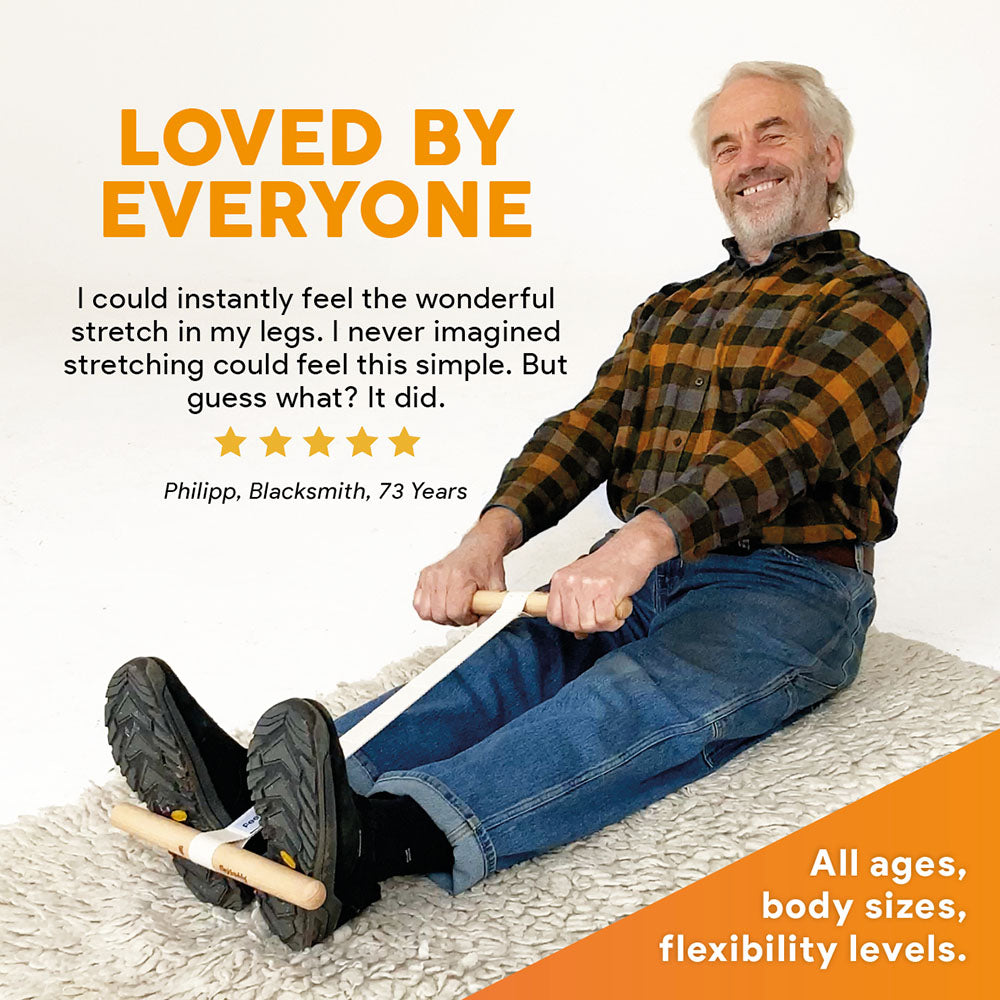
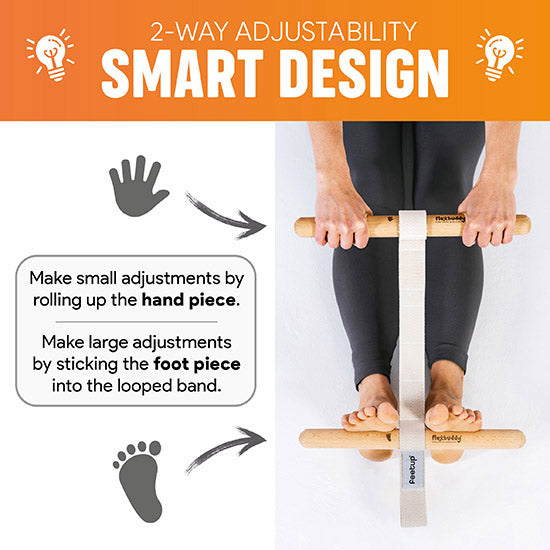
All four are done with FlexBuddy: the foot bar under the soles of your feet and the hand bar in both hands. A long towel or belt round the feet is a fair stand-in while you learn the shapes.
1. Hamstrings Warm Up
How to do it:
- Sit on the floor with your legs extended and the FlexBuddy foot bar under the soles of your feet.
- Hold the hand bar with a relaxed grip and sit tall.
- Rock gently forward and back in a small range for 30 to 45 seconds, breathing slowly. Lead with the chest, not the chin.
What you will feel: a light, moving pull along the back of the thighs that eases with every rock.
Why it helps: the guidance is to stretch after an active warm-up, not from cold [2]. A minute of marching on the spot, then this rocking, is all you need at home.
Beginner tip: knees softly bent. Always an option, never a failure.
2. Static Stretch
How to do it:
- Legs extended, foot bar under the soles, hand bar in both hands. Arms straight while you sit upright.
- Breathe in and grow a centimetre taller. Breathe out and hinge forward from the hips with long arms. The strap carries the pull, so your back stays long.
- Stop at mild tension and stay for 15 to 30 seconds, breathing slowly. Come up on an in-breath, rest for a few breaths, and repeat 2 to 4 times [2].
What you will feel: a steady, even pull along the back of both thighs, and nothing notable in your lower back. If the back complains, you have rounded: rise and lengthen again.
Why it helps: this is where flexibility is built: a calm hold at a depth your body accepts, repeated over weeks.
Common mistake: measuring progress in centimetres to the toes. In the first weeks, measure it by how calm the same depth feels compared with last week.
3. Single Leg Stretch
How to do it:
- Extend one leg. Bend the other knee and rest that foot against the inside of the straight thigh.
- Place the foot bar under the extended foot and hold the hand bar.
- Breathe in tall, breathe out and hinge gently towards the straight leg, chest pointing at the toes. Hold for 15 to 30 seconds, then switch sides. Two rounds per side.
What you will feel: a clear pull along the back of the extended thigh, and probably the news that one side is tighter than the other.
Why it helps: in two-leg stretches the more flexible side does the work and the tight side hides. One at a time, nobody hides.
Beginner tip: give the tighter side one bonus round, gently.
4. Lying Thigh Stretch
How to do it:
- Lie on your side or your front and place the FlexBuddy strap round the top foot.
- Bring the handles over your shoulder and gently draw the heel towards your buttock.
- Keep the knees close together and the pelvis neutral, with no arching of the lower back. Hold for 15 to 30 seconds per side, twice.
What you will feel: a clean stretch down the front of the thigh, perhaps into the front of the hip.
Why it is in a hamstring article: the quadriceps on the front of the thigh act on the hip as well as the knee and influence the relationship between the pelvis and the spine [12]. The front of the thigh pulls the pelvis one way and the hamstrings the other. Ease both sides of that tug-of-war and the forward hinge comes free.
Common mistake: hauling the heel to the buttock. Mild tension is the entire assignment.
No strap yet? What to use instead
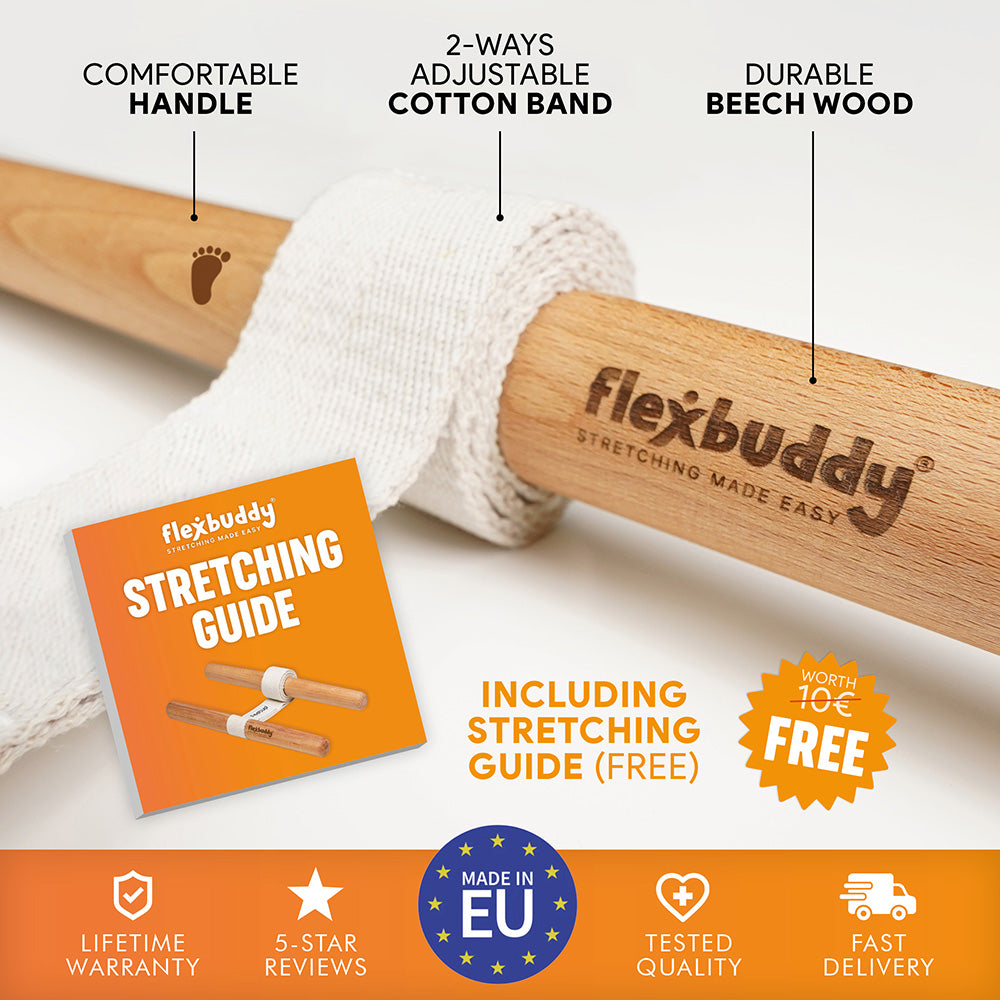
You can start tonight with what is in the house: a bath towel or dressing-gown belt round the feet for the seated stretches, a hand on the ankle for the Lying Thigh Stretch. You will soon notice two things. A towel is often too short, which pulls the shoulders forward and rounds the back, and a thin belt digs into the hands during a hold. FlexBuddy fixes both: the strap adjusts to your exact reach, and the wooden handles sit comfortably in your palms.
If the floor is the problem, sit on a folded blanket or firm cushion so the hips are a little higher than the heels and the pelvis tilts forward more easily. Or lie on your back, put the foot bar under one foot and raise that leg towards the ceiling with the other knee bent: the floor keeps your spine straight for you.
Five beginner mistakes, and the easy fix for each
1. Rounding the back to reach further
In the pelvic-position trial, the forward-tilted pelvis was what produced the gain in hamstring flexibility [1]. Reach less and sit taller. With FlexBuddy in your hands there is nothing to reach for, so this mistake disappears on its own.
2. Bouncing
Stay still and you gain more. A meta-analysis of 77 studies found that static stretching and contract-relax (PNF) stretching produced larger long-term gains in range of motion than ballistic or dynamic stretching [13]. Ease in, then hold.
3. Chasing pain
Gentle is enough. The same meta-analysis found that stretching intensity made no significant difference to how much range people gained [13]. You get the full benefit at mild tension: a clear pull while you can still breathe slowly.
4. Locking the knees at all costs
The hamstrings cross the back of the knee [5], so a slightly bent knee takes a little tension off them and lets the pelvis tip forward. Start with soft knees and straighten them over the weeks.
5. One long session a week
Range improved when stretching was spread over at least five days a week [11], and in a trial of adults aged 18 to 46, those who stretched their hamstrings at least six times a week gained more hip range than those who stretched three times a week [14]. Five minutes most days beats half an hour on Sunday. Keep FlexBuddy where you will see it and the five minutes take care of themselves.
A four-week plan for beginners
Every hold stays inside 15 to 30 seconds [2], and the total reaches 60 seconds per exercise by week two [3]. Repeating a week is normal.
| Week | What you do | Hold and reps | How often | Focus |
|---|---|---|---|---|
| 1 | Warm Up + Static Stretch with FlexBuddy, knees soft, sitting on a cushion if needed | 15 s × 2 | 5 days or more | Chest up, pelvis tipping forward |
| 2 | Add the Single Leg Stretch | 20–30 s × 2–3 | 5 days or more | One extra round for the tighter side |
| 3 | All four stretches | 30 s × 2–3 | Daily if you can | Knees a little straighter, spine still long |
| 4 | All four; shorten the FlexBuddy strap one step | 30 s × 3 | Daily if you can | Repeat the wall check |
| After | Keep the routine as a habit | 30 s × 2 per stretch | Most days, never fewer than 2 a week | Keeping the range you have earned |
What progress really looks like
Straight after a session you will feel looser, from day one. A single bout of stretching adds range that lasts for up to half an hour [15]. The daily habit is what makes it last.
Week one: the stretches stop feeling awkward and start feeling good. Weeks two to three: bending in daily life gets smoother. These early gains arrive fast because they come from your body allowing more stretch [7].
Weeks four to six: now the tape measure agrees. Six weeks of 30-second holds on five days a week improved hamstring range in adults with tight hamstrings [4]. And progress sticks: in the trial of adults aged 18 to 46, people stretched for four weeks and then stopped completely, and four weeks later every stretching group still held significant gains [14]. A missed week is not a reset.
After that the hinge keeps deepening. If touching your toes is the goal, the step-by-step version is in how to touch your toes, and the FlexBuddy Video Course has a dedicated Routine to Touch Toes to follow along.
When a tight hamstring is not just tight
Stretching suits stiff hamstrings, not every pain in the back of the thigh. Hold off and get advice if:
- The pain came on suddenly during a sprint, a kick or a slip, or there is bruising or a tender spot. That points to a strain, which needs rest and a graded return, not stretching. See pulled hamstring or tight hamstring.
- The pull is electric, burning or tingling, or runs below the knee. That suggests an irritated nerve and not a short muscle, and more stretching is not the answer. See a doctor or physiotherapist.
- You have lower back pain as well. Tight hamstrings and a sore lower back are often found together, and a systematic review has pooled 17 studies on the link [16]. Gentle stretching with a long spine suits stiffness. It is not a treatment for a back condition: for that, see a physiotherapist first.

Get it right from day one with FlexBuddy
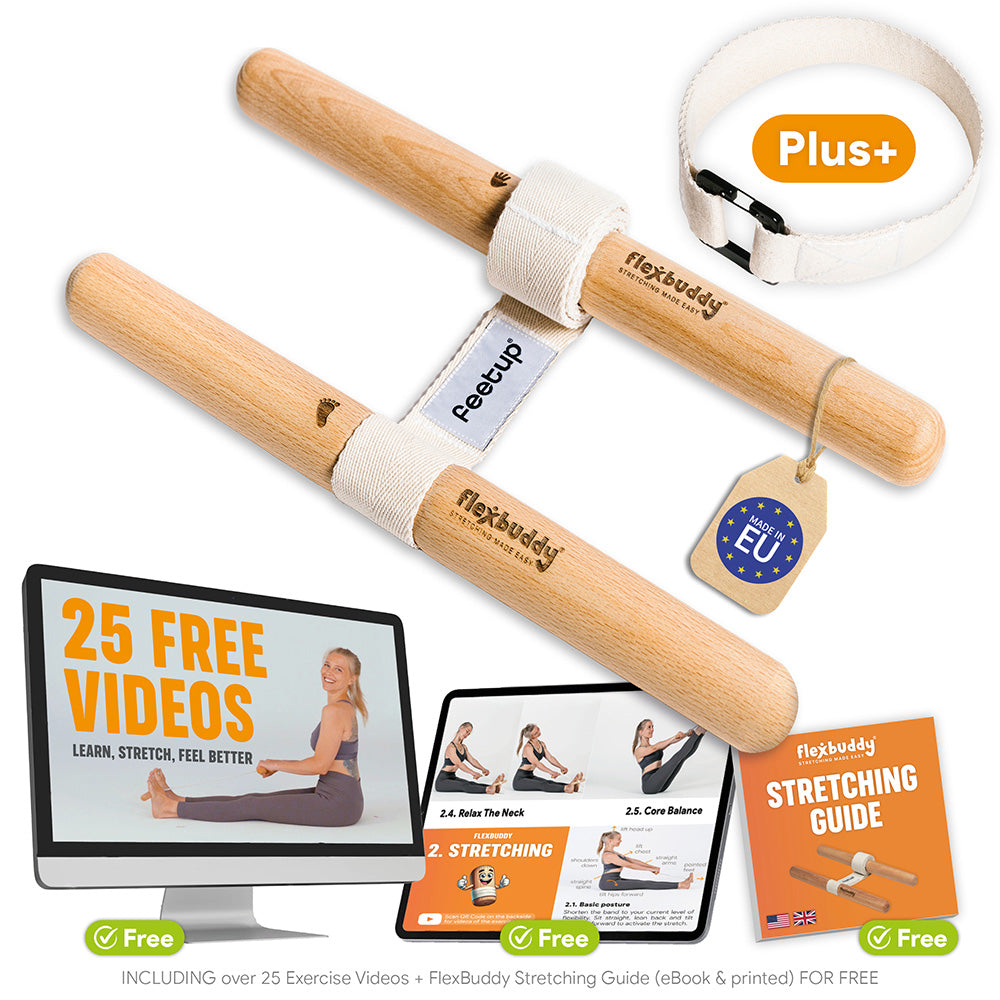
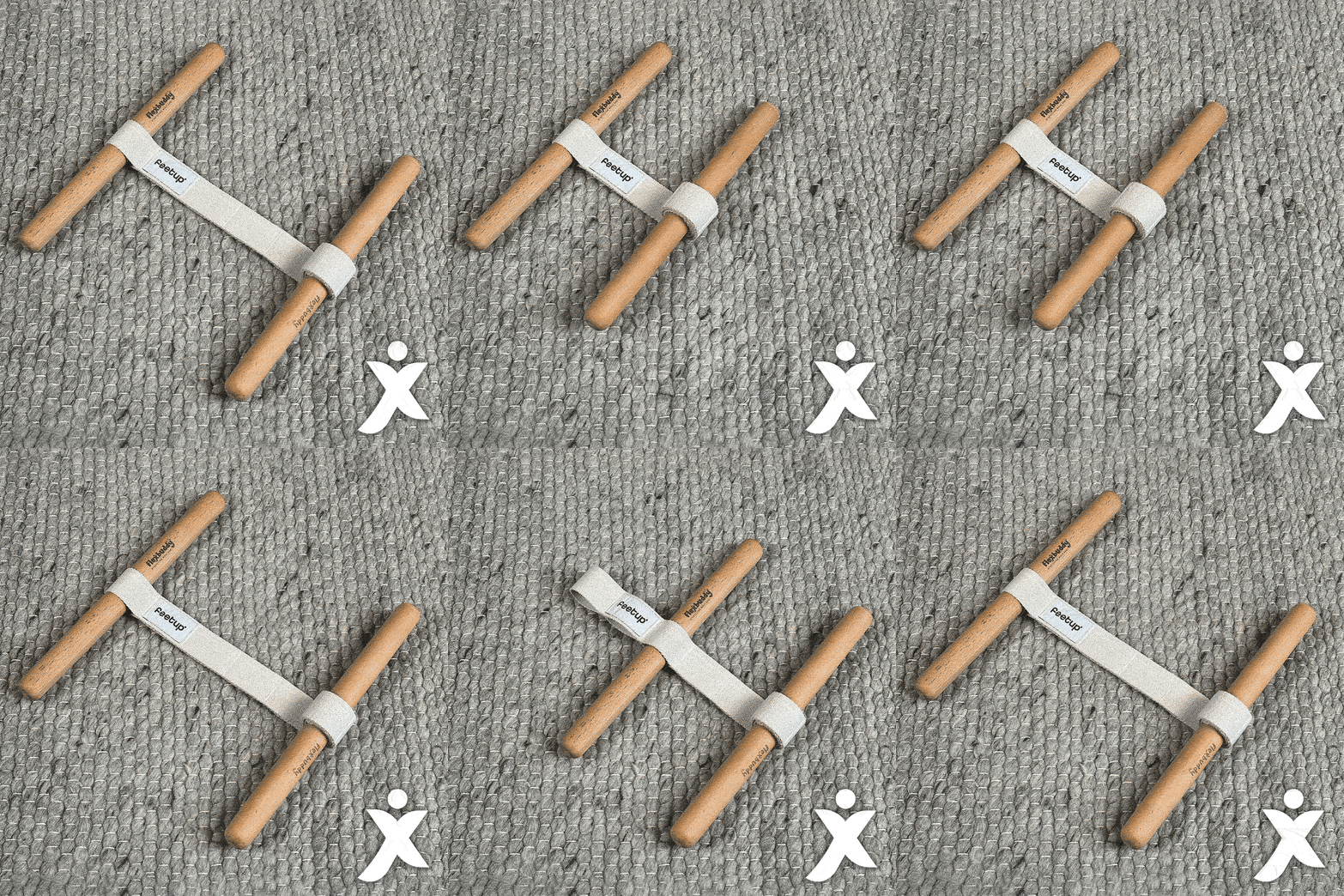
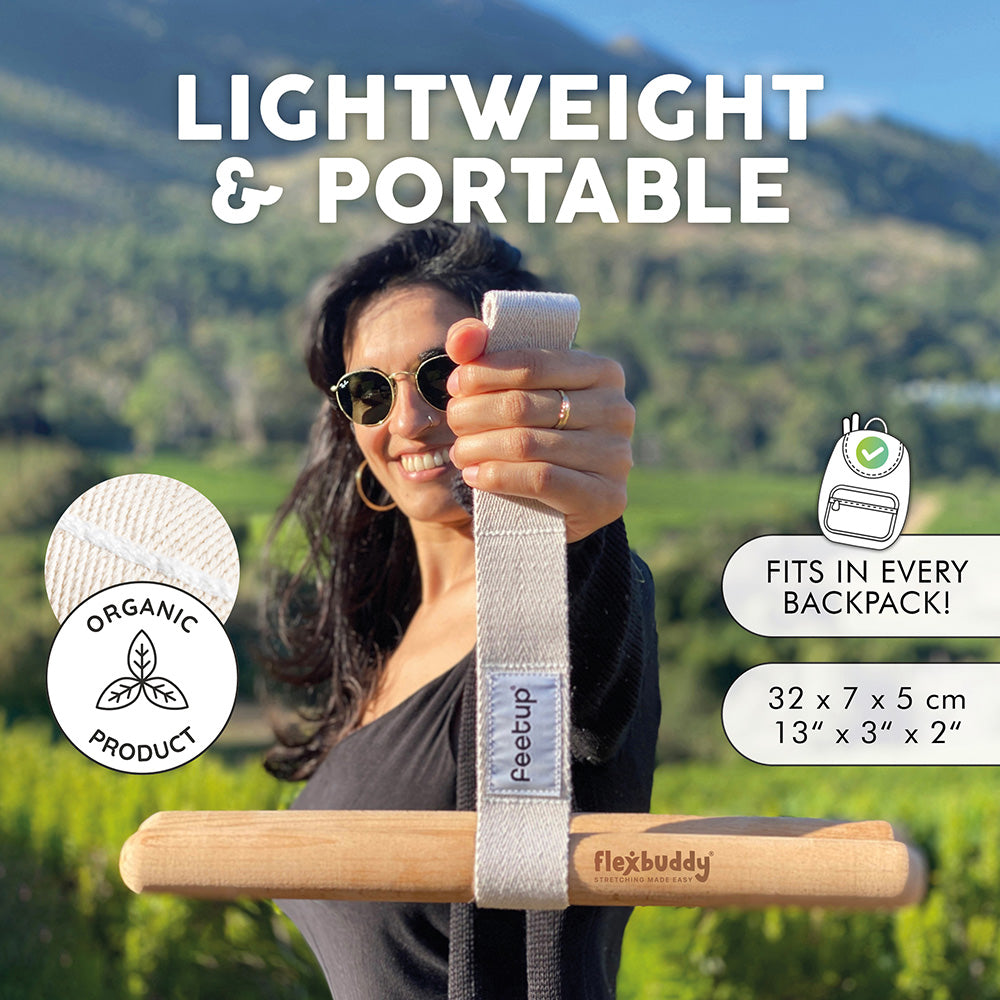
Beginner hamstrings need one thing: a position comfortable enough to relax in. FlexBuddy® gives you that position. It is a patented stretching device made of two beech-wood bars joined by an adjustable natural-cotton strap: one bar under the soles of your feet, the other in both hands. Because your hands are connected to your feet, you sit tall, tilt the hips forward and let the strap supply the reach you do not have yet. The stretch lands in the back of the thighs, not in a rounded lower back. Adjustment works two ways: move the foot bar to a different loop for big steps, or roll the strap round the hand bar for small ones. The wooden handles are comfortable to hold, with no rope burn.
Bob J. wrote: "I am 64 and have never touched my toes. FlexBuddy changed that in a week!" Two minutes a day can improve your flexibility and posture. FlexBuddy is rated 4.5 by verified buyers and comes with a 30-day money-back guarantee and a lifetime warranty, so you can try it without risk. Get your FlexBuddy, or take the two-minute quiz to find your starting routine.
Frequently asked questions
How often should beginners stretch their hamstrings?
Most days, in short sessions. That is how range builds fastest: long-term studies show it improves when stretching is spread over at least five days a week [11]. The ACSM minimum is a total of 60 seconds per exercise on at least 2 days a week [3].
How long should I hold a hamstring stretch?
Hold for 15 to 30 seconds and repeat 2 to 4 times [2]. That is all it takes: in adults under 40 with tight hamstrings, 30-second holds worked as well as 60 [4]. People over 65 gained more from 60-second holds in one trial [10].
Why do I feel hamstring stretches in my lower back?
Because you are rounding your spine to reach further. Come up, lengthen, and let FlexBuddy or a strap do the reaching. In a stretching trial, the forward-tilted pelvis is what produced the gain in hamstring flexibility [1].
Should my knees be straight when I stretch my hamstrings?
Not at first. The hamstrings cross the knee [5], so softly bent knees take off enough tension for the pelvis to tip forward, and a long spine matters more than straight legs. Straighten gradually over the weeks as it becomes comfortable.
Is it OK to stretch my hamstrings every day?
Yes, and it pays off. In a four-week hamstring programme, people who stretched at least six times a week gained more range than those who stretched three times a week [14]. Keep it at mild tension, and do not stretch a hamstring you have just injured.
How long until I can touch my toes?
You will feel looser within the first week, and trials measure a clear gain in range after about six weeks of regular stretching [4]. How soon you reach your toes depends on where you start: weeks for some, a few months for others.
This article is general information, not medical advice. Tight muscles usually respond well to regular stretching. If your pain is sharp, radiates down a leg, comes with numbness, weakness, fever, bladder or bowel changes, follows an injury, or keeps getting worse, see a doctor or physiotherapist before you stretch.
References
- Sullivan MK, Dejulia JJ, Worrell TW. Effect of pelvic position and stretching method on hamstring muscle flexibility. Med Sci Sports Exerc. 1992;24(12):1383–1389. PMID 1470022. https://pubmed.ncbi.nlm.nih.gov/1470022/ (accessed 14 Nov 2026).
- Page P. Current concepts in muscle stretching for exercise and rehabilitation. Int J Sports Phys Ther. 2012;7(1):109–119. PMID 22319684 / PMC3273886. https://pmc.ncbi.nlm.nih.gov/articles/PMC3273886/ (full text accessed 14 Nov 2026).
- Garber CE, Blissmer B, Deschenes MR, et al.; American College of Sports Medicine. Position stand: quantity and quality of exercise for developing and maintaining cardiorespiratory, musculoskeletal, and neuromotor fitness in apparently healthy adults: guidance for prescribing exercise. Med Sci Sports Exerc. 2011;43(7):1334–1359. doi:10.1249/MSS.0b013e318213fefb. PMID 21694556.
- Bandy WD, Irion JM, Briggler M. The effect of time and frequency of static stretching on flexibility of the hamstring muscles. Phys Ther. 1997;77(10):1090–1096. doi:10.1093/ptj/77.10.1090. PMID 9327823.
- Hu Y, Raja A. Anatomy, Bony Pelvis and Lower Limb, Hamstring Muscle. In: StatPearls [Internet]. Treasure Island (FL): StatPearls Publishing; updated 31 Jan 2026. PMID 31536294. https://pubmed.ncbi.nlm.nih.gov/31536294/ (accessed 14 Nov 2026).
- Esola MA, McClure PW, Fitzgerald GK, Siegler S. Analysis of lumbar spine and hip motion during forward bending in subjects with and without a history of low back pain. Spine. 1996;21(1):71–78. doi:10.1097/00007632-199601010-00017. PMID 9122766.
- Weppler CH, Magnusson SP. Increasing muscle extensibility: a matter of increasing length or modifying sensation? Phys Ther. 2010;90(3):438–449. doi:10.2522/ptj.20090012. PMID 20075147.
- Medeiros DM, Cini A, Sbruzzi G, Lima CS. Influence of static stretching on hamstring flexibility in healthy young adults: systematic review and meta-analysis. Physiother Theory Pract. 2016;32(6):438–445. doi:10.1080/09593985.2016.1204401. PMID 27458757.
- Decoster LC, Cleland J, Altieri C, Russell P. The effects of hamstring stretching on range of motion: a systematic literature review. J Orthop Sports Phys Ther. 2005;35(6):377–387. doi:10.2519/jospt.2005.35.6.377. PMID 16001909.
- Feland JB, Myrer JW, Schulthies SS, Fellingham GW, Measom GW. The effect of duration of stretching of the hamstring muscle group for increasing range of motion in people aged 65 years or older. Phys Ther. 2001;81(5):1110–1117. PMID 11319936. https://pubmed.ncbi.nlm.nih.gov/11319936/ (accessed 14 Nov 2026).
- Thomas E, Bianco A, Paoli A, Palma A. The relation between stretching typology and stretching duration: the effects on range of motion. Int J Sports Med. 2018;39(4):243–254. doi:10.1055/s-0044-101146. PMID 29506306.
- Bordoni B, Varacallo MA. Anatomy, Bony Pelvis and Lower Limb: Thigh Quadriceps Muscle. In: StatPearls [Internet]. Treasure Island (FL): StatPearls Publishing; updated 8 May 2023. PMID 30020706. https://pubmed.ncbi.nlm.nih.gov/30020706/ (accessed 14 Nov 2026).
- Konrad A, Alizadeh S, Daneshjoo A, et al. Chronic effects of stretching on range of motion with consideration of potential moderating variables: a systematic review with meta-analysis. J Sport Health Sci. 2024;13(2):186–194. doi:10.1016/j.jshs.2023.06.002. PMID 37301370.
- Cipriani DJ, Terry ME, Haines MA, Tabibnia AP, Lyssanova O. Effect of stretch frequency and sex on the rate of gain and rate of loss in muscle flexibility during a hamstring-stretching program: a randomized single-blind longitudinal study. J Strength Cond Res. 2012;26(8):2119–2129. doi:10.1519/JSC.0b013e31823b862a. PMID 22027850.
- Behm DG, Blazevich AJ, Kay AD, McHugh M. Acute effects of muscle stretching on physical performance, range of motion, and injury incidence in healthy active individuals: a systematic review. Appl Physiol Nutr Metab. 2016;41(1):1–11. doi:10.1139/apnm-2015-0235. PMID 26642915.
- Hori M, Hasegawa H, Takasaki H. Comparisons of hamstring flexibility between individuals with and without low back pain: systematic review with meta-analysis. Physiother Theory Pract. 2021;37(5):559–582. doi:10.1080/09593985.2019.1639868. PMID 31317831.