- Your joints are younger than you think. In a US national sample, average hip and knee range differed by only 3 to 5 degrees between the youngest and oldest adults for most movements [1]. Most stiffness after 60 is disuse, and that is yours to change.
- Your body still responds, at any age. In people over 65 with tight hamstrings, 60-second holds gained range nearly twice as fast as 30-second holds, and the gains lasted longer [2].
- You walk better. Stretching the hips and legs gave older adults longer steps and a faster pace [3][4]. Balance and strength exercise is what cuts falls [5], so the routine below includes both.
- You can start today, from a chair. Osteoporosis, a joint replacement, dizziness on standing or a recent fall change which stretches you do, not whether you stretch.
- The dose is small. Two to three days a week at least, daily is best, to mild tightness and never pain [6][7]. It covers the NHS request for strength, balance and flexibility work on at least two days a week after 65 [8].
- Four to six weeks of near-daily practice brings change you can measure [2][9]. One customer, 64, touched his toes after a week.
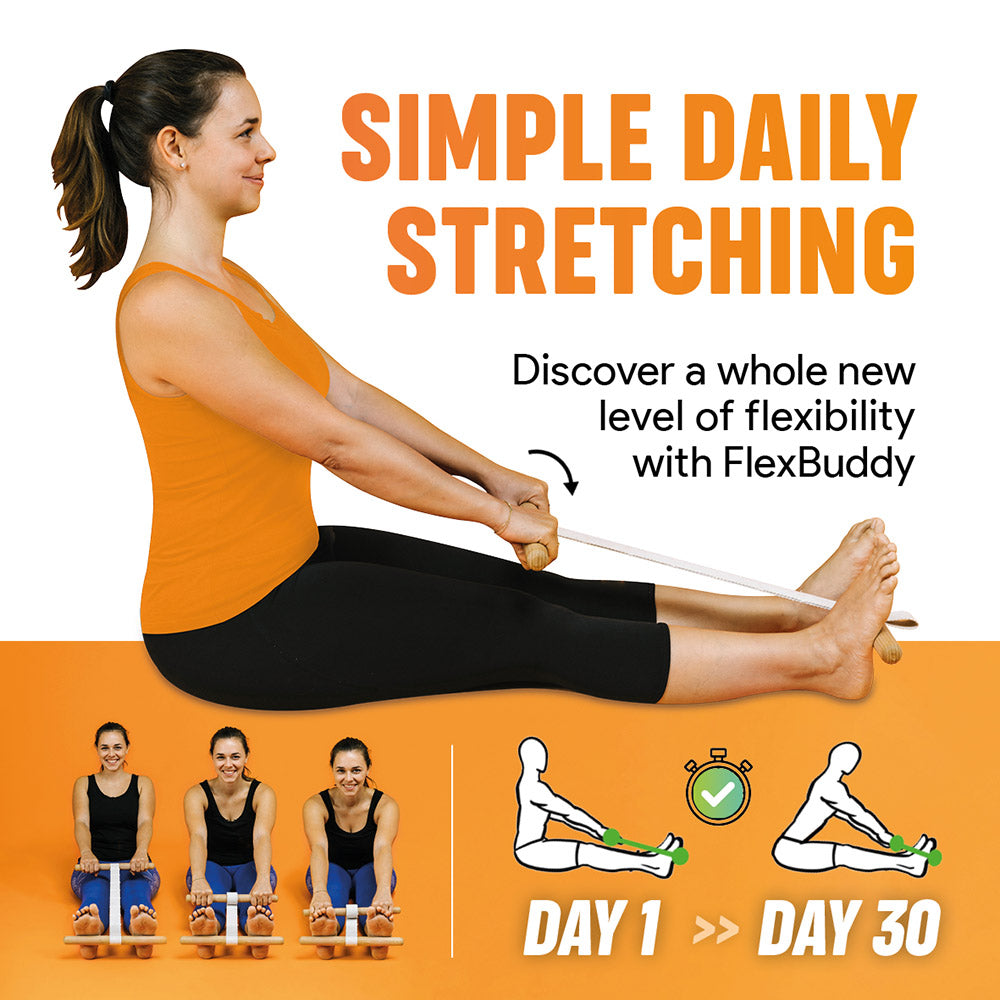
- FlexBuddy® brings your feet to you. The strap covers the reach, so you stretch hamstrings and calves from a chair or the edge of the bed with a tall back.
What changes after 60: joints, tendons and muscle
Good news first: far less changes than you have been told, and stiffness responds to gentle, regular stretching. Stiffness in later life has three ingredients.
Joints
Your joints keep almost all of their range (what changes and what is reversible is the subject of flexibility after 50). A US national health survey measured hip and knee range in 1,892 people. The difference between the youngest and oldest age groups was small, 3 to 5 degrees [1]. One movement gave up more: hip extension, taking the leg behind you, lost more than 20% of its arc [1]. That is the stride you take when you walk, and the standing hip stretch below goes after it.
Tendons and fascia
Tendons connect muscle to bone, and the muscle-tendon unit stiffens with age partly because non-contractile material accumulates inside it [10]. A stiffer tendon is not weaker, but it gives less, so the same stretch feels tight sooner. Slow, long holds are the answer, and they feel good.
Muscle
Muscle quantity and quality decline with age. When that reduces strength and performance it has a name, sarcopenia, which the European consensus defines as a muscle disease common in older age [11]. Stretching frees the movement and strength holds you up on a kerb, so the routine below puts heel raises and a chair-stand next to the stretches.
What is normal after 60, and what is not
The research is kinder than most people expect. The Canadian Health Measures Survey tested 5,188 people from childhood to old age. Grip strength declined steadily from the thirties, but sit-and-reach flexibility "remained relatively stable with age in both sexes" [12]. The US survey authors went further: at least up to age 74, any substantial loss of joint mobility should be viewed as abnormal, not put down to ageing, and given the same care it would get in a younger person [1]. You are not too old to get it back.
Normal: a moment to straighten up after sitting; feeling the backs of the thighs when you reach for your shoes; a hip that swings less far behind you. Not normal, and a GP visit rather than a stretch: a joint that is hot, swollen or suddenly much stiffer than its partner; morning stiffness that lasts well into the day; pain that wakes you; numbness, pins and needles or weakness in a leg; or a loss of movement that arrived over days rather than years. The red flags for back pain apply at every age: pain radiating down a leg, bladder or bowel changes, fever, unexplained weight loss, or pain after a fall.
Safety first: who should check with a GP before stretching
Most people over 60 can start the seated routine today. These groups adjust it, and a few should ask first.
- Osteoporosis or a spinal fracture. The Royal Osteoporosis Society flags exercises that curl the spine, including sit-ups and touching your toes, as ones that put pressure on the spine, and teaches the hip hinge instead: bend from the hip with a straight back [13]. That is exactly the posture this article teaches. If you have had spinal fractures, broken many bones or had many falls, talk to a doctor or physiotherapist first and stay with low-impact exercise [13].
- Hip or knee replacement. After a hip replacement, NHS advice is not to bend the hip beyond 90 degrees, not to cross the legs and not to sit in a low chair [14]. A deep seated forward fold breaks the first rule, so keep that stretch shallow and follow your surgical team's own list, which overrides anything here.
- Balance problems or a recent fall. The NHS lists weakening muscles, conditions that affect balance such as arthritis, stroke and Parkinson's disease, low blood pressure, medicine side effects and problems with eyesight or hearing as the usual causes of falls [15]. Do every standing stretch with a hand on a chair back, and tell your GP about the fall: strength and balance training is the fix that works [15][5].
- Dizziness or blood pressure medicines. Light-headedness on standing points to postural low blood pressure; the NHS advice is to get up slowly, from lying to sitting to standing [16]. Never spring up from a stretch, and count breaths rather than seconds so you are never holding your breath while straining.
- Arthritis. Exercise is part of osteoarthritis treatment; the NHS warns that doing too much too quickly, or the wrong sort, can damage joints, and suggests your GP or a physiotherapist discusses a programme with you [17]. Stretch to a gentle pull, never into joint pain, and rest a joint that is hot or swollen.
- Heart or lung conditions, recent surgery, cancer treatment. Ask. Gentle stretching is almost always allowed, but the person who knows your case should say so.
The dose: how long and how often to stretch after 60
The dose is small. The general adult guideline, from the American College of Sports Medicine position stand, is flexibility exercise for each major muscle-tendon group totalling about 60 seconds per exercise, on at least two days a week [6]; Harvard Health puts it at two to three times a week, with the 60 seconds split however you like, for example 15 seconds four times [7]. The NHS asks adults over 65 to be active every day and to work on strength, balance and flexibility on at least two days a week [8].
For older adults, one study shows how to get more from every minute. Researchers took people aged 65 to 97 (average 84.7) with tight hamstrings and stretched one leg five times a week for six weeks, holding 15, 30 or 60 seconds [2]. The 60-second group gained knee-extension range at 2.4 degrees a week, the 30-second group at 1.3 and the 15-second group at 0.6. Four weeks after the last session, the 60-second group still had 5.4 degrees more than at the start [2]. People in their eighties and nineties, gaining range week after week. A later review of stretching science points the same way: longer stretch times than the usual 15 to 30 seconds for older adults, and people over 65 respond better to static (held) stretching than to the contract-relax techniques that suit younger adults [18].
So your dose after 60: hold each stretch 30 to 60 seconds, twice, five or more days a week, at the point of mild pull. Ten slow breaths is roughly 30 seconds, so two rounds of ten breaths does it. The article on how long to hold a stretch covers every age.
The 10-minute routine: seated first, then standing
Ten minutes, one chair, and you stand up feeling taller. A chair takes balance out of the equation. The seated block is five minutes and complete on its own; the standing block adds the hip flexors, calves and balance for anyone steady enough to hold a chair back. Use a firm dining chair without wheels, sit towards the front of the seat with both feet flat, and keep your spine long throughout. Nothing here is done on the floor. A longer all-seated sequence is in stretches you can do in a chair.
| # | Stretch | Position | Hold / reps | What you should feel |
|---|---|---|---|---|
| 1 | Seated hamstring | Chair; one heel forward, knee straight, toes up; hinge from the hips with a long back | 30–60 s, 2 per leg | A pull along the back of the thigh; nothing in the lower back |
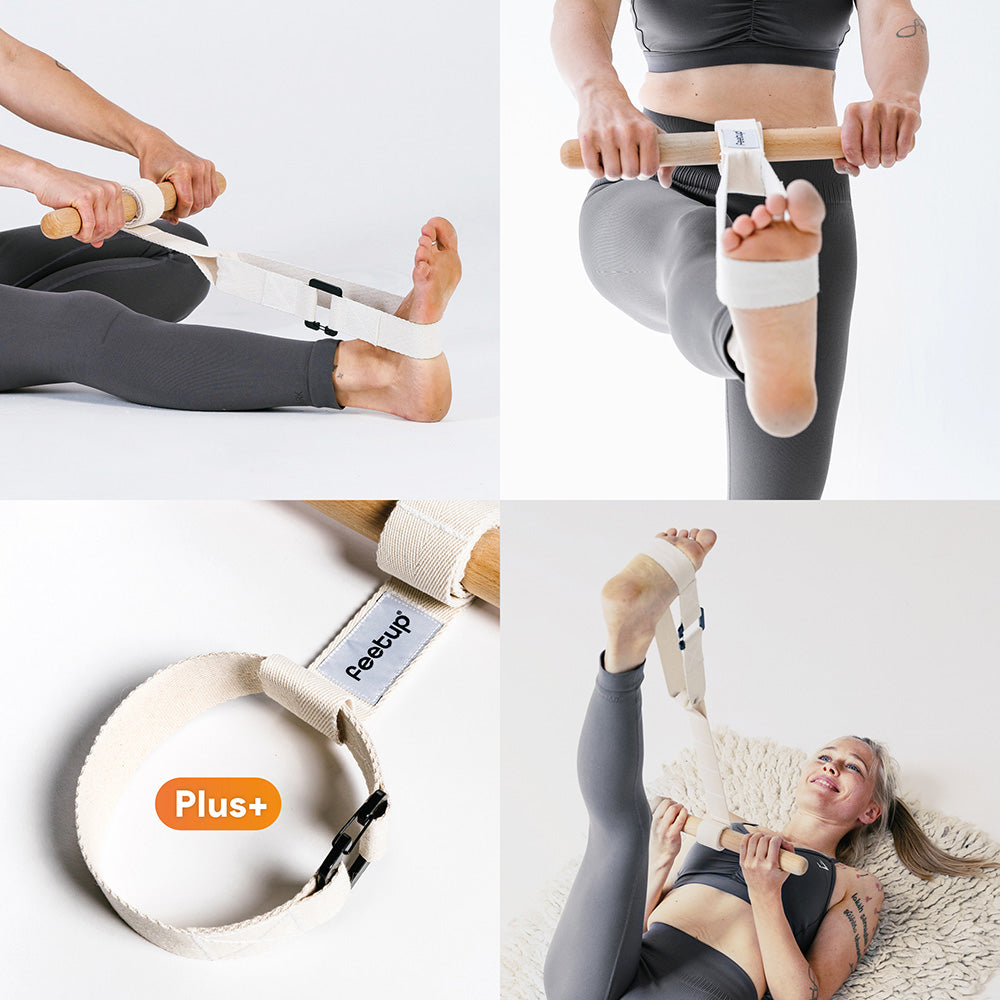
| 2 | Seated calf with FlexBuddy or a strap | Chair; FlexBuddy foot bar under the sole, or a belt or towel round the ball of the foot, leg straight; draw the toes towards you | 30–60 s, 2 per leg | A pull in the calf and behind the knee |
| 3 | Chest opener | Chair, away from the backrest; shoulders back and down, arms out to the sides, chest forward and up | 5–10 s, 5 times | A stretch across the chest |
| 4 | Upper-body twist | Chair; arms crossed, hands on shoulders; turn the upper body one way, hips still | 5 each side | Gentle rotation through the mid-back |
| 5 | Hip marching | Chair; hold the sides; lift one bent knee as far as comfortable, lower with control | 5 each leg | Work in the front of the hip (mobility and strength, not a stretch) |
| 6 | Neck turn | Chair; shoulders relaxed; turn the head towards one shoulder, hold, return | 3 each side | A light stretch on the side of the neck |
| 7 | Standing hip flexor | Hand on a chair back; one foot stepped back, both feet forward; tuck the tailbone under, stand tall | 30–60 s, 2 per leg | A pull in the front of the back hip |
| 8 | Wall calf | Hands on a wall; one leg back, heel down, knee straight; lean in | 30–60 s, 2 per leg | A pull in the calf of the back leg |
| 9 | Standing side reach | Hand on a chair back; other arm overhead, lean gently away from the chair | 20–30 s, 2 per side | A stretch down the side of the trunk |
| 10 | Heel raises and sit-to-stand | Hand on a chair back; rise onto the toes, lower slowly; then stand up from the chair and sit down slowly | 10 raises, 5 stands | Calves and thighs working (strength and balance, to finish) |
Moves 3 to 6 are the NHS's own seated exercises with their published repetitions [19]; the hold times for 1, 2, 7 and 8 follow the older-adult research above [2][18].
1. Seated hamstring stretch
Sit towards the front of the chair. Slide one heel forward until the knee is straight, toes pointing up, the other foot flat. Hands on the bent thigh, lift your chest, and lean forward from the hips as if trying to put your belly button on the straight thigh. Stop at the first clear pull in the back of the thigh. If you feel it between the shoulder blades or in the lower back, you have rounded: sit up and start again. Ten slow breaths, rest, ten more. After a hip replacement, keep the lean inside the right angle your surgeon gave you [14]. The article on why you cannot touch your toes explains the mechanics.
2. Seated calf stretch with FlexBuddy or a strap
Same chair, same straight leg. Put the FlexBuddy foot bar under the sole and hold the hand bar in both hands, or loop a belt or dressing-gown cord round the ball of the foot. Keep the knee straight, sit tall and draw the toes towards your shin until the calf pulls. Ankle range is what keeps you stepping cleanly, and it comes back: in women aged 76 to 91, six weeks of static calf stretching, five days a week, increased ankle range by 12.3 degrees on average [9]. Two rounds of ten breaths per leg.
3 to 6. The NHS seated set
The chest opener, upper-body twist, hip marching and neck turn are the NHS's seated exercises for people who have not exercised for a while [19]. Do them as the table says, upright and away from the backrest. They take about two minutes and open the two areas the leg stretches miss: the chest and upper back, which round forward over decades of reading, and the hips, which stiffen from sitting. The article on tight hips from sitting has a seated version of every hip stretch.
7. Standing hip flexor stretch
Stand behind a sturdy chair with one hand on its back. Step one foot back about half a metre, both feet pointing forward, back heel lifted. Now the part that makes it work: tuck your tailbone under, as if zipping up tight trousers, and stand tall. The pull should appear in the front of the back hip. Do not lean forward or arch the lower back to chase a bigger stretch. This is the stretch behind the walking results in older adults [20][3].
8. Wall calf stretch
Hands flat on a wall, one leg back with the heel down and the knee straight, front knee bent. Lean in until the back calf pulls. For the deeper calf muscle, bend the back knee a little while keeping the heel down. Shoes on is fine.
9 and 10. Side reach, heel raises, sit-to-stand
The side reach lengthens the trunk muscles that shorten when we sit. Heel raises and sit-to-stands are not stretches; they are the strength and balance work the NHS asks for twice a week [8], folded into the routine so it gets done. Sit down slowly enough to count to three.
The in-bed morning version
Mornings are the stiffest hour, and five minutes in bed changes how the day starts. Two rules: a mattress is soft, so keep the holds gentle, and get up afterwards in stages, lying to sitting to standing, pausing at each, which is the NHS advice for anyone who gets light-headed on standing [16].
- Ankle pumps. On your back, point and pull the toes, 10 times each foot.
- Single knee hug. Draw one knee towards the chest with your hands behind the thigh, other leg long. Ten breaths each side; after a hip replacement, stay inside your 90-degree limit [14].
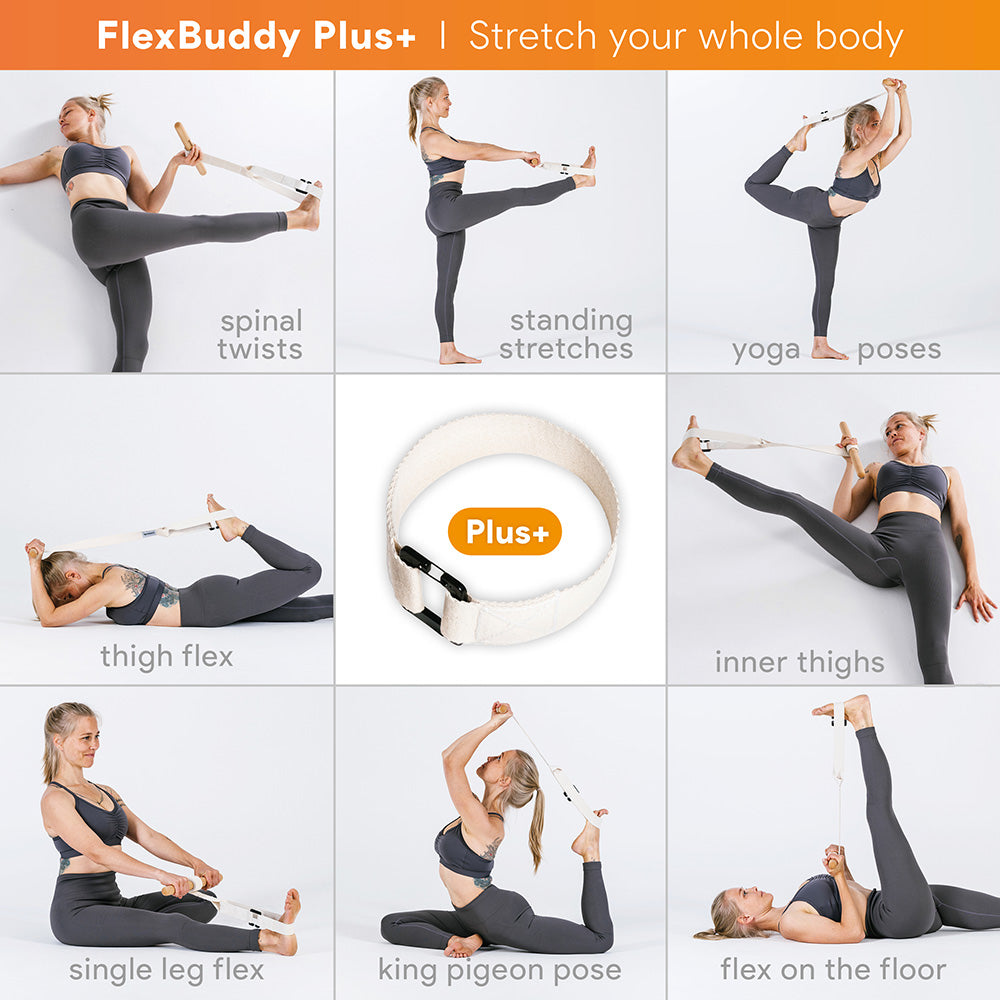
- Lying hamstring with FlexBuddy or a strap. Put the FlexBuddy foot bar under one sole, or loop a strap round the foot, and straighten the leg towards the ceiling as far as the back of the thigh allows, other knee bent with the foot on the bed. The back stays flat; the strap does the holding. Ten breaths, twice, each leg. The safest hamstring stretch for anyone with a sore back.
- Lying hip flexor. Near the edge of the bed, hug one knee to the chest and let the other leg hang off the side, knee bent. Ten breaths each side. Skip it if you are unsteady getting on and off the bed.
- Gentle knee rocks. Both knees bent, feet on the bed, let the knees roll a little to each side, 10 each way. With osteoporosis keep the range small; this is a mobiliser, not a twist [13].
Then sit on the edge of the bed for a few breaths before standing. A fuller version is in the article on stretches you can do in bed, and the morning mobility routine adds the standing moves.
Stretching, balance and walking: what the research says
This is where stretching pays you back every day. Start with staying on your feet. The Cochrane review of 108 trials with 23,407 participants found that exercise reduces the rate of falls by 23%. Balance and functional exercise is the type that does it: 24% fewer falls [5]. That is why the routine above finishes with heel raises and sit-to-stands.
Now the walking. In a randomised, double-blinded trial in healthy older people, ten weeks of home hip flexor stretching twice a day increased how far the hip could extend, from 6.1 to 7.7 degrees, and the authors concluded that the shorter stride of older walkers is largely a static tightness of the hip flexors [20]. Tightness is something you can stretch. In a second trial, women averaging 66 did 12 supervised stretching sessions over four weeks. They took longer steps, walked faster and spent less time with both feet on the ground, and their gait figures came to resemble those reported for healthy young adults [3]. Even a single session shifted the same gait measures for the hour afterwards [21]. A 2025 systematic review of 29 randomised trials confirmed it: stretching programmes increased gait speed compared with doing nothing [4].
Balance joins in. In a 16-week randomised crossover trial in adults averaging 67, a standing flexibility programme improved sway, timed up-and-go and sit-to-stand as much as resistance training did [22]. And a review of 22 studies found that flexibility training reliably improves range of motion in older adults [23].
Put together: stretch the hips and calves for a longer, quicker stride, and do the balance and strength work that keeps you steady. The routine above contains both. If walking worries you, ask your GP about a strength and balance class as well; Tai Chi and group balance programmes are among the things the Cochrane review found to work [5].
Socks, floors and chairs: what the flexibility is for
The point of a hamstring stretch at 70 is not a toe touch. It is putting on your socks on the edge of the bed, cutting your own toenails, picking a grandchild's toy off the floor and getting up from a low sofa without a push. Each of those is a hip hinge with a long back, the shape of stretch 1, and each gets easier within weeks, because early flexibility gains come mostly from the nervous system allowing more range rather than from longer tissue [24].
And long holds last: in the over-65 study, the 60-second group still had 5.4 degrees of extra range four weeks after the last session [2]. Keep FlexBuddy beside your chair or on the bedside table, stretch at the same moment every day, and in a few weeks you will notice it at sock time.
Your timeline: what you will notice, and when
Day one: you finish the routine and stand up taller. Week one: you learn the shapes, and the pull arrives early. Stay there and breathe. Week two: the same range feels mild. That is your nervous system letting go [24], and it is your first real win. Weeks four to six: change you can measure. In the over-65 trial the 60-second holds added about 2.4 degrees of knee extension a week, roughly 14 degrees in six weeks [2]; in the calf study the six-week gain was 12.3 degrees of ankle range [9]. Ten weeks: the hip flexor trial's gain in hip extension, the movement behind your stride [20]. After that, two to three sessions a week keeps what you have built [6][7].
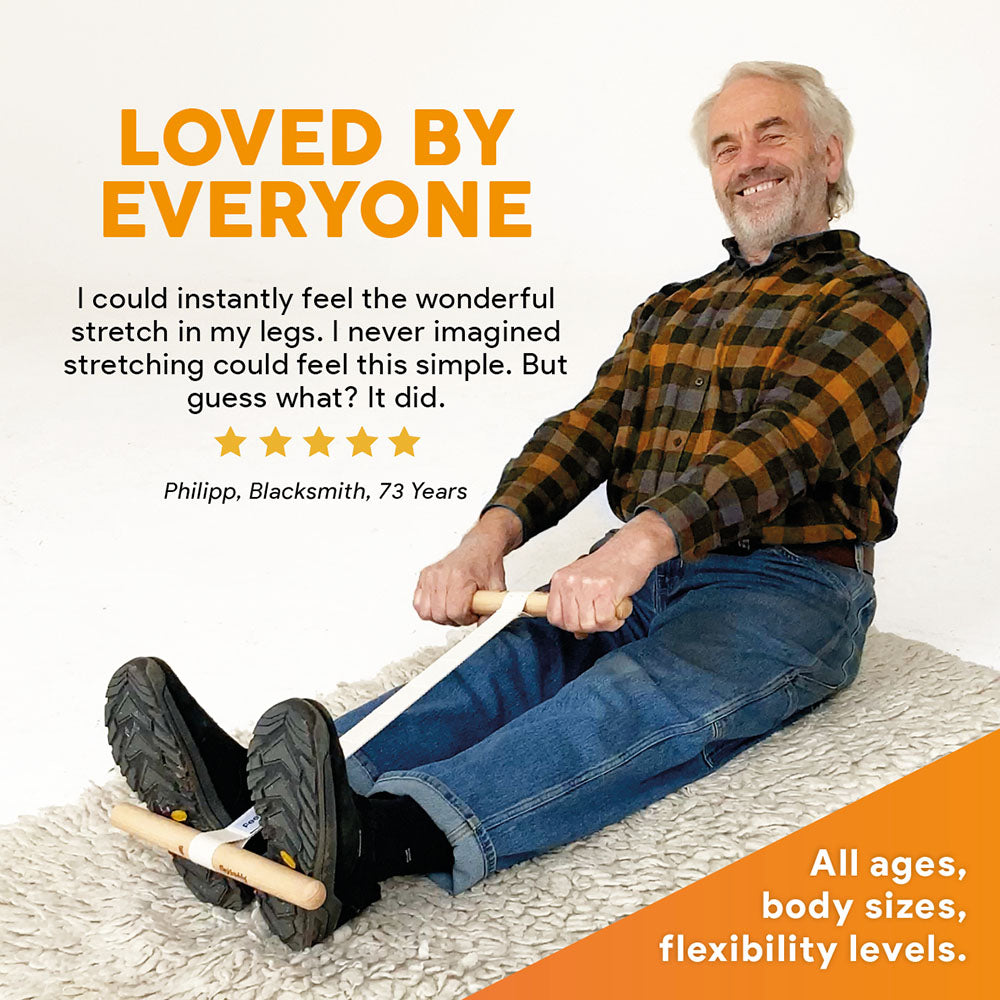
Customers tell the same story. Philipp, a blacksmith of 73, says: "I never imagined that I would regain my flexibility. But I did!" Yours starts today.

Make it easy with FlexBuddy
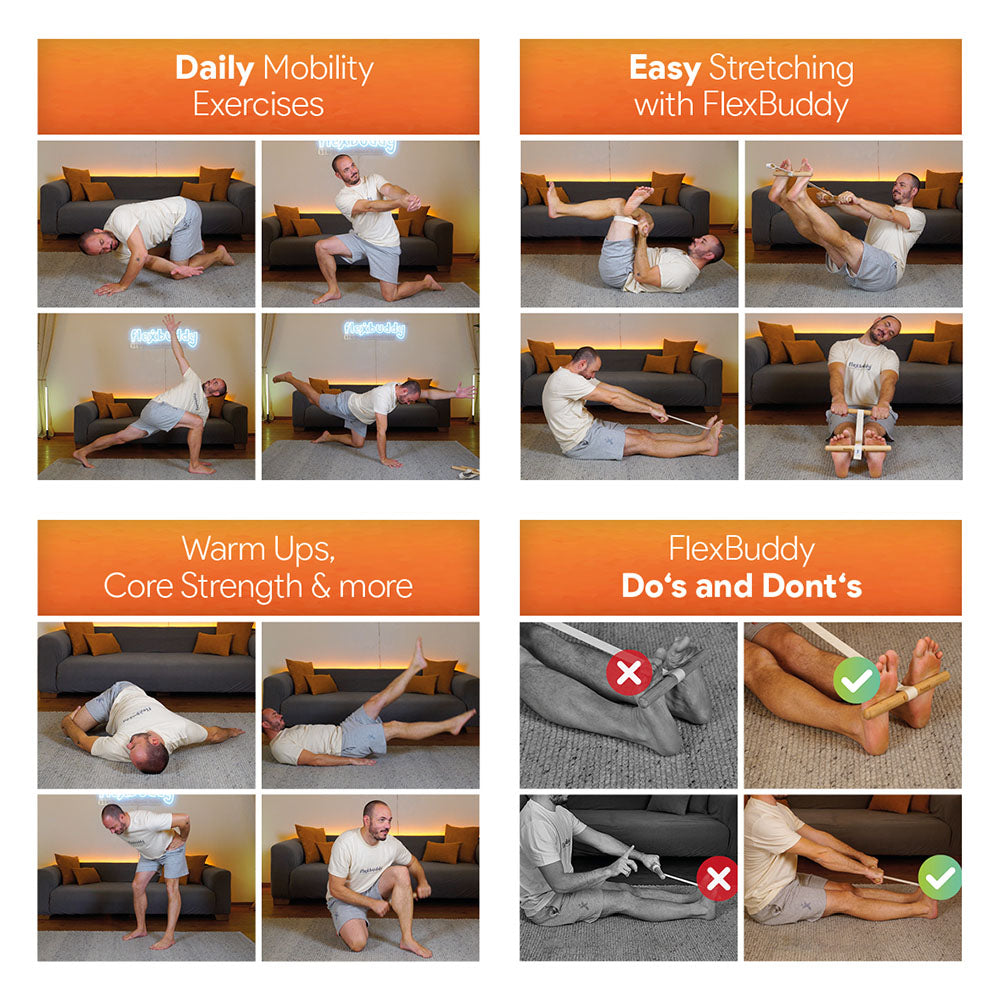
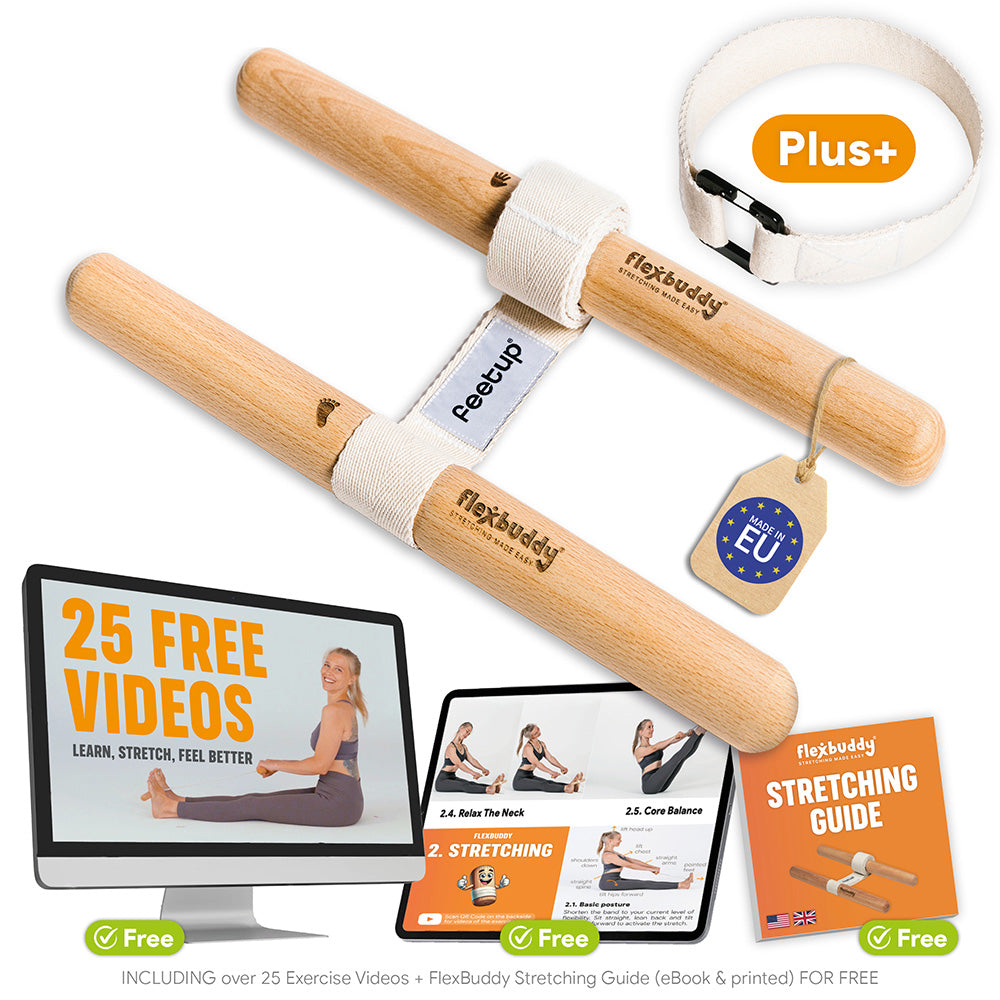
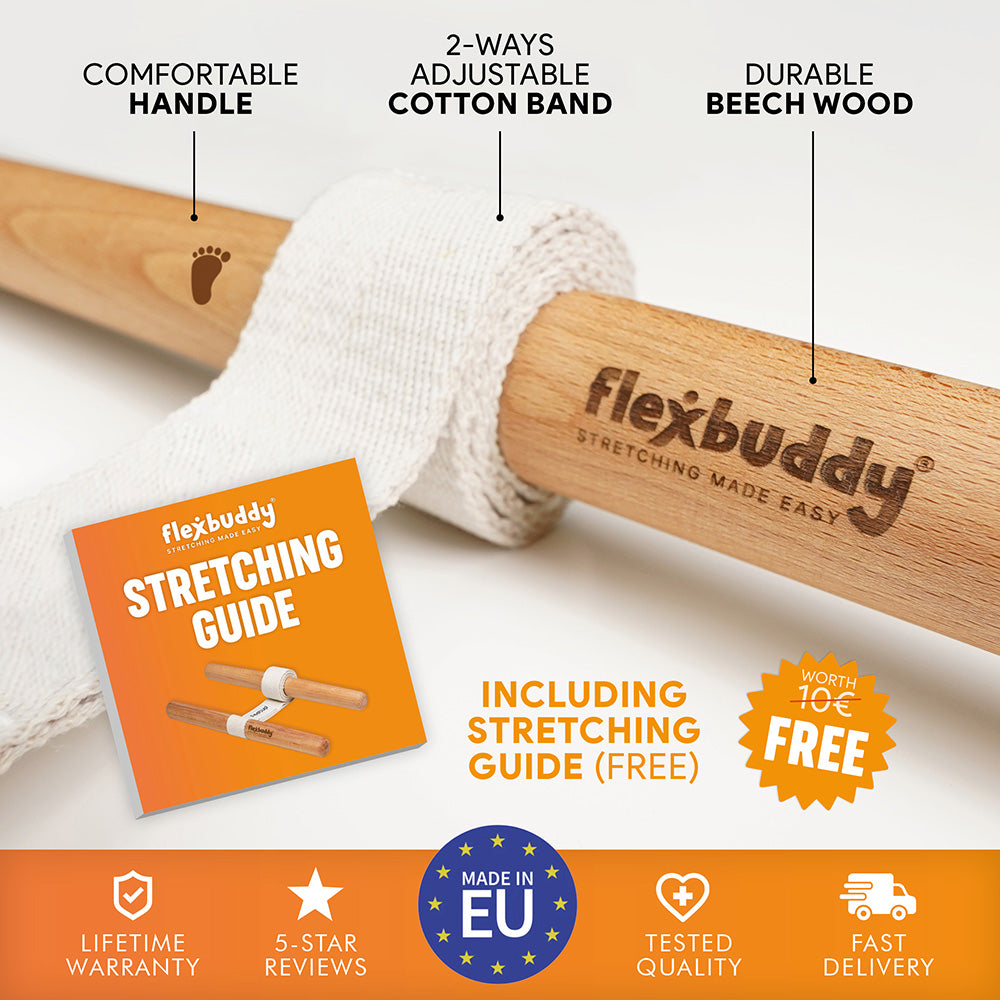
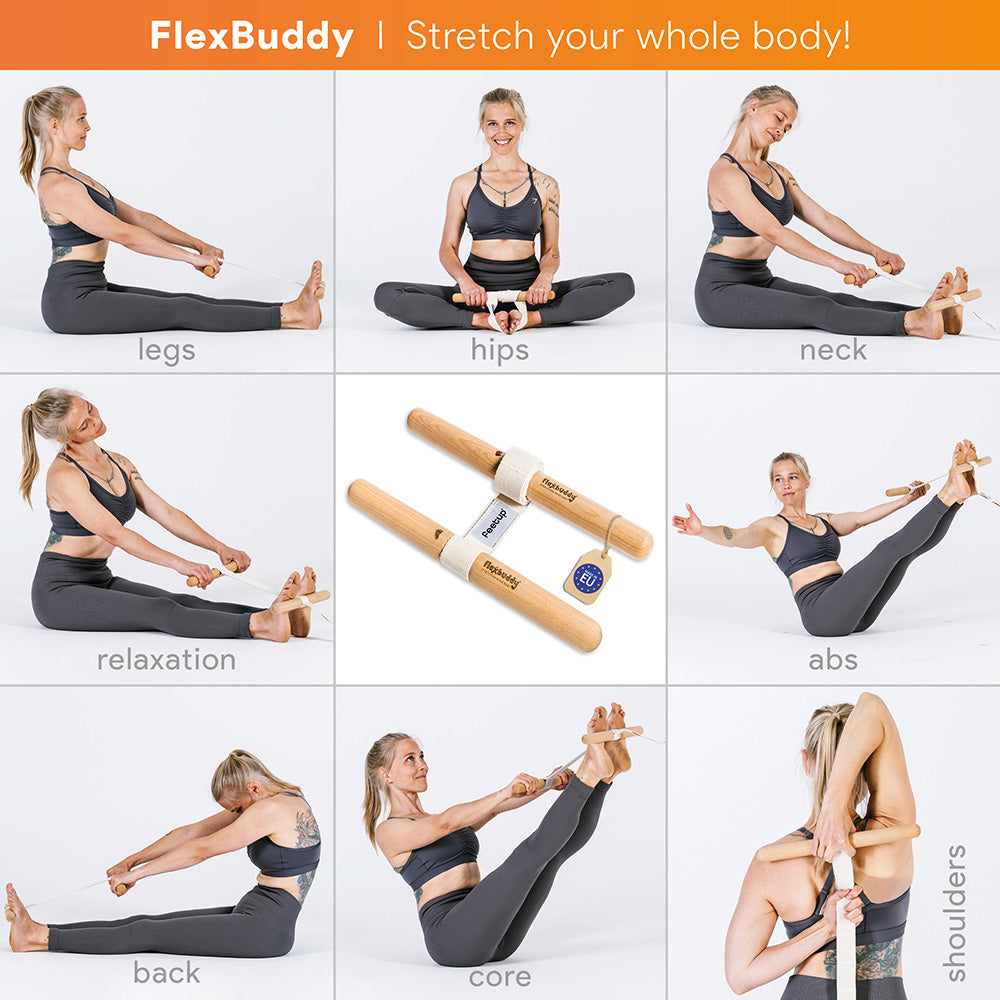
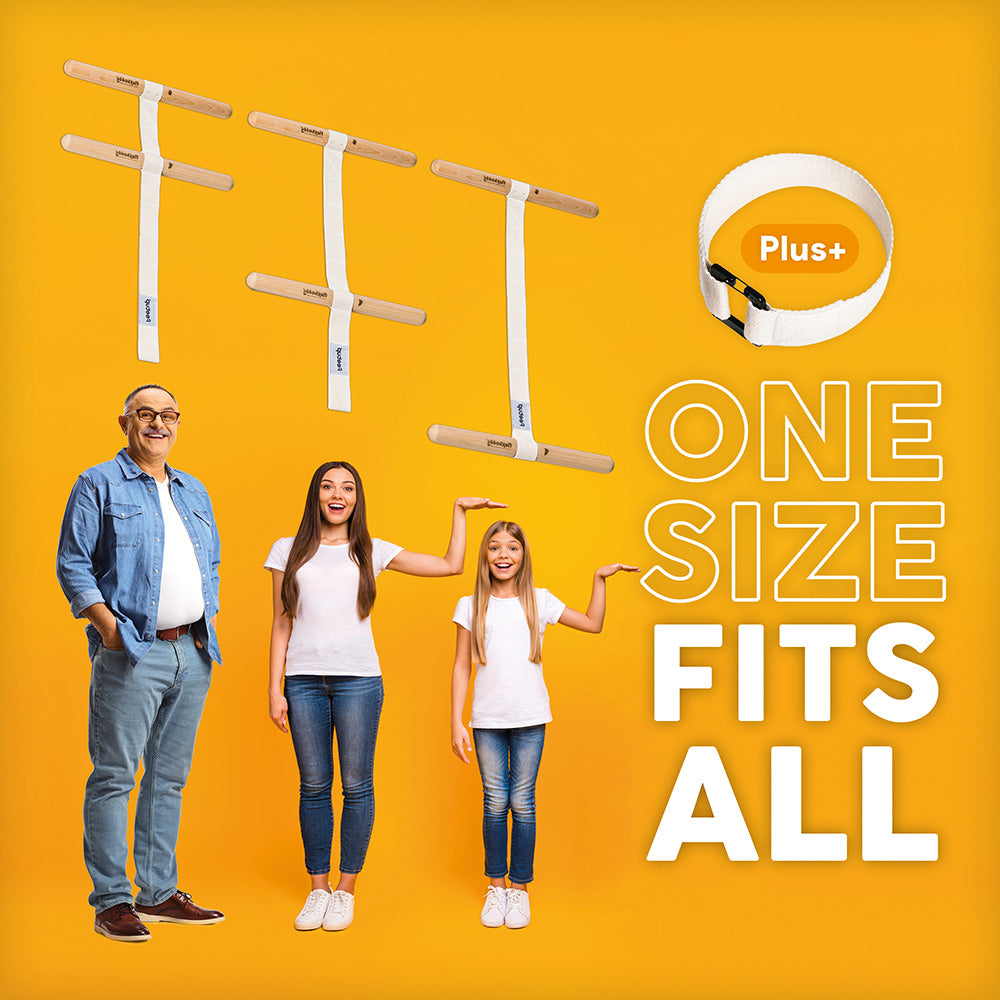
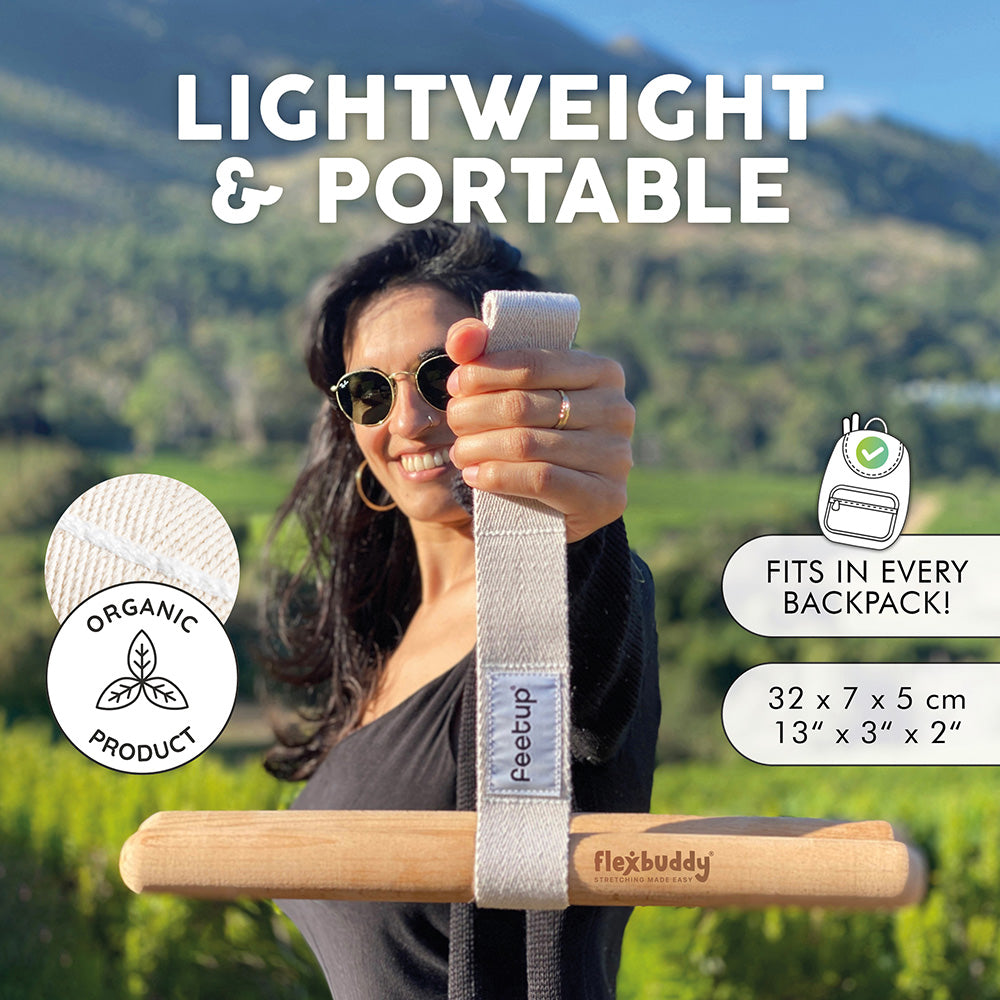
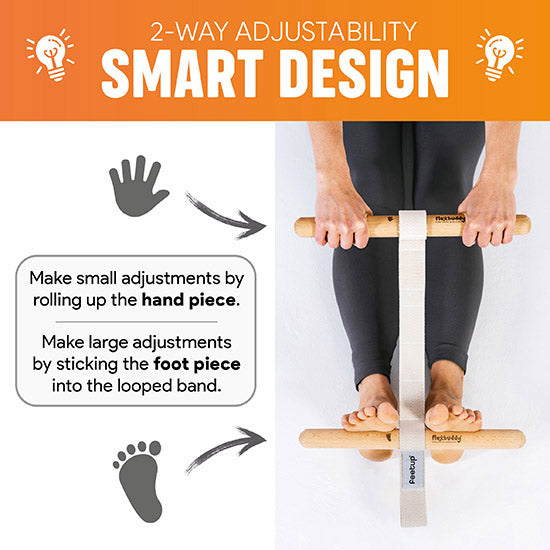
Every stretch in the seated and in-bed routines meets the same obstacle: the moment you reach for your foot, the back rounds and the stretch leaves the leg. FlexBuddy® removes the reach. It is a patented stretching device made of two beech-wood bars joined by an adjustable natural-cotton strap. The foot bar goes under the soles of the feet, the hand bar sits in both hands, and the strap covers the distance. You sit tall on a chair or the edge of the bed, lean back, tilt the hips forward, and the pull arrives in the hamstrings and calves while your spine stays long. No floor, no getting down and up again.
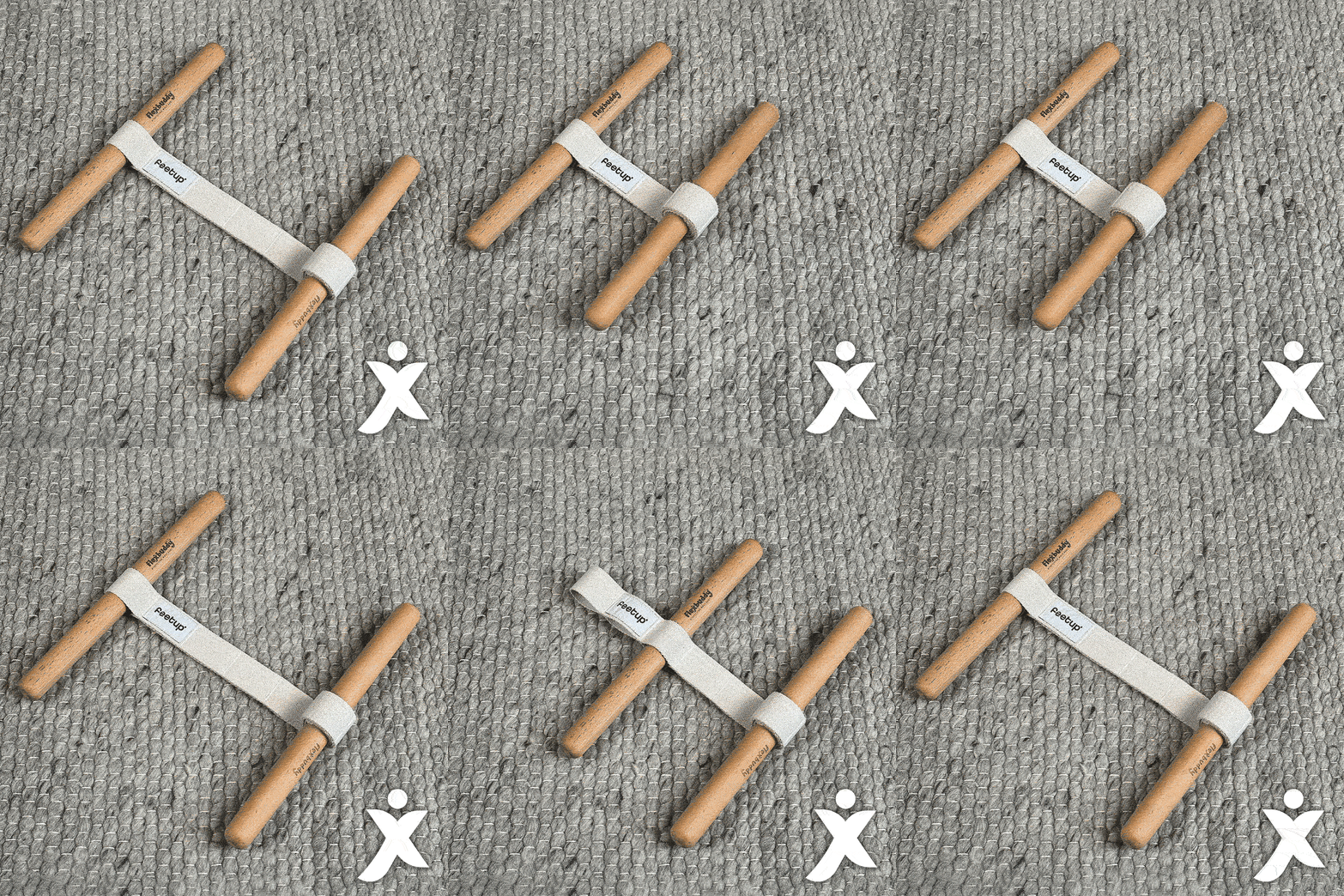
It adjusts to your range: move the foot bar one loop for a big step, or roll the strap around the hand bar for a fine one. The wooden handles do not cut into older hands the way a cord does. Ten slow breaths, twice per leg, takes about two minutes, and two minutes a day can improve your flexibility and posture. Bob J. wrote: "I am 64 and have never touched my toes. FlexBuddy changed that in a week!" It is rated 4.5 by verified buyers and comes with a 30-day money-back guarantee and a lifetime warranty, so you can try it without risk. Get your FlexBuddy, or take the two-minute quiz to find your routine.
Frequently asked questions
Is stretching safe for seniors over 70?
Yes, for almost everyone. The strongest research comes from people far older than 70: the hamstring hold-time trial had an average age of 84.7 and a top age of 97, with no stretch-related harm reported [2]. What changes with age is the method: seated or supported, slow, held 30 to 60 seconds, never into pain. Check with your GP first if you have osteoporosis with spinal fractures, a recent joint replacement, dizziness on standing or a recent fall.
Is there a stretching for seniors PDF I can print?
Yes. The routine table above is the printable version: ten moves, holds and reps on one page. Print the page, or ask us for the one-page A4 version in larger type with space to tick off days, and tape it to the fridge.
Should seniors stretch every day?
Yes, daily is best. It is the most effective frequency, and two to three days a week is the minimum that keeps your range [6][7]. The NHS asks adults over 65 to be active every day, even lightly, with strength, balance and flexibility on at least two days [8]. The in-bed version takes five minutes, and with FlexBuddy on the bedside table it is an easy habit to keep.
What stretches can seniors do in bed?
Ankle pumps, single knee hugs, a lying hamstring stretch with FlexBuddy or a strap round the foot, a lying hip flexor stretch at the edge of the bed and gentle knee rocks. Keep the holds gentle on a soft mattress, and get up in stages, lying to sitting to standing [16].
Does stretching help balance in seniors?
Yes. Trials show stretching lengthens the stride and speeds walking in older adults [3][4], and in one trial a standing flexibility programme improved balance tests as much as strength training did [22]. For fewer falls, add balance and strength exercise, the kind that reduces them [5]. The routine here has both.
Can I stretch with arthritis?
Yes. Exercise is part of osteoarthritis treatment. The NHS warns against doing too much too quickly or the wrong kind, and suggests your GP or a physiotherapist helps plan it [17]. Stretch to a gentle pull, keep the joint within its comfortable range, and rest a joint that is hot or swollen.
This article is general information, not medical advice. Tight muscles usually respond well to regular stretching. If your pain is sharp, radiates down a leg, comes with numbness, weakness, fever, bladder or bowel changes, follows an injury, or keeps getting worse, see a doctor or physiotherapist before you stretch.
References
- Roach KE, Miles TP. Normal hip and knee active range of motion: the relationship to age. Phys Ther. 1991;71(9):656–665. doi:10.1093/ptj/71.9.656. PMID 1881956.
- Feland JB, Myrer JW, Schulthies SS, Fellingham GW, Measom GW. The effect of duration of stretching of the hamstring muscle group for increasing range of motion in people aged 65 years or older. Phys Ther. 2001;81(5):1110–1117. doi:10.1093/ptj/81.5.1110. PMID 11319936.
- Cristopoliski F, Barela JA, Leite N, Fowler NE, Rodacki AL. Stretching exercise program improves gait in the elderly. Gerontology. 2009;55(6):614–620. doi:10.1159/000235863. PMID 19713691.
- Salse-Batán J, González-Devesa D, Duñabeitia I, Bidaurrazaga-Letona I, Ayán-Pérez C, Sanchez-Lastra MA. Effects of stretching exercise on walking performance and balance in older adults: a systematic review and meta-analysis. Geriatr Nurs. 2025;61:479–490. doi:10.1016/j.gerinurse.2024.12.018. PMID 39733629.
- Sherrington C, Fairhall NJ, Wallbank GK, et al. Exercise for preventing falls in older people living in the community. Cochrane Database Syst Rev. 2019;1(1):CD012424. doi:10.1002/14651858.CD012424.pub2. PMID 30703272; PMC6360922.
- Garber CE, Blissmer B, Deschenes MR, et al.; American College of Sports Medicine. Position stand: quantity and quality of exercise for developing and maintaining cardiorespiratory, musculoskeletal, and neuromotor fitness in apparently healthy adults. Med Sci Sports Exerc. 2011;43(7):1334–1359. doi:10.1249/MSS.0b013e318213fefb. PMID 21694556.
- Harvard Health Publishing. The ideal stretching routine. Harvard Medical School, 16 Mar 2026 (reviewed by H. E. LeWine, MD). https://www.health.harvard.edu/staying-healthy/the-ideal-stretching-routine (accessed 4 Nov 2026).
- NHS. Physical activity guidelines for older adults. Last reviewed 15 Aug 2024. https://www.nhs.uk/live-well/exercise/exercise-guidelines/physical-activity-guidelines-older-adults/ (accessed 4 Nov 2026).
- Johnson E, Bradley B, Witkowski K, et al. Effect of a static calf muscle-tendon unit stretching program on ankle dorsiflexion range of motion of older women. J Geriatr Phys Ther. 2007;30(2):49–52. doi:10.1519/00139143-200708000-00003. PMID 18171487.
- Roig M, Macintyre DL, Eng JJ, Narici MV, Maganaris CN, Reid WD. Preservation of eccentric strength in older adults: evidence, mechanisms and implications for training and rehabilitation. Exp Gerontol. 2010;45(6):400–409. doi:10.1016/j.exger.2010.03.008. PMID 20303404; PMC3326066.
- Cruz-Jentoft AJ, Bahat G, Bauer J, et al.; Writing Group for the European Working Group on Sarcopenia in Older People 2 (EWGSOP2). Sarcopenia: revised European consensus on definition and diagnosis. Age Ageing. 2019;48(1):16–31. doi:10.1093/ageing/afy169. PMID 30312372.
- Hoffmann MD, Colley RC, Doyon CY, Wong SL, Tomkinson GR, Lang JJ. Normative-referenced percentile values for physical fitness among Canadians. Health Rep. 2019;30(10):14–22. doi:10.25318/82-003-x201901000002-eng. PMID 31617933.
- Royal Osteoporosis Society. How to exercise safely for bones. Last reviewed 1 Jun 2026. https://theros.org.uk/information-and-support/exercise/how-to-exercise-safely-for-bones/ (accessed 4 Nov 2026).
- NHS. Recovering from a hip replacement. Last reviewed 6 Mar 2024. https://www.nhs.uk/tests-and-treatments/hip-replacement/recovering-from-a-hip-replacement/ (accessed 4 Nov 2026).
- NHS. Falls. Last reviewed 6 Mar 2025. https://www.nhs.uk/conditions/falls/ (accessed 4 Nov 2026).
- NHS. Low blood pressure (hypotension). Last reviewed 11 Jul 2023. https://www.nhs.uk/conditions/low-blood-pressure-hypotension/ (accessed 4 Nov 2026).
- NHS. Osteoarthritis: treatment. Last reviewed 20 Mar 2023. https://www.nhs.uk/conditions/osteoarthritis/treatment/ (accessed 4 Nov 2026).
- Page P. Current concepts in muscle stretching for exercise and rehabilitation. Int J Sports Phys Ther. 2012;7(1):109–119. PMC3273886. https://pmc.ncbi.nlm.nih.gov/articles/PMC3273886/ (accessed 4 Nov 2026).
- NHS. Sitting exercises. Last reviewed 18 Jan 2024. https://www.nhs.uk/live-well/exercise/sitting-exercises/ (accessed 4 Nov 2026).
- Kerrigan DC, Xenopoulos-Oddsson A, Sullivan MJ, Lelas JJ, Riley PO. Effect of a hip flexor-stretching program on gait in the elderly. Arch Phys Med Rehabil. 2003;84(1):1–6. doi:10.1053/apmr.2003.50056. PMID 12589613.
- Rodacki AL, Souza RM, Ugrinowitsch C, Cristopoliski F, Fowler NE. Transient effects of stretching exercises on gait parameters of elderly women. Man Ther. 2009;14(2):167–172. doi:10.1016/j.math.2008.01.006. PMID 18314375.
- Bird ML, Hill K, Ball M, Williams AD. Effects of resistance- and flexibility-exercise interventions on balance and related measures in older adults. J Aging Phys Act. 2009;17(4):444–454. doi:10.1123/japa.17.4.444. PMID 19940323.
- Stathokostas L, Little RM, Vandervoort AA, Paterson DH. Flexibility training and functional ability in older adults: a systematic review. J Aging Res. 2012;2012:306818. doi:10.1155/2012/306818. PMID 23209904; PMC3503322.
- Weppler CH, Magnusson SP. Increasing muscle extensibility: a matter of increasing length or modifying sensation? Phys Ther. 2010;90(3):438–449. doi:10.2522/ptj.20090012. PMID 20075147.