- The spine is stiffest in the first hour after waking: the discs refill with fluid overnight (pressure in one measured disc rose from 0.1 to 0.24 MPa during sleep [1]) and a forward bend loads them far harder early in the morning than later in the day [2]. Morning bed stretches are gentle, lying down, never a hard forward fold.
- Stretching in bed before sleep has evidence: in a randomised trial of 80 adults over 55, nightly calf and hamstring stretches cut night cramps by about 1.2 per night [3], and in people with chronic insomnia four months of stretching improved sleep about as much as weight training [4].
- Each routine takes about five minutes and fits the guideline range: about 60 seconds per muscle group, at least two to three days a week, daily best [5][6].
- The mattress is a good floor for lying stretches and a bad one for balance. Stay on your back, side or all fours.
- Get up in stages, lying to sitting to standing, as the NHS advises anyone who gets light-headed [7]. Pain radiating down a leg, numbness, weakness or bladder and bowel changes mean a doctor first, not a routine.
There are two moments in the day when most of us would rather not move: when the alarm goes, and when we finally lie down. They are also the two moments when a few slow stretches do the most good: the muscles are warm and the body is supported. Below: a wake-up routine and a wind-down routine, both done on the mattress, plus versions for lower back pain, sciatica, tight hips, older bodies and the heel that hurts on the first step. If you already follow a standing morning mobility routine, treat the wake-up sequence as its first two minutes.
Why stretching in bed works, and where it stops working
Friction is the enemy of habits
Most stretching plans fail because they ask for a decision: get up, find the mat, clear a space. A stretch done before getting out of bed asks for nothing. Habit research says a new behaviour sticks fastest when tied to a cue already in your daily routine and repeated there until automatic, which took around 66 days on average in the study behind a British general-practice review; a missed day did no lasting harm [8]. Waking and lying down are the two most reliable cues you own.
The mattress as a floor
For lying stretches a bed is close to ideal. The back is supported along its whole length, nothing digs in, and the muscles are warm from the duvet, the state in which guideline authors say static stretching should be done [9]. A strap takes the pull and the mattress takes the rest, so a full minute's hold costs nothing.
Why mornings are different
Overnight the body does something you cannot feel. Lying down unloads the spine and the intervertebral discs, which are mostly water, slowly draw fluid back in. A pressure sensor implanted in a volunteer's lumbar disc read 0.1 MPa lying flat and climbed to 0.24 MPa over seven hours of sleep [1]. Height follows the same cycle: in one study people were on average 19 mm taller on waking than at bedtime, and more than half of that was lost in the first hour after rising [10]. A fuller disc is a stiffer, more bulging disc [11]. The lumbar spines of 21 volunteers bent 5 degrees less in the early morning than in the afternoon, and combined with cadaver tests this suggested an early-morning forward bend puts about 300 per cent more bending stress on the discs and 80 per cent more on the ligaments than the same bend later in the day; discs and ligaments, the authors concluded, are at greater risk of injury early in the morning [2].
That is why morning stiffness is normal, why it eases within an hour, and why the wake-up routine contains no toe-touching, no hard forward folds and no loaded flexion. It moves the hips, hamstrings and ankles and lets the spine wake up in neutral.
The limits
A soft surface is wrong for anything that needs balance or a firm base: standing stretches, kneeling lunges, downward dog. And half asleep, you will not notice you have passed mild tightness until it hurts. Keep every hold at the level of "I can breathe slowly through this".
Safety in bed: get up in stages, mind the neck, know who should not
Standing up after lying down drops the blood pressure briefly, and after minutes of relaxed stretching the drop can be bigger. The NHS tells people who get light-headed to take care getting out of bed and move slowly from lying to sitting to standing [7]. Make it a rule: legs over the edge, sit for 30 seconds, then stand with a hand on the bedside table. Older readers and anyone on blood-pressure medication should treat this as part of the routine.
Protect the neck. On a soft mattress the head sinks, so keep a thin pillow under it in the twist and chest opener, and never pull the head with your hands.
Who should not do this unsupervised: anyone whose back pain radiates below the knee, comes with pins and needles, numbness or weakness, or started after a fall; anyone with a disc herniation under treatment, recent spinal or hip surgery, or osteoporosis with a previous vertebral fracture. The NHS lists sudden severe back pain, numbness or weakness in both legs, loss of feeling around the genitals and new difficulty passing urine as reasons to seek urgent help, and says not to stay in bed for long periods with back pain [12].
The 5-minute wake-up routine
Do it before your feet touch the floor, in this order. Holds are about 10 slow breaths, roughly 30 seconds: 30 seconds worked as well as 60 for hamstrings in adults in their twenties and thirties [13], while adults over 65 gained range faster with 60-second holds [14]. The ankle work follows the NHS seated-exercise routine, two sets of five per foot [15].
| Stretch | Position | Hold | Reps | What it wakes up |
|---|---|---|---|---|
| Knees to chest | On your back, one knee then both drawn to the chest, hands behind the thighs | 10 breaths | 1 each leg, 1 both | Lower back, glutes |
| Supine hamstring with strap | On your back, other knee bent, strap round the sole of the raised straight leg | 10 breaths (over 65: 60 s) | 2 per leg | Hamstrings, calf |
| Figure-4 | Ankle on the opposite knee, draw that thigh towards you | 10 breaths | 1 per side | Glutes, deep hip rotators |
| Gentle supine twist | Knees bent and together, let them fall a little to one side, shoulders down | 5 breaths | 2 per side | Lower and mid back |
| Ankle pumps and circles | Legs straight, point and flex the feet, then circle | 2 s each | 2 × 5 per foot | Calves, plantar fascia, circulation |
| Cat-cow | All fours on the mattress, or sitting on the bed edge with hands on knees | 1 breath each way | 6–8 rounds | Whole spine, neutral range |
How to do each one
Knees to chest. On your back, draw one knee towards the chest with your hands behind the thigh, not on the kneecap. Let it come a little closer on each out-breath; the lower back should spread onto the mattress, not arch. Change legs, then both together. Unloaded, this is the mildest lumbar flexion there is.
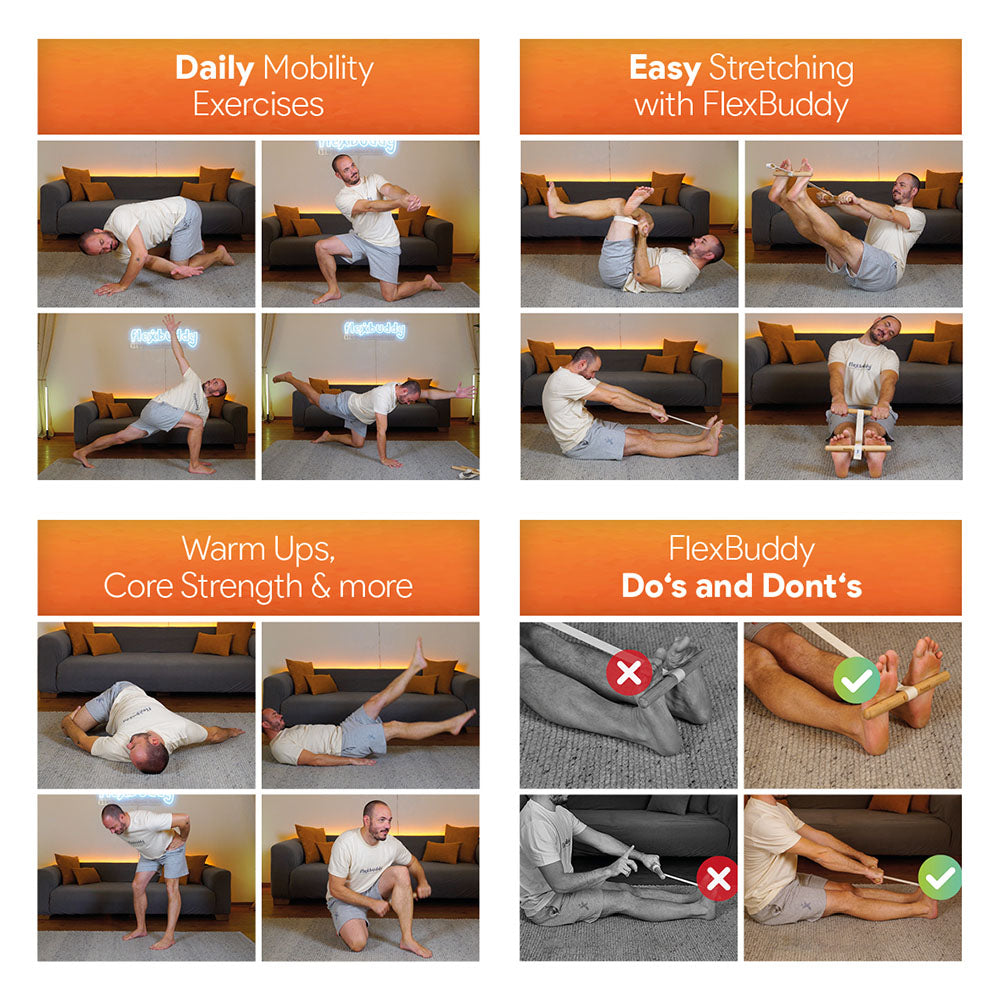
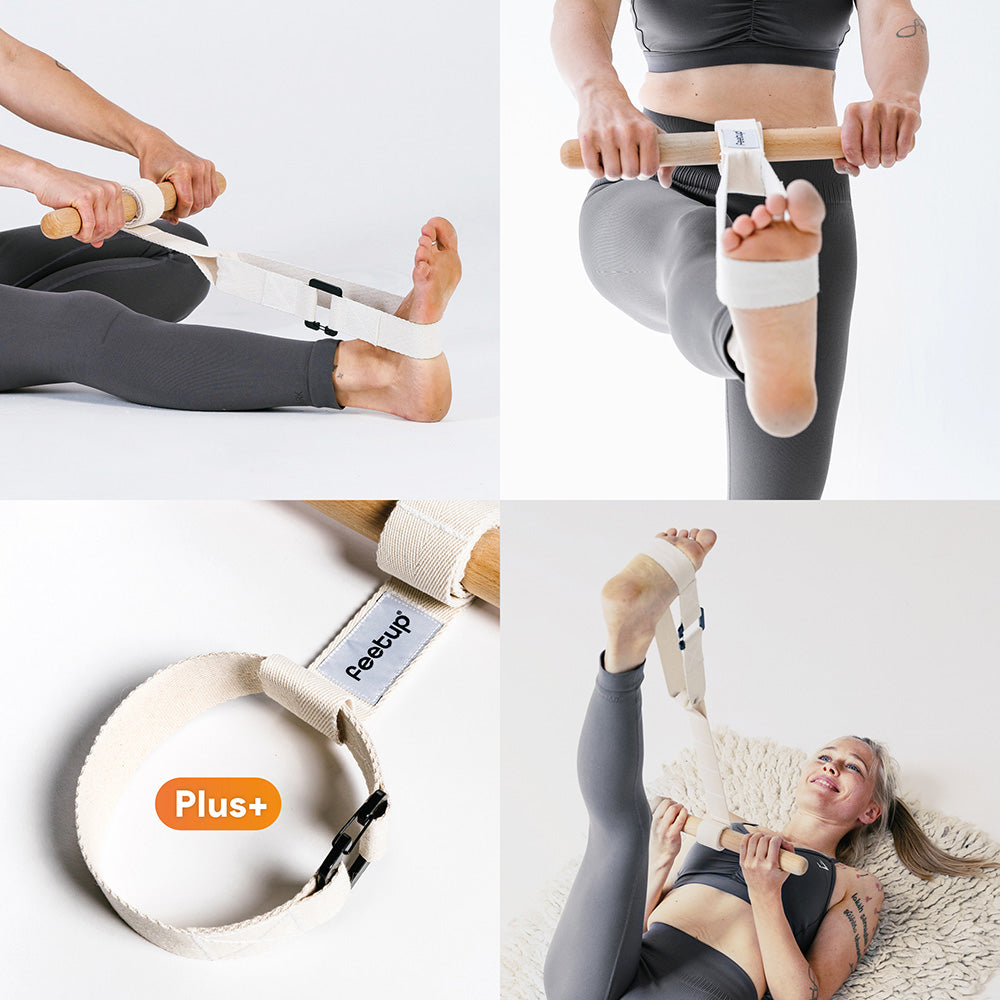
Supine hamstring with a strap. Bend one knee, foot flat. Loop a strap, belt or stretching device round the sole of the other foot and raise that leg, knee straight, until you feel the back of the thigh. If the back lifts or the knee bends, you have gone too far. Two rounds per leg. This is the most useful stretch in the article, and the one FlexBuddy was designed for.
Figure-4. Knees bent, feet on the mattress. Cross the right ankle over the left knee, reach through and hold the left thigh, drawing it towards you until the right buttock feels the stretch. Keep the right foot flexed to protect the knee; loop the strap behind the thigh if you cannot reach it.
Gentle supine twist. Knees bent, feet together, arms out. Let both knees tip a little to the right and stop well before the left shoulder lifts. Five slow breaths, centre, other side. The range is small on purpose: the spine is still full and stiff.
Ankle pumps and circles. Legs straight. Point the toes away, then pull them towards you, holding each end for two seconds; then circle each foot five times each way. If you have plantar fasciitis, add the pre-standing step described further down.
Cat-cow. On all fours, breathe in and let the belly drop while the chest lifts; breathe out and round the back gently. Six to eight slow rounds, never to the end of the range. If kneeling on a soft bed hurts, do the same movement sitting on the bed edge, hands on knees.
Then sit on the edge of the bed for half a minute before you stand [7]. The routine fits the guideline numbers [5][6], and done most days it clears the five minutes a week that a review of 23 studies found necessary for lasting range-of-motion gains [16].
The 5-minute wind-down routine
Here the aim changes: at night you want to lower muscle tension and heart rate. The Sleep Foundation's physician-reviewed guidance recommends static holds rather than dynamic movement at bedtime and advises against vigorous exercise in the two hours before sleep [17].
| Stretch | Position | Hold | Reps | What it settles |
|---|---|---|---|---|
| Child's pose on the bed | Kneel, sit back towards the heels, forehead on the mattress or a pillow | 10 breaths | 1–2 | Lower back, hips, shoulders |
| Supine hamstring and calf | As in the morning; pull the toes towards you for the calf | 10 breaths (over 65: 60 s) | 2 per leg | Hamstrings, calves (cramps) |
| Gentle happy baby | On your back, knees towards the armpits, hold behind the thighs or the strap | 10 breaths | 1 | Inner thighs, hips, lower back |
| Chest opener | On your back, rolled towel lengthways under the spine, arms out at 45 degrees | 10–15 breaths | 1 | Chest, front of shoulders |
| Breathing | One hand on the belly, in for 4 counts, out for 6 | 2 minutes | once | Heart rate, mind |
Child's pose on the bed. Kneel with big toes together and knees apart, sit the hips back towards the heels and walk the hands forward until the forehead rests. A pillow between thighs and calves spares the knees; if kneeling is impossible, knees to chest on your back does the same job.
Supine hamstring and calf. The morning stretch with one addition: once the leg is up, pull the toes towards your face with the strap so the calf joins in, relax, repeat three or four times, then hold. This is the combination from the cramp trial: 80 adults over 55 stretched calves and hamstrings every evening immediately before sleep for six weeks and had on average 1.2 fewer cramps per night, and less painful ones, than people who did nothing [3]. The NHS is more cautious: regular calf stretching may reduce cramps without stopping them completely, and most cramps happen at night or at rest [18].
Gentle happy baby. On your back, draw the knees towards the armpits, holding the backs of the thighs, the ankles, or a strap looped under both feet. Let the lower back stay heavy and the knees fall outward. Gentle means the sacrum stays on the mattress; if it lifts, hold the thighs instead.
Chest opener. Roll a towel into a tube and lie on it lengthways from pelvis to head, thin pillow under the head if the neck arches. Arms out at 45 degrees, palms up, and let the front of the shoulders drop.
Breathing. Towel away, lie flat, one hand on the belly. In through the nose for four, out through the mouth for six. Most people do not reach the end of the two minutes awake.
Versions for your particular problem
For lower back pain
Use the wake-up routine with two changes: knees to chest one leg at a time only, and pelvic tilts instead of the twist (knees bent, press the lower back into the mattress for five seconds, release, ten times). Keep the hamstring stretch: in a 2024 pooling of 14 randomised trials, 735 people with low back pain who stretched their hamstrings reported moderately less pain and better function than controls [19]. Lying with a strap is the back-friendliest version because the spine cannot round. For why sitting makes this worse, see tight hips from sitting and the two-minute daily routine.
For sciatica
Gently, and only once you have been checked. Sciatica is nerve irritation, and an irritated nerve does not want long, hard holds. Keep knees to chest, the figure-4 (which stretches the piriformis, the small muscle the sciatic nerve passes near) and the supine hamstring stretch, but take each only to the point where the leg symptoms do not change; if the leg tingles, burns or goes numb, back off. Skip the twist and happy baby. Our guide to sciatica stretches explains nerve glides, the movement nerve-related tightness responds to, and the red flags that mean stop.
For tight hips
Add a lying hip-flexor stretch to either routine: lie near the edge of the bed, hug one knee to the chest and let the other leg hang off the edge, heavy, for ten breaths; swap sides. Figure-4 and happy baby already cover the glutes and inner thighs; give the side that feels locked an extra round.
For seniors
Everything above applies, with three adjustments. Hold longer: in adults aged 65 to 97 with tight hamstrings, 60-second holds five days a week improved knee extension by 2.4 degrees a week, against 1.3 for 30-second holds and 0.6 for 15 seconds, and the gain lasted longer [14]. Keep the strap, because reaching for the foot is when people round the back or strain a shoulder. And get up in stages, every time [7]. If restless legs keep you awake, the NHS suggests walking, stretching or massaging the legs when symptoms appear, exercising during the day and avoiding strenuous exercise late at night [20]; the wind-down routine fits that advice. The full guide to stretching for seniors covers chairs, balance and life after a hip replacement.
For calves and plantar fasciitis, before the first step
If the first steps of the morning hurt under the heel, stretch before you load it. Still lying down, loop the strap round the ball of the foot and pull the toes towards you for 10 breaths; then sit on the bed edge, cross the sore foot over the other knee and pull the toes back with your hand for another 10 breaths. Only then stand. The NHS calf stretch against a wall, three per side, is the standing follow-up [21]. The full programme, including the strength work the trials found matters most, is in our plantar fasciitis stretches guide.
Does stretching before bed improve sleep? The honest evidence
Exercise in general improves sleep, modestly. A review of three earlier meta-analyses covering 950 adults found a moderate improvement in overall sleep quality (standardised mean difference about −0.50) while rating the evidence low to very low [22]. A review of 13 trials found regular resistance training improved sleep quality most of all, but the effect of a single session was poorly studied and inconsistent [23].
Stretching specifically has far less data. The best trial is small: 28 people with chronic insomnia did four months of resistance training, stretching or nothing. Both exercise groups improved about equally and clearly more than controls; the stretching group's insomnia severity score fell by 8 points, time to fall asleep shortened by about 5 minutes, night waking shrank by about 7 minutes and sleep efficiency rose 5 per cent on wrist actigraphy, with no change on laboratory recordings and less reported tension and anxiety [4]. In women with sleep problems, a meta-analysis of 19 yoga trials with 1,832 participants found a small improvement in sleep quality, but none for women with breast cancer or around the menopause [24].
So the fair summary: a wind-down stretch will not fix insomnia, but in the one trial that tested it, regular stretching improved sleep about as much as lifting weights, and it reliably reduces night cramps in older adults [3]. What it cannot do is compensate for caffeine after midday, screens in bed or an irregular bedtime, the basics the NHS lists alongside stretching for restless legs [20].
What to expect, and how to make it stick
Days to feel it, weeks to measure it. In the first fortnight the change is mostly in what your nervous system tolerates, which research on muscle extensibility attributes to a change in sensation rather than longer fibres [25]. Measurable range comes with weeks of near-daily repetition [16]; the older-adult trial's best group gained about 2.4 degrees of knee extension a week over six weeks [14]. Morning stiffness itself will not disappear, because the disc cycle is physiology, not a fault, but ten minutes of feeling rusty tends to shrink to two or three.
Three habit rules. Keep the strap on the bedside table, so the routine needs no decision. Attach each routine to a cue that already exists, alarm and lights-out, and expect it to feel automatic after a couple of months rather than weeks [8]. And when you miss a night, miss it; one gap does not undo the habit [8].
Doing this with FlexBuddy
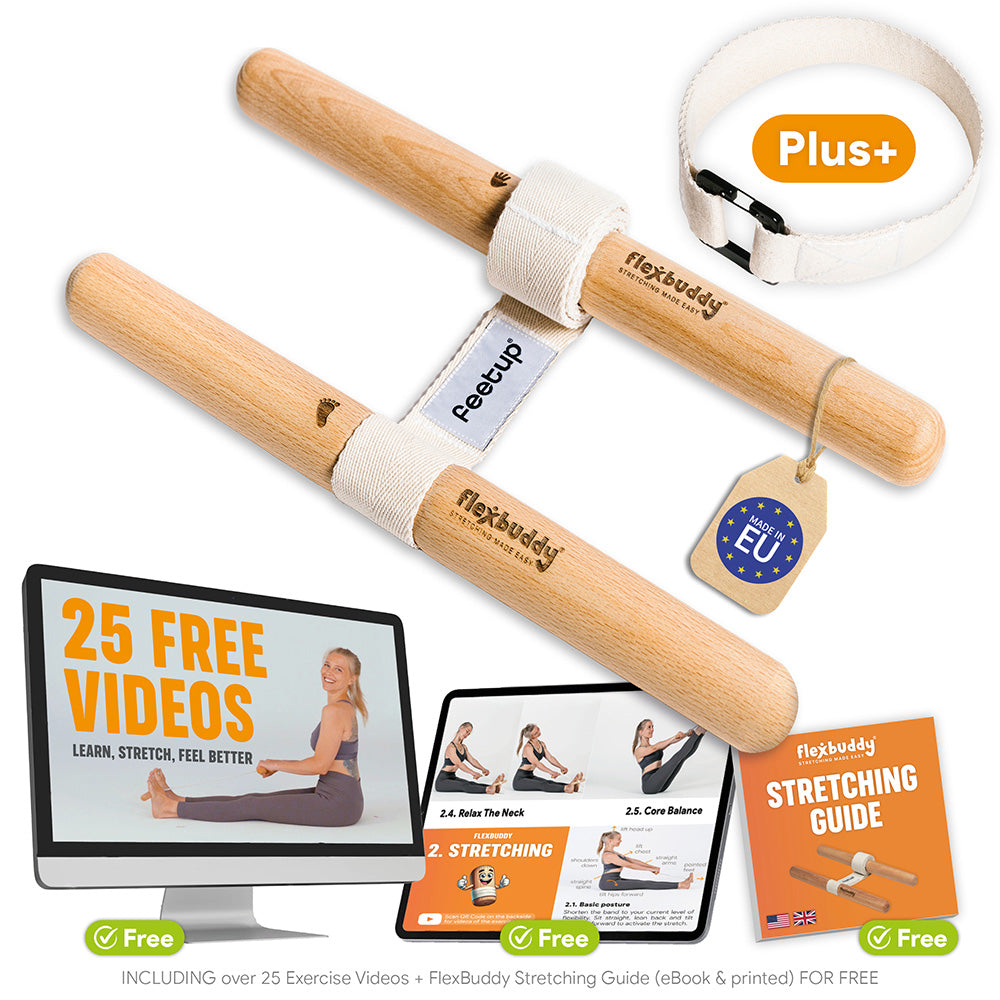
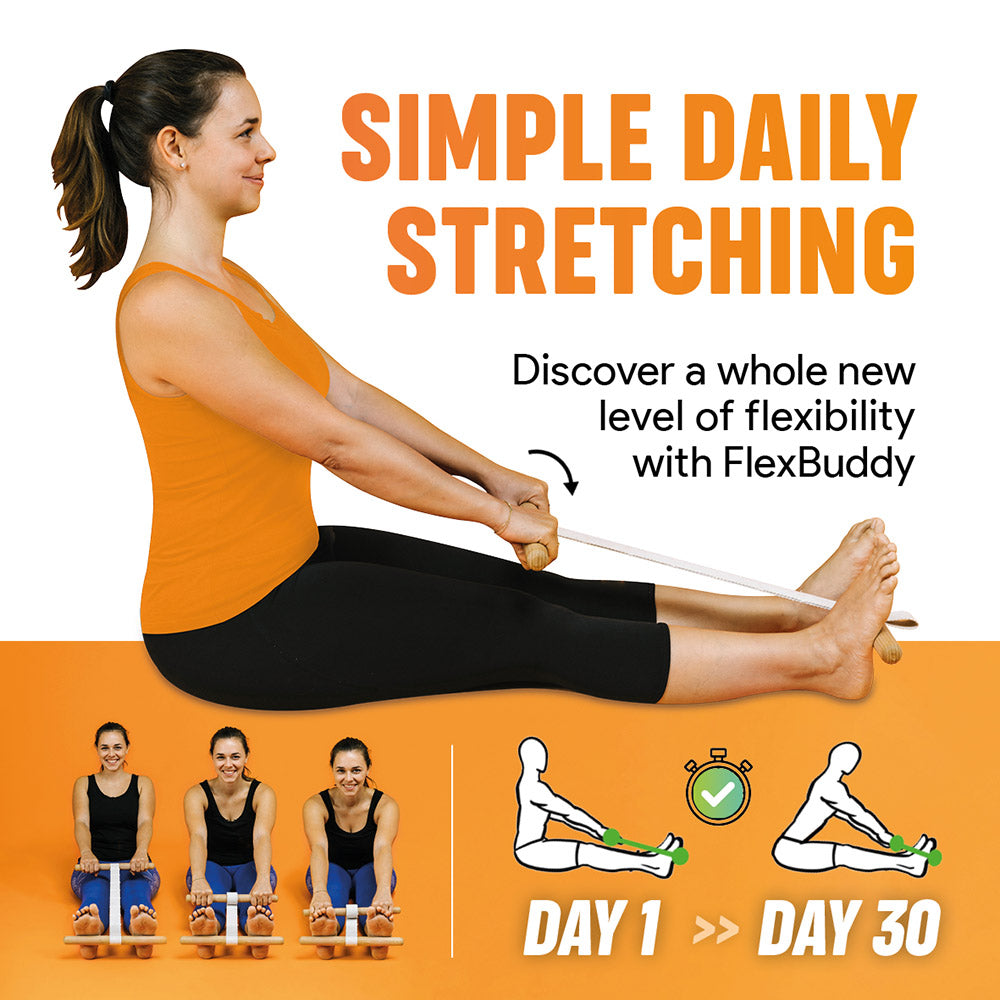
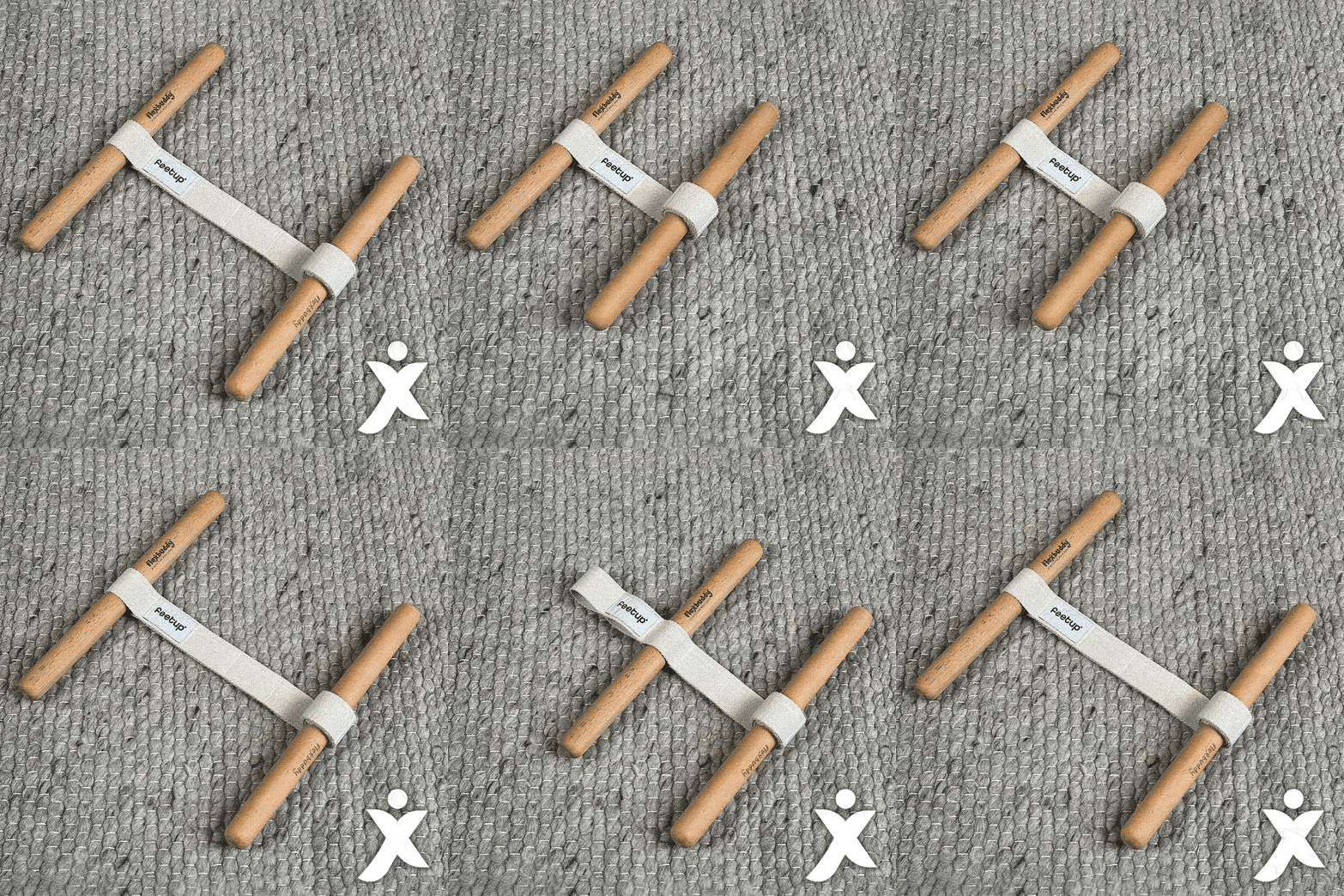
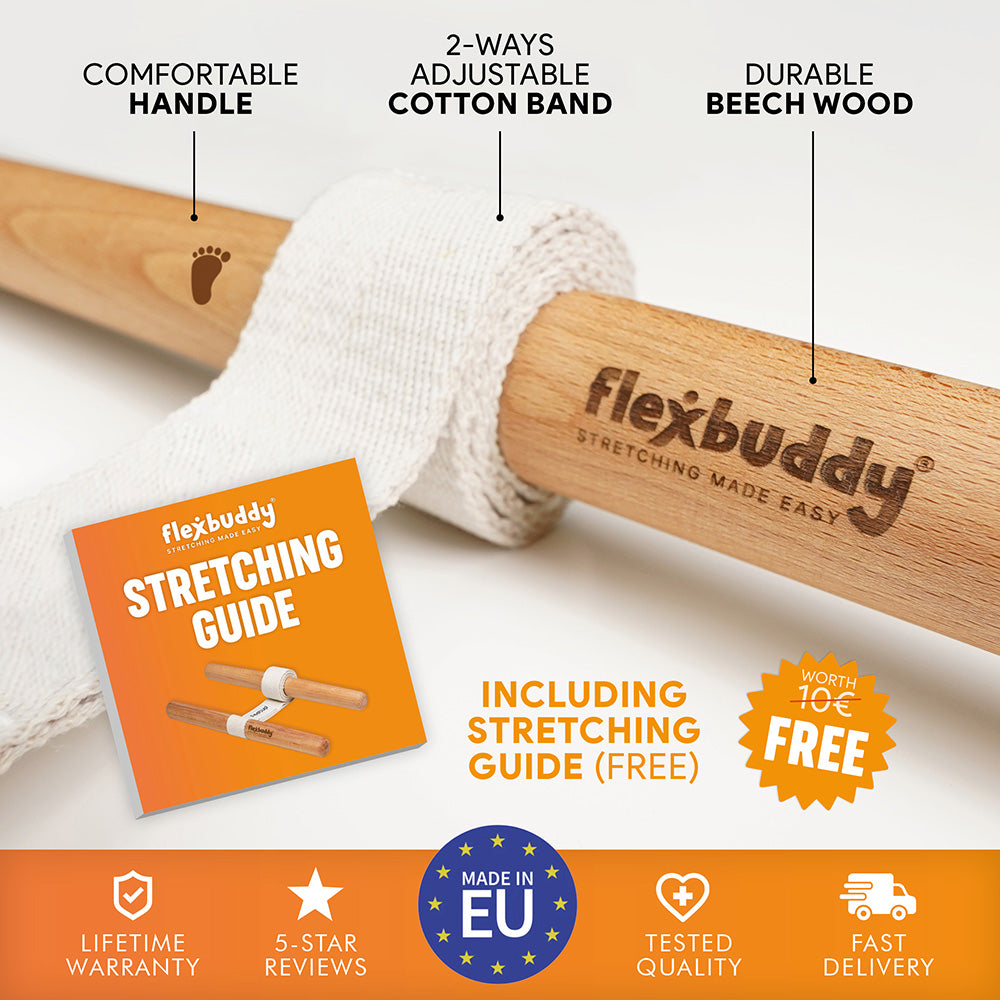
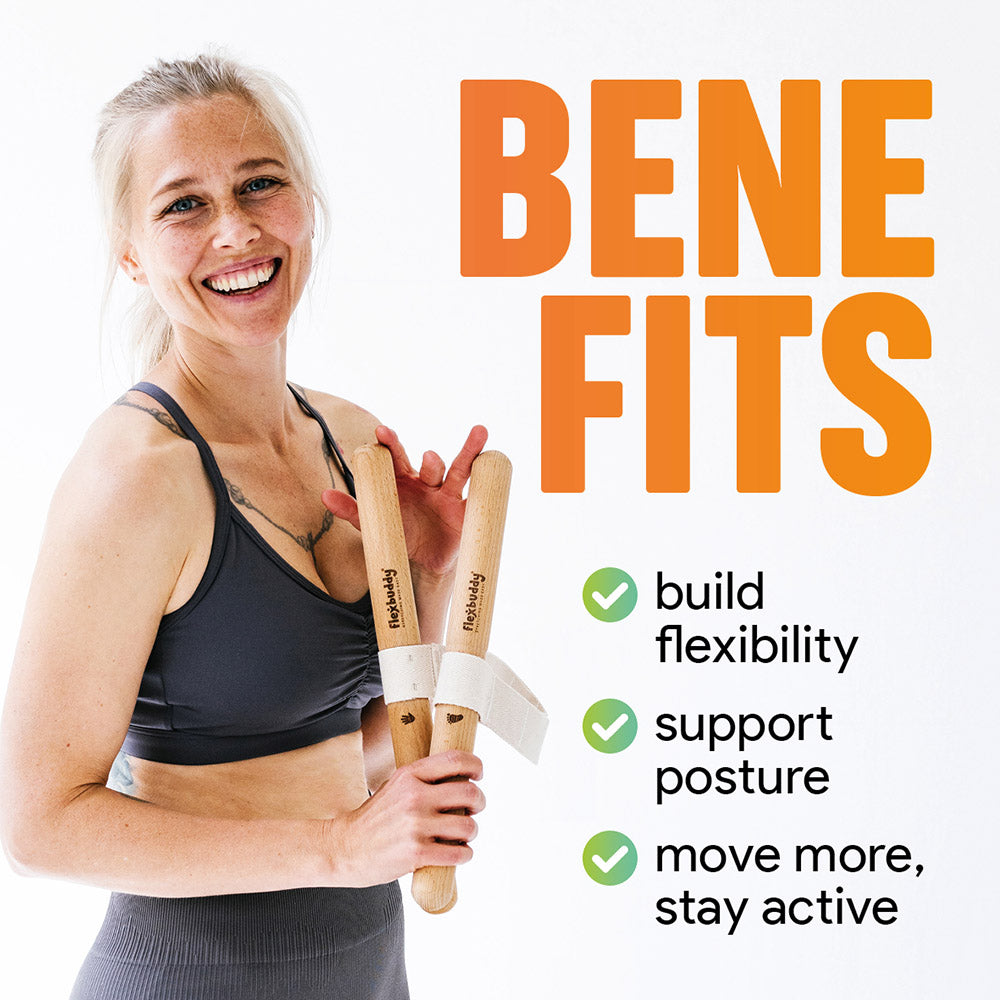
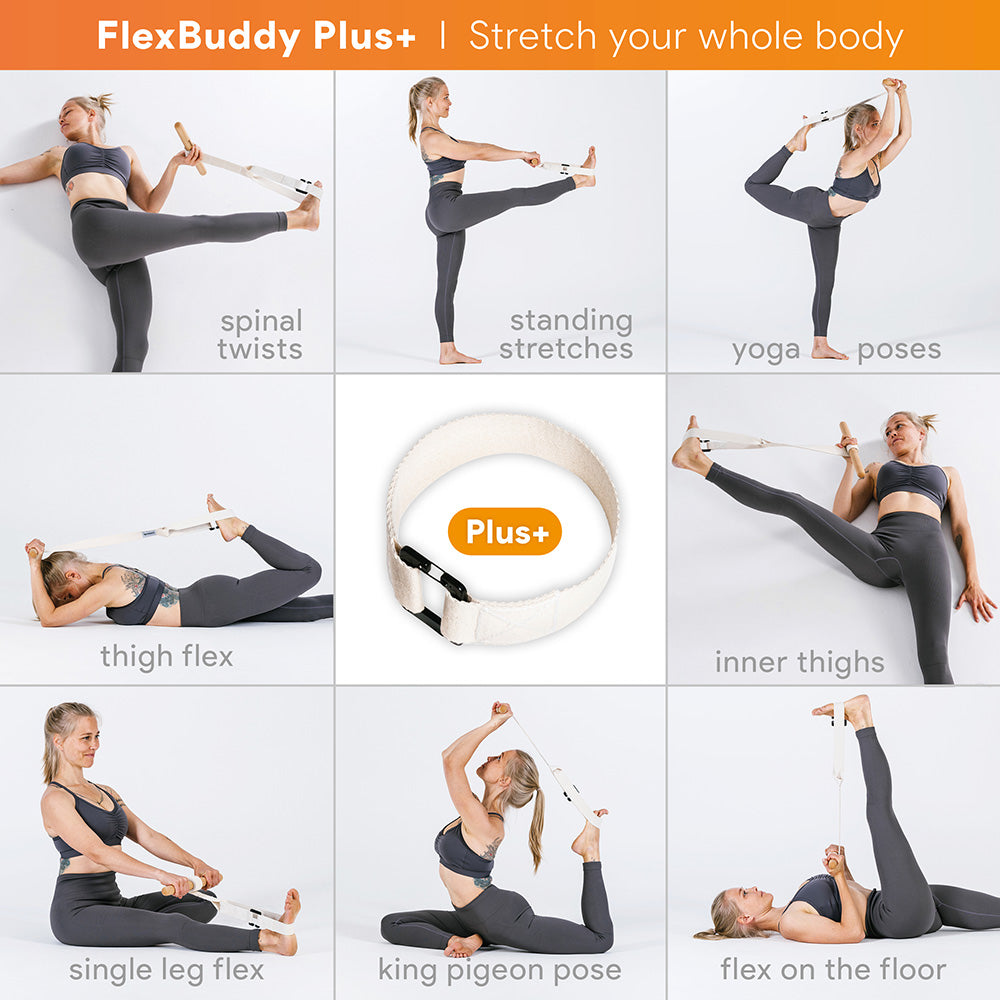
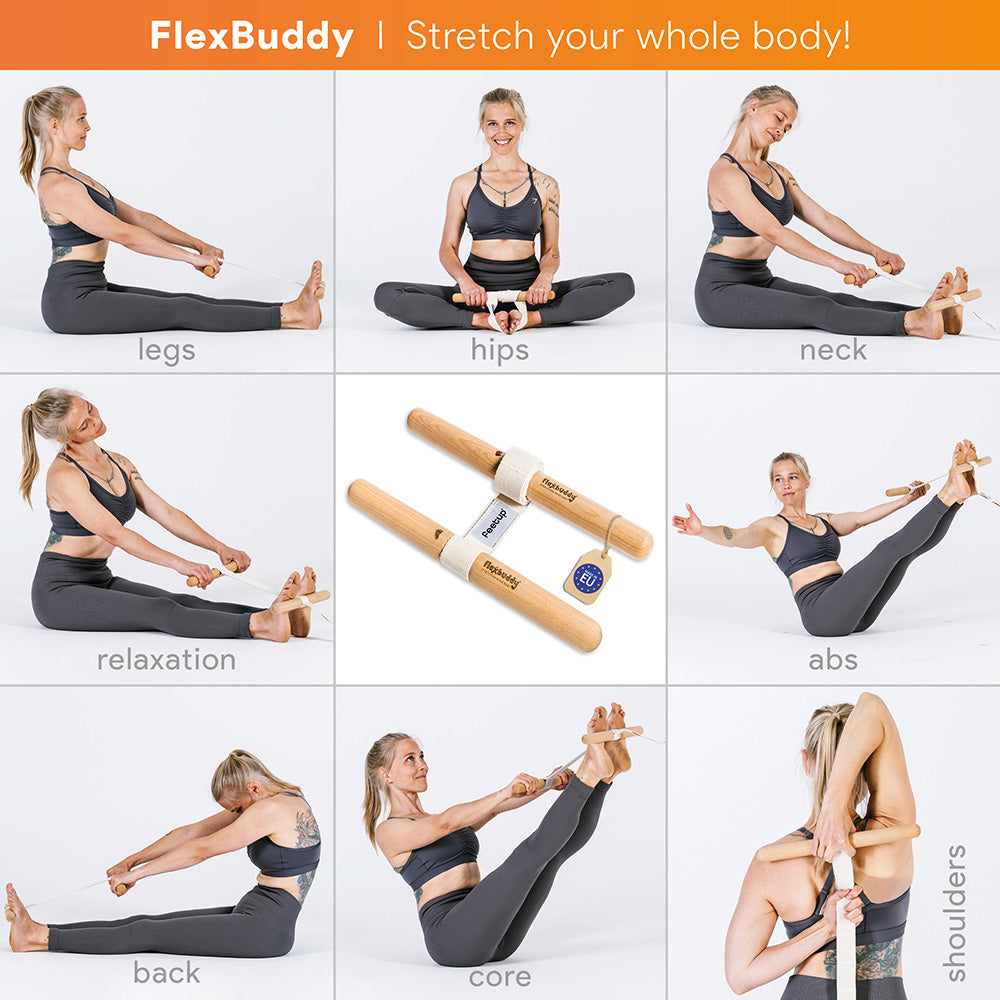
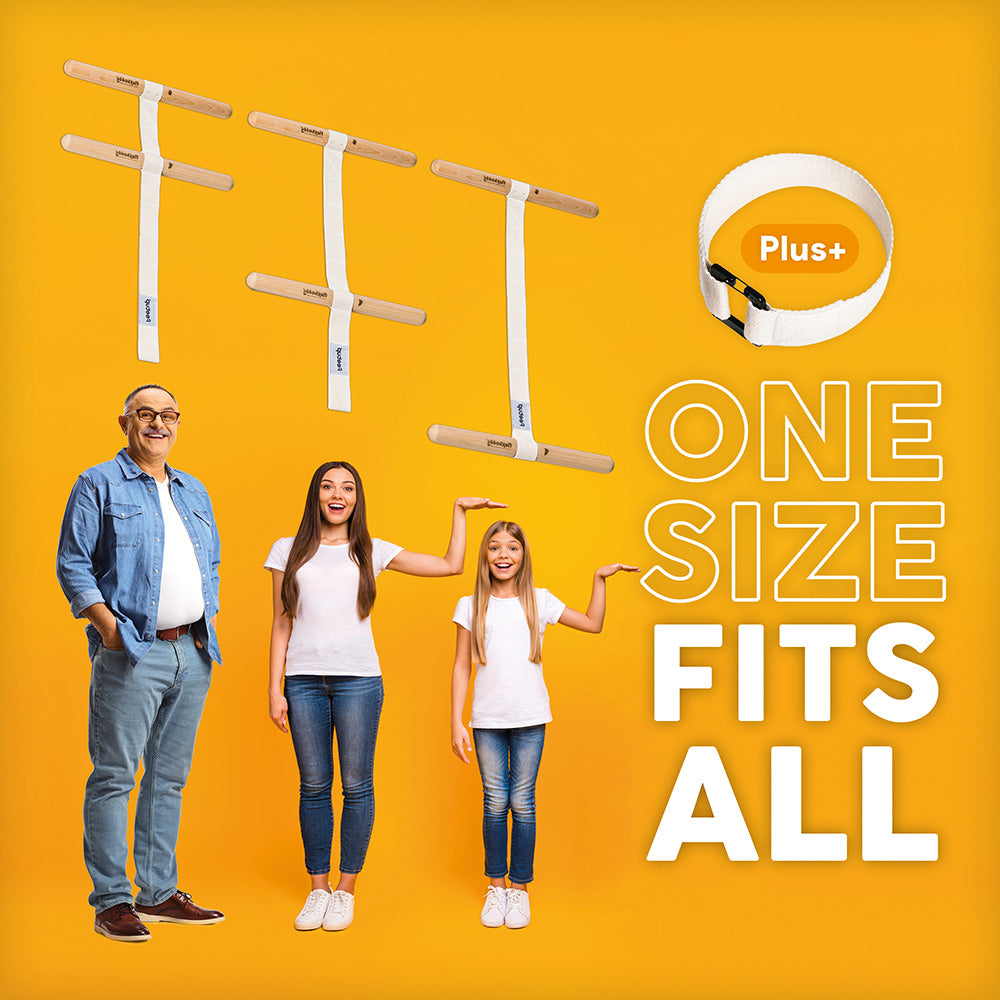
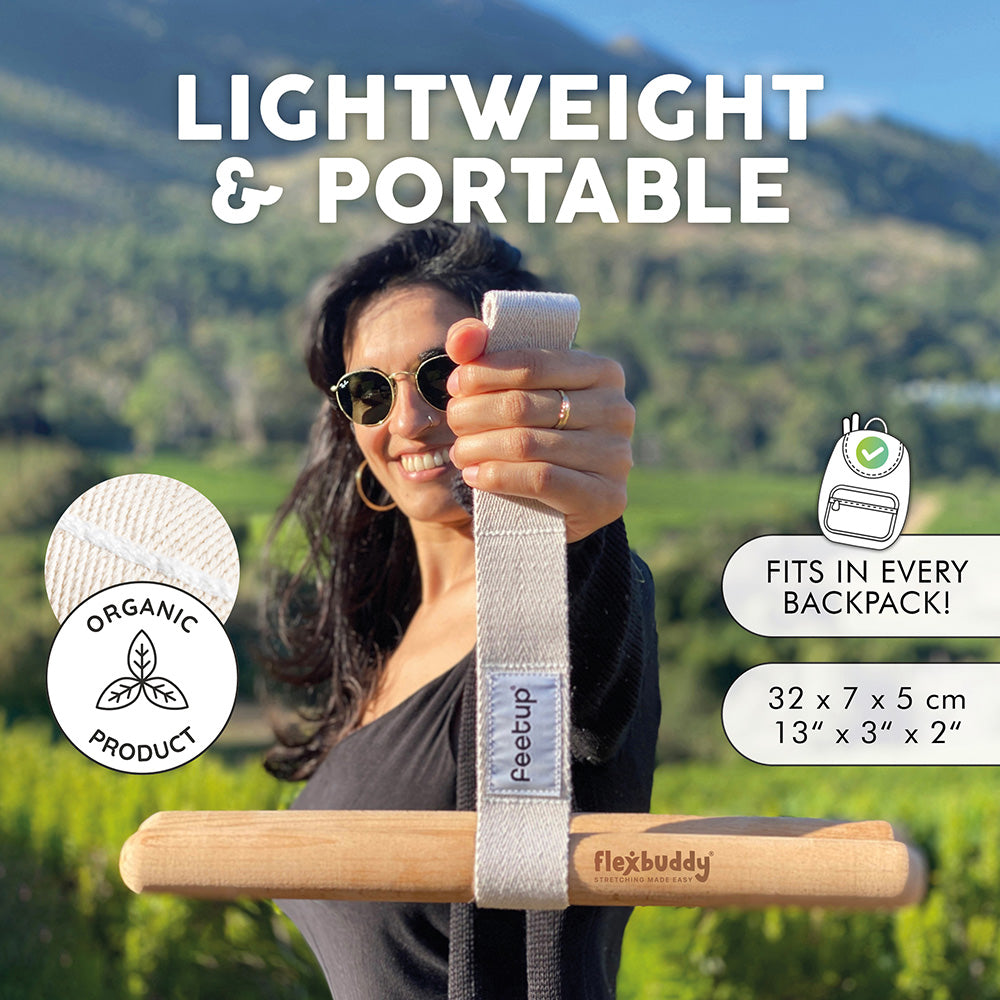
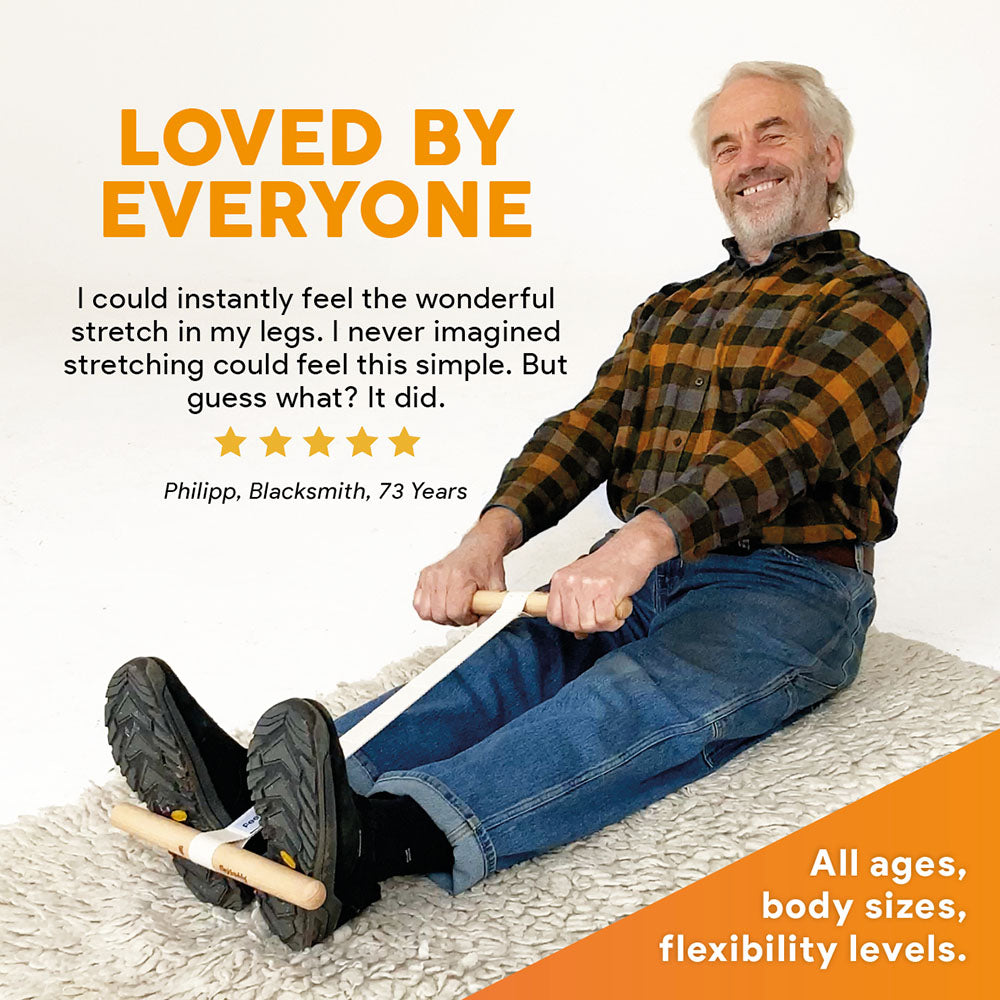
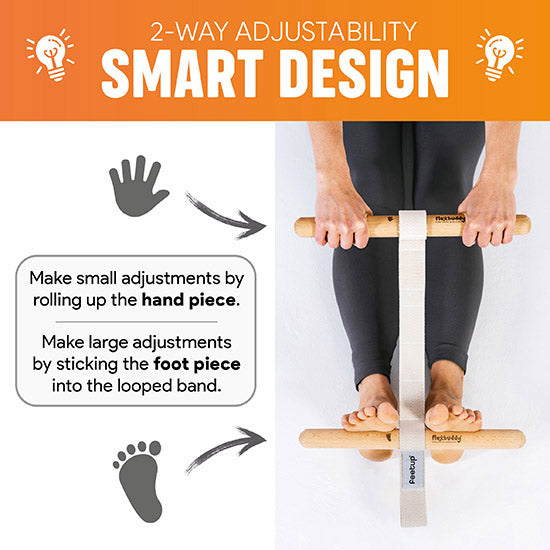
The one stretch both routines depend on is the lying hamstring stretch, and it depends on holding a straight leg steady for a minute without the back lifting or the hands tiring. FlexBuddy® does that job. It is two beech-wood bars joined by an adjustable cotton strap: one bar sits under the sole of the raised foot, the other rests in your hands, and the wooden handles carry the pull so no rope cuts into the fingers. Lying down, you pick the strap loop that brings the leg to mild tightness and stay there for ten breaths; as the weeks pass you move the foot bar one loop shorter. Sitting up against the headboard, the same device holds the basic seated posture, back tall and chest lifted, so the stretch lands in the legs. One Amazon reviewer wrote: "I use it before I go to bed and if I don't, I can really tell a difference in the morning. I think it's helping with plantar fasciitis too." Lifetime warranty, 30-day money-back guarantee. See FlexBuddy, or take the two-minute quiz to find the routine for your kind of stiffness.
Frequently asked questions
What are good stretches to do in bed in the morning?
On your back: knees to chest, a straight leg raised with a strap round the foot, a figure-4 hip stretch, a small twist, ankle pumps, then cat-cow. Hold about 10 breaths each, keep the lower back on the mattress, and avoid hard forward bends in the first hour after waking, when bending stress on the discs is highest [2].
What stretches should I do in bed before sleep?
Slow static holds: child's pose on the mattress, a supine hamstring and calf stretch with a strap, gentle happy baby, a chest opener on a rolled towel and two minutes of slow breathing. Nightly calf and hamstring stretching reduced night cramps by about 1.2 per night in a trial of adults over 55 [3].
Which bed stretches help lower back pain?
Knees to chest one leg at a time, the single-leg hamstring stretch with the back flat, pelvic tilts and a small twist. Trials of hamstring stretching in people with low back pain found moderately less pain [19]. Skip anything that rounds the lower back hard, and get checked first if pain radiates down a leg or comes with numbness, weakness or bladder or bowel changes [12].
Can I do sciatica stretches in bed?
Yes, gently: knees to chest, figure-4 and the supine hamstring stretch, each held short of the point where the leg tingles or burns. Nerve-related tightness responds to gentle movement, not long hard holds. If symptoms are new or spreading, see a physiotherapist or doctor first.
Is it OK to stretch in bed?
For lying stretches, yes: the mattress supports the spine and warm muscles stretch well. Stay on your back, side or all fours, since a soft surface is unsafe for balance poses; avoid loaded forward bending in the first hour after waking [2]; and get up in stages, as the NHS advises anyone who feels light-headed [7].
What are the best bed stretches for seniors?
Lying stretches with the back supported, held for 60 seconds: knees to chest one leg at a time, the strap-assisted hamstring stretch, ankle pumps, a small twist and a chest opener. In adults aged 65 to 97, 60-second holds improved hamstring range faster than shorter ones [14]. Sit on the bed edge before standing.
This article is general information, not medical advice. Tight muscles usually respond well to regular stretching. If your pain is sharp, radiates down a leg, comes with numbness, weakness, fever, bladder or bowel changes, follows an injury, or keeps getting worse, see a doctor or physiotherapist before you stretch.
References
- Wilke HJ, Neef P, Caimi M, Hoogland T, Claes LE. New in vivo measurements of pressures in the intervertebral disc in daily life. Spine. 1999;24(8):755–762. doi:10.1097/00007632-199904150-00005. PMID 10222525 (abstract accessed 4 Nov 2026).
- Adams MA, Dolan P, Hutton WC. Diurnal variations in the stresses on the lumbar spine. Spine. 1987;12(2):130–137. doi:10.1097/00007632-198703000-00008. PMID 3589804 (abstract accessed 4 Nov 2026).
- Hallegraeff JM, van der Schans CP, de Ruiter R, de Greef MH. Stretching before sleep reduces the frequency and severity of nocturnal leg cramps in older adults: a randomised trial. J Physiother. 2012;58(1):17–22. doi:10.1016/S1836-9553(12)70068-1. PMID 22341378 (abstract accessed 4 Nov 2026).
- D'Aurea CVR, Poyares D, Passos GS, et al. Effects of resistance exercise training and stretching on chronic insomnia. Braz J Psychiatry. 2019;41(1):51–57. doi:10.1590/1516-4446-2018-0030. PMID 30328967; PMC6781703 (abstract accessed 4 Nov 2026).
- Garber CE, Blissmer B, Deschenes MR, et al.; American College of Sports Medicine. Position stand: quantity and quality of exercise for developing and maintaining cardiorespiratory, musculoskeletal, and neuromotor fitness in apparently healthy adults. Med Sci Sports Exerc. 2011;43(7):1334–1359. doi:10.1249/MSS.0b013e318213fefb. PMID 21694556 (abstract accessed 4 Nov 2026).
- Harvard Health Publishing. The ideal stretching routine. Harvard Medical School, 16 Mar 2026 (reviewed by H. E. LeWine, MD). https://www.health.harvard.edu/staying-healthy/the-ideal-stretching-routine (accessed 4 Nov 2026).
- NHS. Low blood pressure (hypotension). Page last reviewed 11 Jul 2023. https://www.nhs.uk/conditions/low-blood-pressure-hypotension/ (accessed 4 Nov 2026).
- Gardner B, Lally P, Wardle J. Making health habitual: the psychology of 'habit-formation' and general practice. Br J Gen Pract. 2012;62(605):664–666. doi:10.3399/bjgp12X659466. PMC3505409. https://pmc.ncbi.nlm.nih.gov/articles/PMC3505409/ (accessed 4 Nov 2026).
- Page P. Current concepts in muscle stretching for exercise and rehabilitation. Int J Sports Phys Ther. 2012;7(1):109–119. PMC3273886. https://pmc.ncbi.nlm.nih.gov/articles/PMC3273886/ (accessed 4 Nov 2026).
- Tyrrell AR, Reilly T, Troup JD. Circadian variation in stature and the effects of spinal loading. Spine. 1985;10(2):161–164. doi:10.1097/00007632-198503000-00011. PMID 4002039 (abstract accessed 4 Nov 2026).
- Adams MA, Dolan P, Hutton WC, Porter RW. Diurnal changes in spinal mechanics and their clinical significance. J Bone Joint Surg Br. 1990;72(2):266–270. doi:10.1302/0301-620X.72B2.2138156. PMID 2138156 (abstract accessed 4 Nov 2026).
- NHS. Back pain. Page last reviewed 5 Mar 2026. https://www.nhs.uk/conditions/back-pain/ (accessed 4 Nov 2026).
- Bandy WD, Irion JM, Briggler M. The effect of time and frequency of static stretching on flexibility of the hamstring muscles. Phys Ther. 1997;77(10):1090–1096. doi:10.1093/ptj/77.10.1090. PMID 9327823 (abstract accessed 4 Nov 2026).
- Feland JB, Myrer JW, Schulthies SS, Fellingham GW, Measom GW. The effect of duration of stretching of the hamstring muscle group for increasing range of motion in people aged 65 years or older. Phys Ther. 2001;81(5):1110–1117. doi:10.1093/ptj/81.5.1110. PMID 11319936 (abstract accessed 4 Nov 2026).
- NHS. Sitting exercises. Page last reviewed 18 Jan 2024. https://www.nhs.uk/live-well/exercise/sitting-exercises/ (accessed 4 Nov 2026).
- Thomas E, Bianco A, Paoli A, Palma A. The relation between stretching typology and stretching duration: the effects on range of motion. Int J Sports Med. 2018;39(4):243–254. doi:10.1055/s-0044-101146. PMID 29506306 (abstract accessed 4 Nov 2026).
- Fountain L (medically reviewed by A. Singh, MD). Stretching before bed. Sleep Foundation, last updated 15 Jun 2026. https://www.sleepfoundation.org/physical-activity/stretching-before-bed (accessed 4 Nov 2026).
- NHS. Leg cramps. Page last reviewed 1 Dec 2023. https://www.nhs.uk/conditions/leg-cramps/ (accessed 4 Nov 2026).
- Gou Y, Lei H, Chen X, Wang X. The effects of hamstring stretching exercises on pain intensity and function in low back pain patients: a systematic review with meta-analysis of randomized controlled trials. SAGE Open Med. 2024;12:20503121241252251. doi:10.1177/20503121241252251. PMID 39086556; PMC11289822 (accessed 4 Nov 2026).
- NHS. Restless legs syndrome. Page last reviewed 22 Sep 2025. https://www.nhs.uk/conditions/restless-legs-syndrome/ (accessed 4 Nov 2026).
- NHS. Flexibility exercises. Page last reviewed 20 Nov 2023. https://www.nhs.uk/live-well/exercise/flexibility-exercises/ (accessed 4 Nov 2026).
- Kelley GA, Kelley KS. Exercise and sleep: a systematic review of previous meta-analyses. J Evid Based Med. 2017;10(1):26–36. doi:10.1111/jebm.12236. PMID 28276627; PMC5527334 (abstract accessed 4 Nov 2026).
- Kovacevic A, Mavros Y, Heisz JJ, Fiatarone Singh MA. The effect of resistance exercise on sleep: a systematic review of randomized controlled trials. Sleep Med Rev. 2018;39:52–68. doi:10.1016/j.smrv.2017.07.002. PMID 28919335 (abstract accessed 4 Nov 2026).
- Wang WL, Chen KH, Pan YC, Yang SN, Chan YY. The effect of yoga on sleep quality and insomnia in women with sleep problems: a systematic review and meta-analysis. BMC Psychiatry. 2020;20(1):195. doi:10.1186/s12888-020-02566-4. PMC7193366 (abstract accessed 4 Nov 2026).
- Weppler CH, Magnusson SP. Increasing muscle extensibility: a matter of increasing length or modifying sensation? Phys Ther. 2010;90(3):438–449. doi:10.2522/ptj.20090012. PMID 20075147 (abstract accessed 4 Nov 2026).