- Sitting is a dose, not an injury. In laboratory studies of office work, low-back and hip discomfort reached clinically meaningful levels within two hours of unbroken sitting [6], and lower-leg blood flow fell measurably over a sitting afternoon [8].
- The fix has two parts: break the sitting (a change of posture every 30 to 60 minutes) and undo the day (about two minutes of straight-spine stretching after work). Trials in office workers support both [9][14][16].
- In 563 office workers, daily stretching plus twice-weekly trunk endurance work cut new episodes of low back pain over a year from 19.7% to 8.8% [16].
- Hips, hamstrings, calves and neck are one chain. A chair parks the hip flexors and calves at their shortest length, slackens the hamstrings behind a rounded back, and leaves the neck holding a head that has drifted towards the screen.
- Hold times: about 60 seconds per muscle group per session, in holds of 10 to 30 seconds, at least two to three days a week [17][18]. The eight-exercise routine below fits inside those numbers.
- Standing desks cut sitting time, but fixed standing brings low-back symptoms after about 71 minutes in lab studies [20]. Alternate; do not swap one fixed posture for another.
You can relieve the stiffness from sitting all day with a short set of stretches that target your hamstrings, hips, spine, shoulders and neck. These stretches work best when you do them gently and often, and with FlexBuddy® supporting each position, "gently and often" gets a lot easier, even if you currently feel about as flexible as a filing cabinet. This guide goes further than a routine. It explains what a chair does to your body hour by hour, what the research says about sitting breaks and standing desks, which stretches you can do at your desk without an audience, and how to put the whole day right in two minutes once you get home.
What "sitting all day" actually means
Researchers have a precise definition. Sedentary behaviour is any waking behaviour that uses 1.5 metabolic equivalents or less while sitting, reclining or lying; sitting is "a position in which one's weight is supported by one's buttocks rather than one's feet"; a break is any non-sedentary bout between two sedentary ones [2]. Standing up to fetch water counts. Leaning back in the chair does not. By that definition most of us sit for a living: the NHS notes that many adults spend more than seven hours a day sitting down [1], and the World Health Organization, alongside its 150 minutes of moderate activity a week, says every age group should limit the time spent being sedentary [3].
The "sitting is killing you" headline is half right. In a harmonised analysis of more than a million adults, people who sat more than eight hours a day and were in the least active quarter had a 59% higher death rate over follow-up than those who sat under four hours and were most active; people who sat more than eight hours but were also highly active, roughly 60 to 75 minutes of moderate activity a day, showed no increased risk at all [4]. The chair is not the problem on its own; the chair plus not moving is. The lever is movement, and movement can be small and frequent.
What changes after one, four and eight hours in a chair
These studies are small and mostly laboratory-based, so read the numbers as a direction rather than a rule. The direction is consistent.
The first hour
Discomfort starts early and depends on shape. When ten healthy adults each sat for an hour in three postures, the forward-leaning posture produced the most low-back discomfort, while upright sitting worked the deep abdominal muscles more and loaded the back extensors only moderately [5]. The lesson is not "sit up straight for eight hours", which nobody can do; it is that the slump towards the screen is the most expensive shape and the one to break first.
Two to three hours
Twenty adults did two hours of seated computer work in a laboratory. Discomfort rose in every body region, and in the low back and the hip, thigh and buttock area it crossed the threshold researchers consider clinically meaningful; the lumbar curve flattened, the pelvis fidgeted more, and errors on a creative problem-solving task increased [6]. Your arteries notice too. In twelve young men, dilation of the thigh's main artery fell from 4.7% to 0.5% within the first hour of sitting still, but men who walked slowly for five minutes at 30, 90 and 150 minutes kept their vessel function at baseline across three hours [7]. Five minutes an hour was enough.
Six to eight hours
After six hours of uninterrupted sitting, resting blood flow in the artery behind the knee had dropped markedly and the lower leg's ability to increase flow on demand was 43% lower than before; a ten-minute walk, about a thousand steps, restored it [8]. That pooling is why "sitting all day, swollen ankles" is such a common search. And across a full week, 23 overweight office workers who alternated sitting and standing every 30 minutes for five eight-hour days reported significantly less fatigue and 31.8% less low-back discomfort than in a week of sitting throughout, with no loss of work output [9].
The chain: hips, hamstrings, calves and neck
If you stand up after hours at a desk and feel creaky, you are not broken. You are under-moved. The stiffness has an order to it, and it helps to know which link is doing what.
Hips
The main hip flexor is the iliopsoas: psoas major starts on the lumbar vertebrae, iliacus on the inside of the pelvis, and the two join to attach on the inside of the upper thigh bone; their job is to flex the hip [10]. In a chair the hip sits at about a right angle, so this muscle spends the day at its shortest length and adapts to it, which is why the front of your hips can feel tight when you finally stand, and why the pelvis tips forward, which often pairs with an achy or guarded lower back. The hip side has its own guide: tight hips from sitting.
Hamstrings
The hamstrings run from the sitting bone to just below the knee [11]. They attach to the pelvis, so when they feel short, your pelvis may not tilt as freely when you bend. That can turn everyday moves, picking up a bag, loading the dishwasher, into a lower-back job instead of a hip job.
One honest caveat. The folk story says sitting shortens the hamstrings; the evidence is weaker than the story. In 508 adults aged 20 to 65, work setting and lifestyle did not predict hamstring length, although people with chronic low back pain had shorter hamstrings whatever their job [12]. Short hamstrings and back pain travel together, and stretching them is worth doing, but the chair alone is not a guaranteed hamstring-shortener. What it reliably trains is the rounded-back bend, the habit the hamstrings and back pain guide is about; the back itself is covered in lower back pain from sitting.
Calves
The calves are the least discussed link and the most measurable one. With the feet flat and still under a desk, the calf never contracts, so it never pumps blood back up the leg; that is the mechanism behind the six-hour drop in lower-leg blood flow and its recovery after a short walk [8]. Calf raises at the desk and a calf stretch at home are the two cheapest fixes in this article.
Neck and shoulders
Sitting tends to pull your shoulders forward and keep your upper back relatively still. The thoracic spine likes motion. When it gets less of it, you may notice stiffness between the shoulder blades or a neck that feels overworked by late afternoon. The research on office neck pain points at habits rather than anatomy: a meta-analysis of ten cohort studies and two trials found that low variation in work tasks, a keyboard close to the body and low satisfaction with the workplace each raised the risk of neck pain by roughly a quarter to a half [13]. "Low task variation" means you did not move. For the head-forward shape itself, see what actually works for posture.
Sitting breaks: what the evidence supports
The advice to get up regularly is old; the question is whether it does anything for pain. A 2018 systematic review pooled eight randomised and three non-randomised controlled trials of breaks in office workers, with programmes ranging from a break every five minutes to one every two hours. The evidence that breaks reduce pain was low quality and conflicting, but for active breaks involving a change of posture the reviewers found moderate-quality evidence of benefit for both pain and discomfort, and moderate-quality evidence that breaks did not harm productivity [14].
A later trial from the same group followed 193 office workers at high risk of neck and low back pain for a year. Those prompted to take active breaks or to shift posture recovered from pain episodes in a median of one month instead of two, with recurrence rates of 21% and 18% against 44% with a placebo seat pad [15]. The same team's prevention trial assigned 563 healthy office workers with below-normal trunk flexibility or endurance to daily stretching plus twice-weekly endurance training or to nothing: 8.8% of the exercise group developed low back pain over twelve months against 19.7% of controls, a hazard ratio of 0.37 [16]. The American College of Sports Medicine folds this into one sentence: there are health benefits in "interspersing frequent, short bouts of standing and physical activity between periods of sedentary activity, even in physically active adults" [17].
The practical rule: every 30 to 60 minutes, stand up for one to two minutes and change shape. Walk to the kitchen, do one of the desk stretches below, take a call standing. A postural change beats a passive pause. Set a timer for the first fortnight; after that the stiffness itself becomes the timer.
Desk stretches that don't look ridiculous
You will not do a floor routine in an open-plan office, and you do not need to. The moves below look like reaching for a dropped pen or taking a call standing up, need no equipment, and each is a posture change, which is exactly what the break evidence rewards [14].
| Stretch | How | Hold | Targets |
|---|---|---|---|
| Seated hip hinge | Front edge of the chair, one leg straight, heel on the floor; back long, tip forward from the hips until the back of the thigh pulls | 20–30 s per leg | Hamstrings, without rounding the back |
| Seated figure-four | Ankle on the opposite knee, sit tall, lean forward from the hips | 20–30 s per side | Outer hip, glutes |
| Standing half-lunge | Step one foot back, tuck the tailbone under, squeeze the rear glute; hands on the desk | 20–30 s per side | Hip flexors |
| Chair twist | Sit tall, hand on the opposite knee, turn from the ribcage | 3–5 breaths per side | Mid-back rotation |
| Neck side-bend | Hold the seat with one hand to anchor that shoulder, tilt the ear to the opposite shoulder | 20–30 s per side | Upper trapezius |
| Chest opener | Standing, clasp hands behind the back, lift the chest, draw the hands down | 20–30 s | Chest, front of shoulders |
| Calf raises | At the desk, rise onto the toes and lower slowly | 15–20 reps | The calf pump [8] |
Pick two per break and rotate through the list. The holds sit inside the guideline range of 10 to 30 seconds [17][18], so you accumulate the 60 seconds per muscle group across the day. None of this replaces the after-work routine; it stops the dose from building up until then.
The FlexBuddy desk routine: eight exercises
Use this list like a menu, not a test. Pick three to five exercises and do them after work, during a break or before bed. If you only have two minutes, do two stretches and call it a win. A simple format that works for most beginners: hold each stretch 20 to 30 seconds, breathe slowly, then repeat once, which gives each muscle group its 40 to 60 seconds per session [17][18]. Three rules keep desk stretches helpful instead of annoying:
- Never force end range. You want mild, steady tension, not shaking, pinching or sharp pain. With FlexBuddy, depth is controlled by how you hold the handles, so backing off is as easy as relaxing your grip.
- Exhale into the stretch. A longer exhale often lets you soften without pushing harder.
- Anchor it to a habit. Stretch right after you shut your laptop, or while your coffee brews. Keep FlexBuddy next to the desk, not in a cupboard.
Every exercise below is demonstrated in the free FlexBuddy video library; the full set is catalogued in FlexBuddy exercises for back, hips and shoulders.
The routine at a glance
| Exercise | Targets | Time | Best for |
|---|---|---|---|
| 1. Hamstrings Warm Up | Hamstrings, lower back | 30–45 s | Starting cold, stiff legs |
| 2. Static Stretch | Hamstrings | 20–40 s | Releasing the backs of the thighs |
| 3. Inside Thigh Stretch | Inner thighs, hips | 20–30 s per side | Hips locked from sitting |
| 4. Basic Posture | Whole back, posture | 30–60 s | Back decompression |
| 5. Spinal Twist | Mid-back rotation | 3–5 breaths per side | Stiffness between shoulder blades |
| 6. Relax The Neck | Neck, upper traps | 20–30 s per side | Late-afternoon neck tension |
| 7. Shoulder Opener | Chest, front shoulders | 5–8 reps | Rounded desk shoulders |
| 8. Wrist Warm Up | Wrists, forearms | 20–30 s per direction | Keyboard hands |
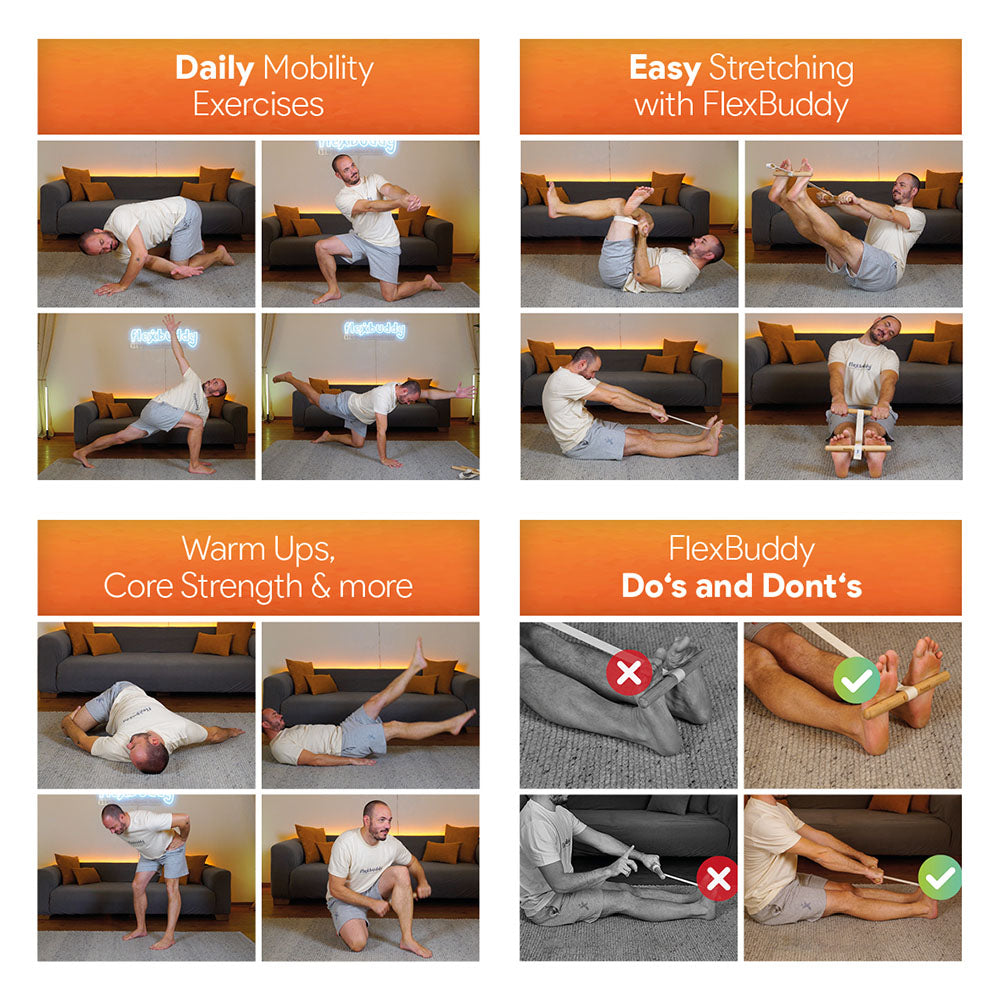
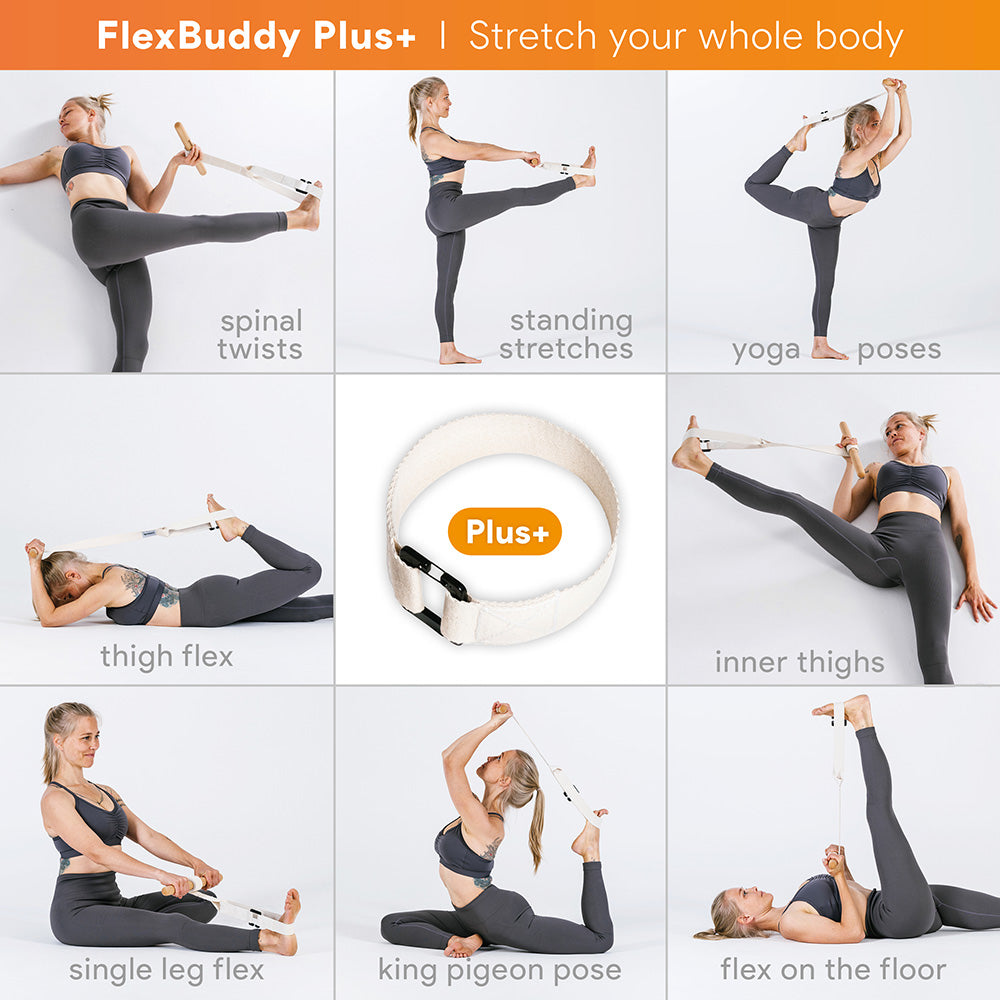
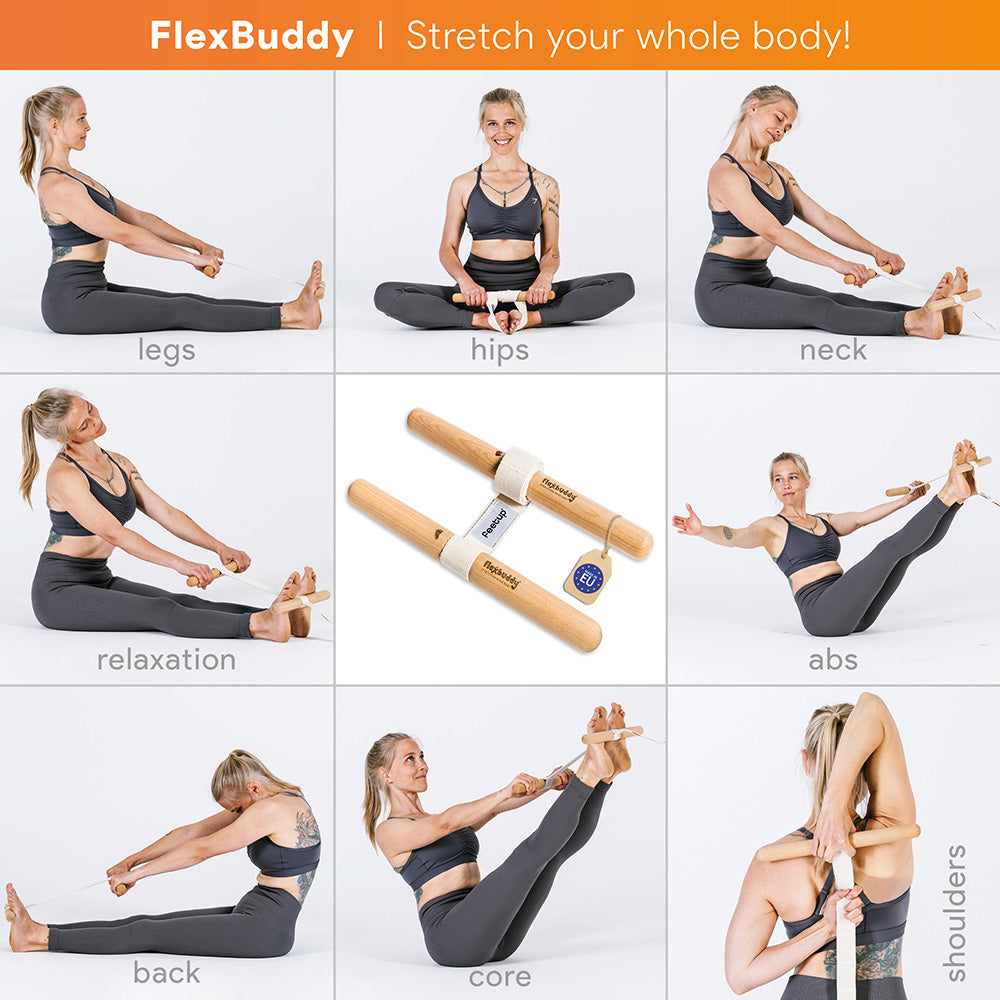
1. Hamstrings Warm Up
The smartest place to start, because cold hamstrings are stubborn hamstrings.
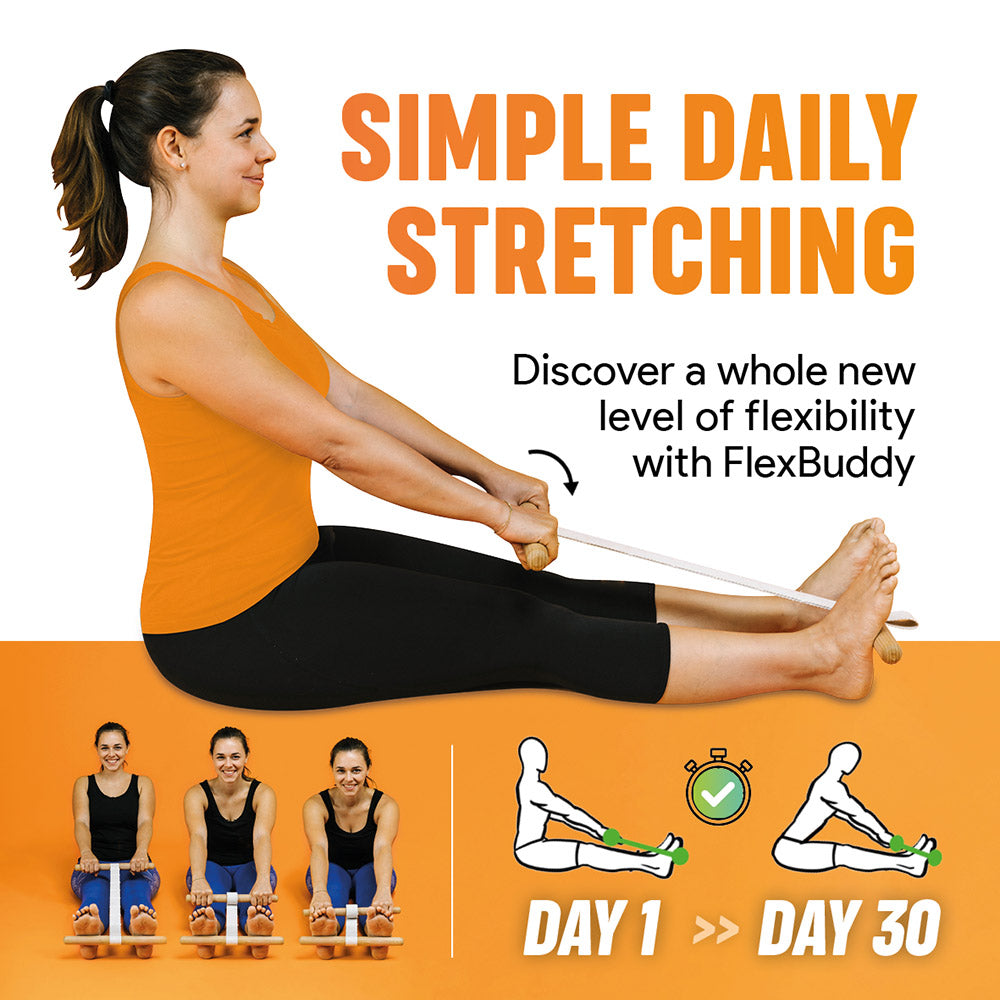
- Sit on the floor with your legs extended and hook FlexBuddy around the soles of your feet.
- Hold the handles with a relaxed grip and sit as tall as you comfortably can.
- Gently rock forward and back in a small range, letting the tool guide the movement.
- Continue for 30 to 45 seconds, breathing slowly and letting the range grow on its own.
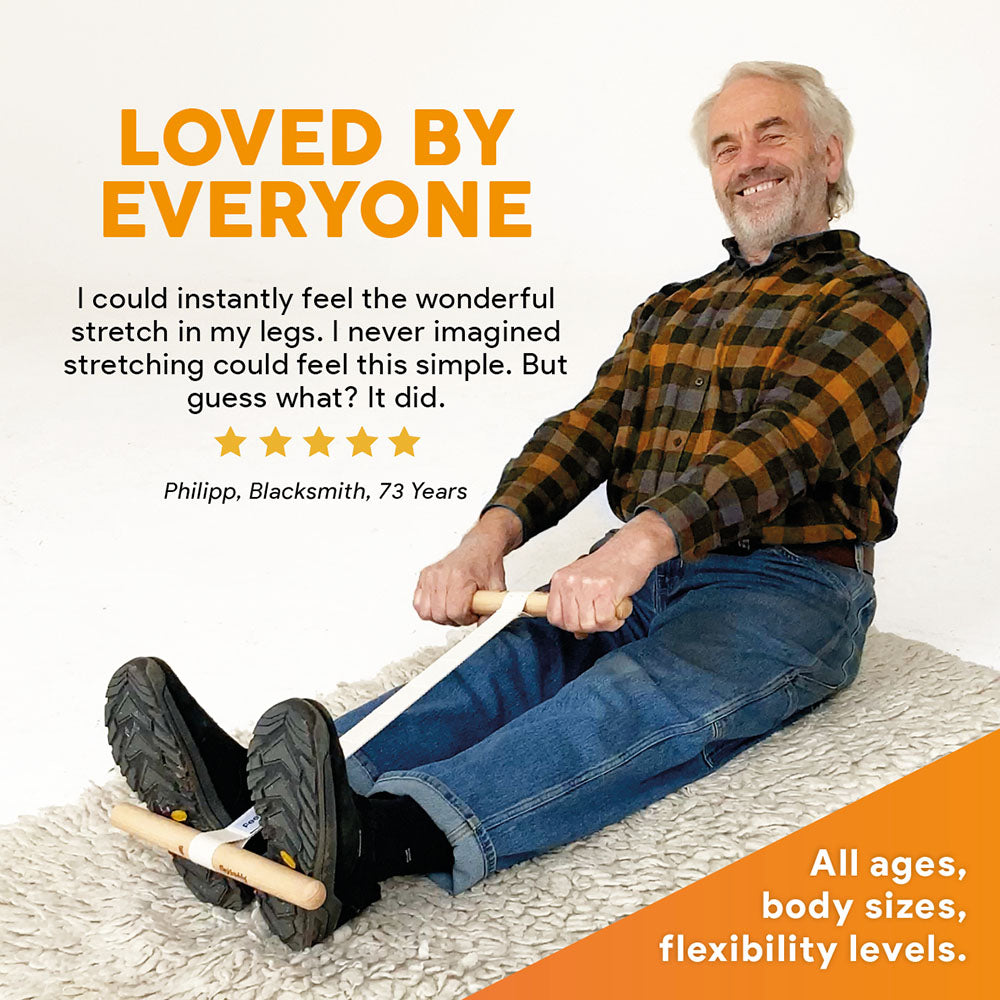
You should feel a light, moving pull along the back of your thighs; nothing sharp, nothing behind the knees. Because FlexBuddy connects your hands to your feet, you can keep a long spine the whole time, the thing that disappears the moment stiff people reach for their toes. Beginner tip: bend your knees slightly. A bent-knee warm-up you do daily beats a straight-leg one you avoid.
2. Static Stretch
The FlexBuddy version of the classic seated forward fold, and the exercise where the tool earns its keep most obviously.
- Stay seated with legs extended, FlexBuddy hooked around your feet.
- Inhale and lengthen your spine; imagine growing a centimetre taller.
- Exhale and hinge forward from your hips, letting your arms stay long on the handles.
- Find the point of mild tension and simply stay there, breathing, for 20 to 40 seconds.
You do not need to touch your toes for this to work; that is the whole point of holding handles instead. Common mistake: pulling hard on the handles to get deeper. FlexBuddy is there for control, not force. If your shoulders creep towards your ears, ease off.
3. Inside Thigh Stretch
Hours of sitting leave the inner thighs and hips quietly locked in one narrow position. This one opens them back up.
- Sit tall and extend one leg out to the side, hooking FlexBuddy around that foot.
- Hold the handles and use light tension to keep your chest lifted.
- Lean gently towards the extended leg until you feel the inner thigh respond.
- Hold 20 to 30 seconds per side, breathing slowly, then switch.
You should feel a clear but kind stretch along the inner thigh, with no pinching in the groin. Beginner tip: a small lean with a tall chest beats a deep collapse.
4. Basic Posture
The foundational FlexBuddy position, and the closest thing this routine has to a reset button for your back.
- Sit on the floor, knees bent, and hook FlexBuddy around both feet.
- Hold the handles and let your arms straighten so the tool takes some of your weight.
- Lean back slightly into the support, lift your chest, and let your spine find its natural length.
- Breathe here for 30 to 60 seconds, shoulders soft.
This feels less like a stretch and more like decompression, a tall, supported, "oh, that's better" feeling through the whole back, and it teaches your body what tall actually feels like. Beginner tip: the best exercise here to anchor to a daily habit, because it feels good immediately.
5. Spinal Twist
Your mid-back was designed to rotate. Desk work mostly asks it not to.
- From a seated position with FlexBuddy hooked around your feet, hold both handles in one hand.
- Sit tall, inhale to lengthen, then exhale and rotate your torso to the free side, placing your other hand on the floor behind you.
- Turn from the ribcage, not the lower back, and keep both sitting bones grounded.
- Hold for 3 to 5 slow breaths, then switch sides.
You should feel rotation through the mid-back and a light opening across the chest, not a crank in the lower back. Common mistake: twisting fast or yanking into range. Slow exhale, gentle turn, repeat tomorrow.
6. Relax The Neck
Sit comfortably with FlexBuddy anchored under your feet, holding one handle to gently weigh down that shoulder. Tilt your head slowly to the opposite side until you feel a soft stretch along the side of the neck. Hold 20 to 30 seconds per side. You should feel the upper trapezius, the muscle that turns into concrete by 4 p.m., gradually let go. The light downward anchor keeps the shoulder from shrugging up and stealing the stretch.
7. Shoulder Opener
Hold FlexBuddy by both handles in front of you with straight arms, then slowly raise it overhead and slightly behind you, only as far as stays comfortable. Hold briefly, lower, and repeat 5 to 8 times. You should feel the chest and front shoulders open, the direct antidote to the forward-rounded shape your desk encourages. The strap held taut between the two bars keeps both shoulders moving evenly.
8. Wrist Warm Up
Kneel or sit and use the wooden bar as a stable support for slow wrist circles and gentle flexion-extension rocking, 20 to 30 seconds per direction. You should feel warmth and easy movement through the forearms, welcome relief for hands that spend eight hours on a keyboard.
The two-minute counter-routine after work
The brand's promise is two minutes a day, and the guideline arithmetic backs it: about 60 seconds per muscle group per session, which can be 15 seconds four times or 20 seconds three times [18], on at least two to three days a week [17][18]. Here is the two-minute version, built to undo a desk day in the order the chain was loaded:
- Basic Posture, ten slow breaths (about 30 seconds). Lean back into the strap, chest up, and let the spine take back the arch it lost during the day [6].
- Static Stretch, ten breaths, twice (about 60 seconds). Shorten the strap by one loop, hinge at the hips with a long back, stop where the thighs pull. That is the hamstrings' full guideline dose [17].
- Relax The Neck, 15 seconds each side (30 seconds). One handle anchoring the shoulder, ear towards the other shoulder.
With five minutes, add the Inside Thigh Stretch and the Shoulder Opener; with none, do Basic Posture alone, because it is the one you will not skip. The two-minute stretching routine for stiff people applies the same idea to a whole body rather than a desk body.
A self-test worth doing once
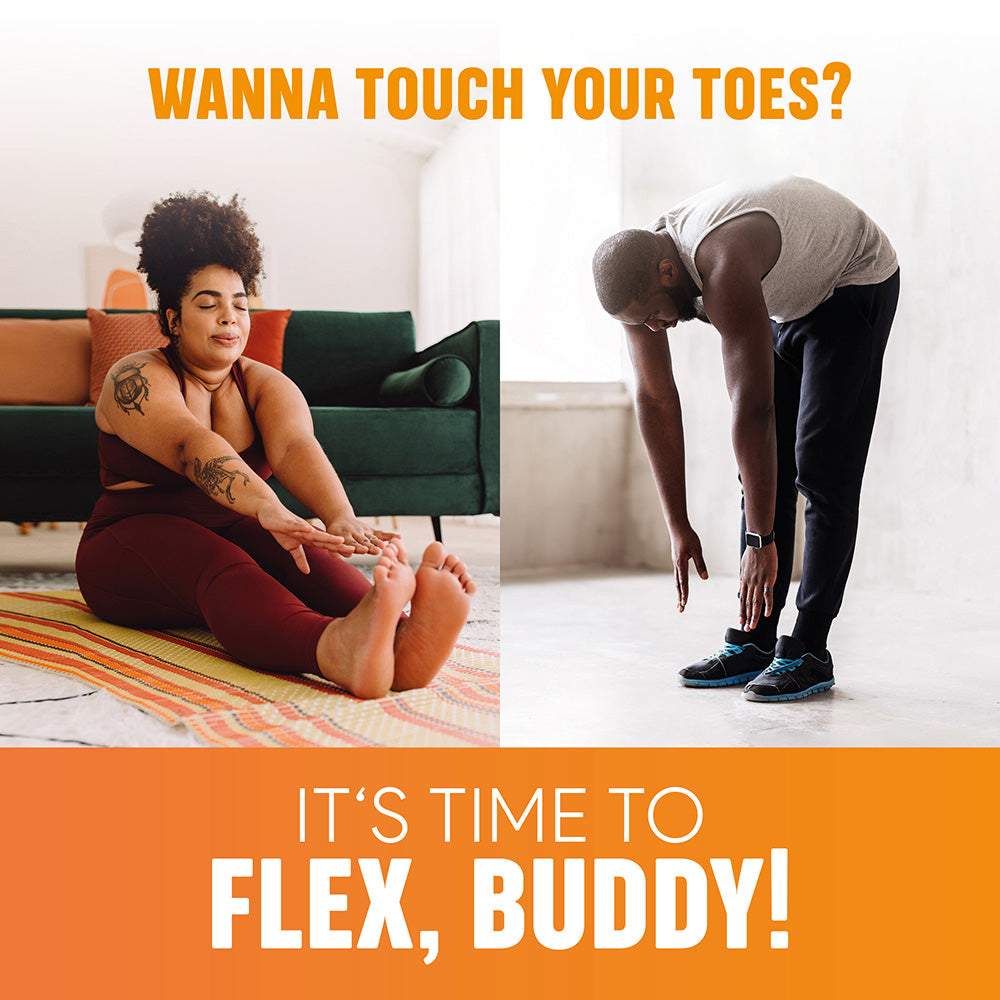
Stand with feet together, knees straight, and reach for the floor at nine in the morning and again at six in the evening; note the fingertip-to-floor distance in centimetres both times. The evening number is usually worse; that gap is your personal dose of sitting. Re-test after four weeks: the morning number tracks flexibility, the gap tells you whether the breaks are working.
An honest timeline
Expect to feel a difference within days, mainly in how the evening feels, and a measurable one in weeks; in the break trial, pain episodes resolved over a month rather than two [15]. One Amazon reviewer, three stars, put the pace fairly: eight weeks in, not yet at his toes, with progress. Progress is the point.
Standing desks: do they help?
They help with the sitting; they do not help with the standing. The Cochrane review found that sit-stand desks reduced sitting time at work by an average of 100 minutes a day in the short term and 57 minutes a day over three to twelve months, from low-quality evidence, and that standing and sit-stand desks did not differ [19]. But fixed standing is not free: a review of 25 laboratory studies found that low-back symptoms reached a clinically relevant level after about 71 minutes of uninterrupted standing, 42 minutes in people prone to standing pain, with blood pooling in the legs the most consistently reported mechanism [20]. In a two-hour standing study of office work, discomfort rose in every body region, and a footrest meant to add movement made the feet worse [21].
So the desk that works is the one you move. The five-day trial that cut low-back discomfort by 31.8% had people switching every 30 minutes, not standing all day [9]. With a sit-stand desk, change position on roughly that rhythm. Without one, the stretches above and a walk to the kitchen do the same job for free.
Doing this with FlexBuddy
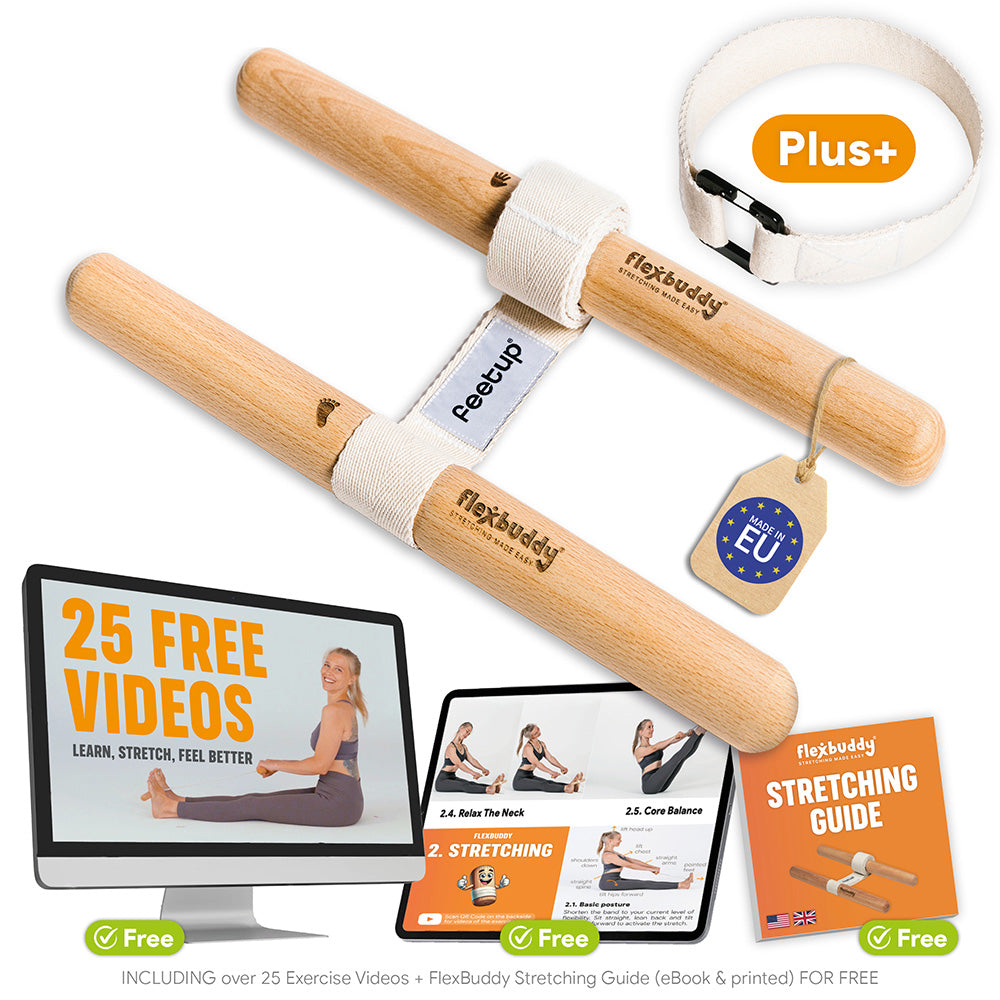
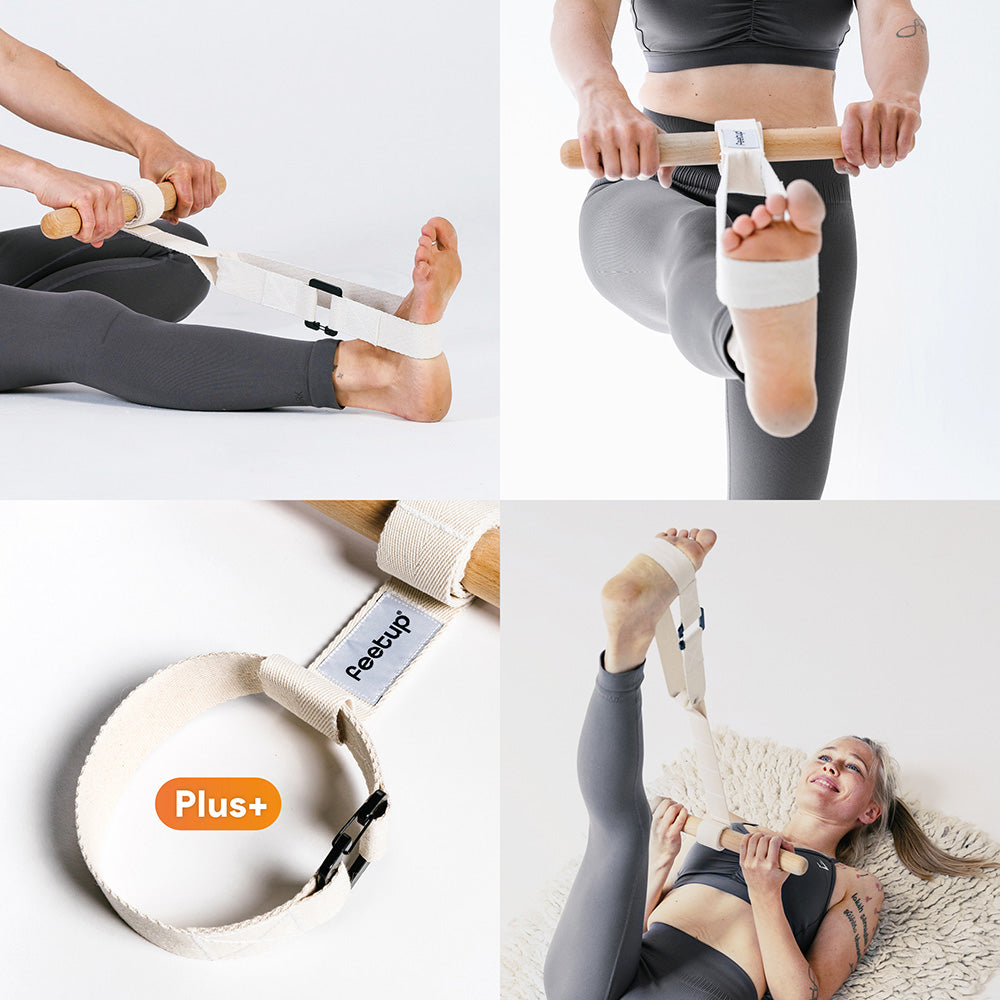
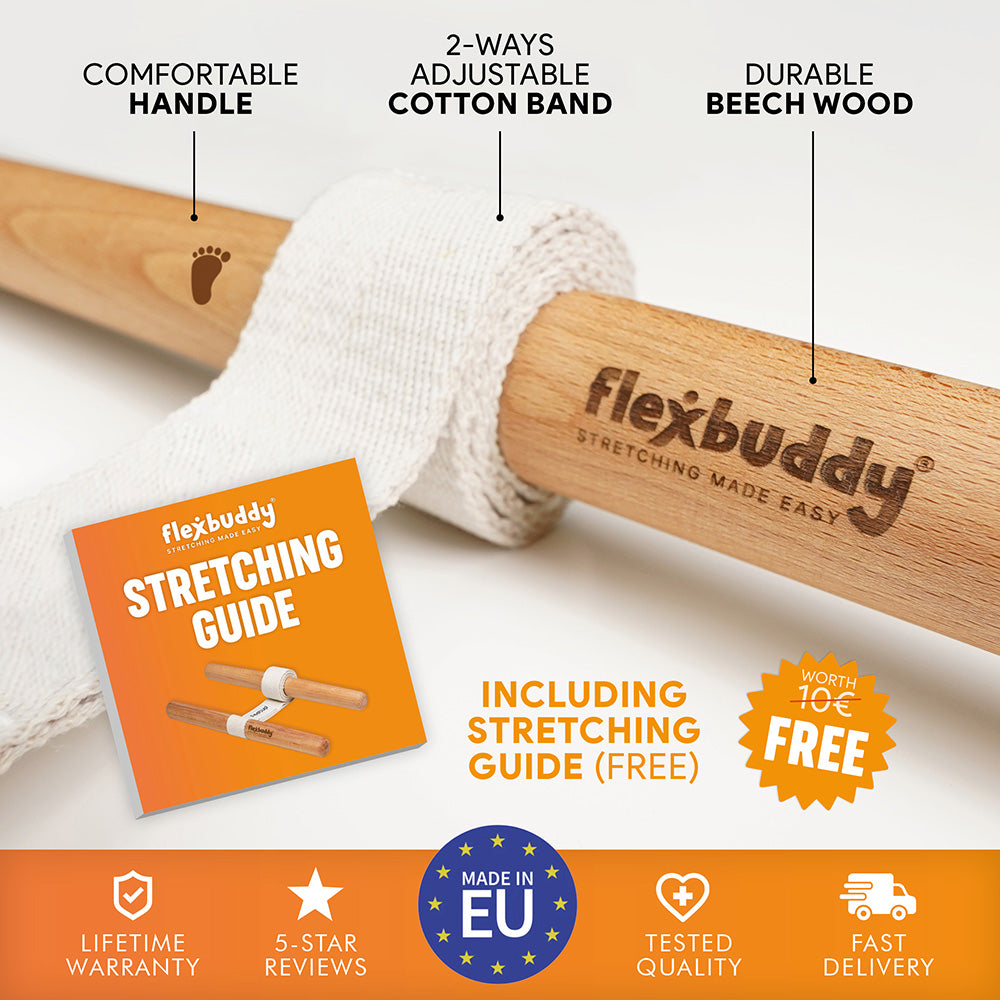
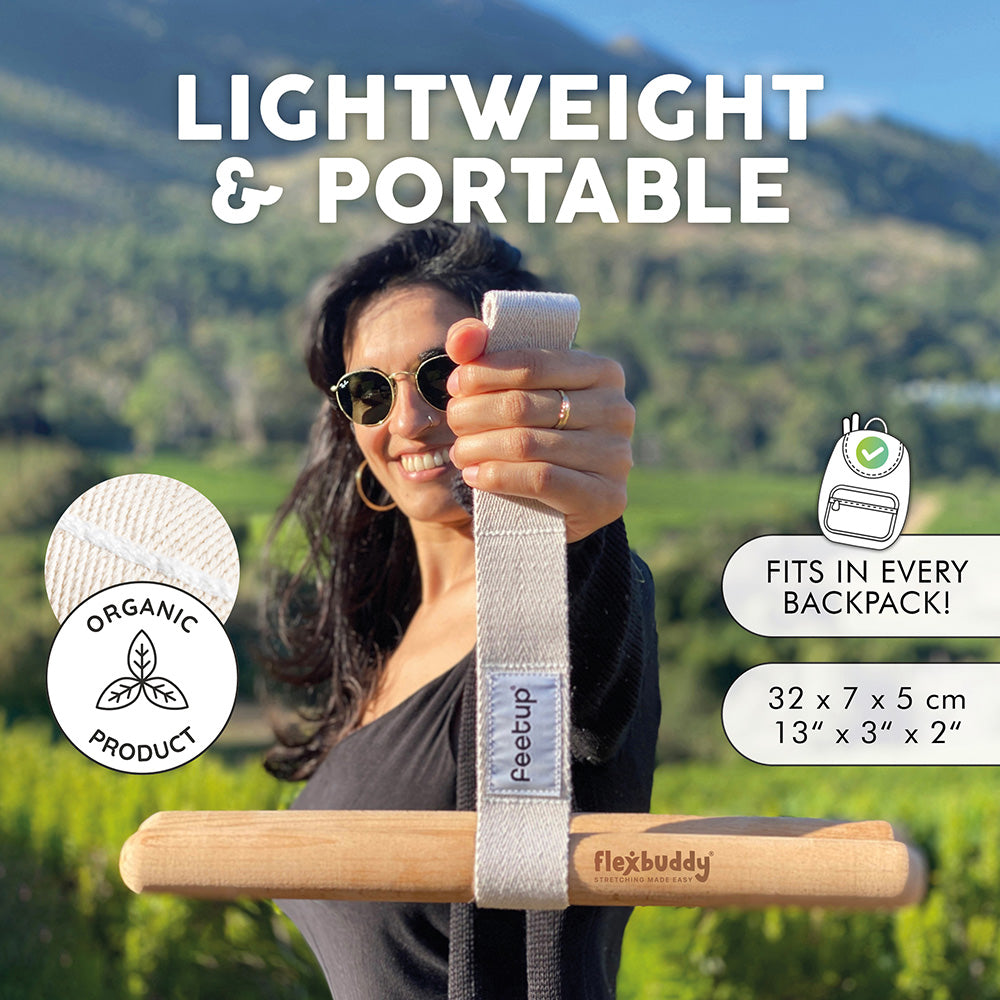
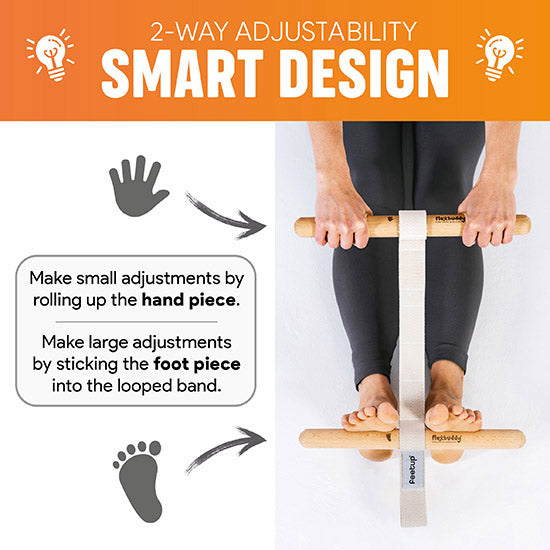
A desk day loads the chain in one direction: hips closed, hamstrings slack behind a rounded back, shoulders forward. Undoing it means the opposite shape, a long spine folding at the hips with the legs straight, and that is the shape stiff people cannot hold on their own; they round the back to reach, the posture they have just spent eight hours in. FlexBuddy® is a stretching device made of two beech-wood bars joined by an adjustable cotton strap. One bar goes under your feet, the other in your hands; you sit tall, lean back and tilt the hips, and the strap carries the reach so your back stays long. Move the foot bar to another loop for a big change of length, or roll the strap around the hand bar for a small one. The wooden handles do not burn the hands the way a strap or towel does, and it lives in a desk drawer. "Sit at a desk 9 hours a day. My lower back used to ache every evening. Two weeks in, that's basically gone," wrote one owner, Stephen W. Lifetime warranty, 30-day money-back guarantee. See FlexBuddy, or take the two-minute quiz and pick the desk path.
When sitting pain needs a doctor
Stiffness that builds through the day and eases with movement is the ordinary cost of a chair, and it responds to the breaks and stretches above. Some symptoms do not fit that picture. Pain that is sharp rather than dull, that runs down a leg as burning, tingling or numbness, that comes with weakness in a leg or foot, with fever, with changes in bladder or bowel control, after a fall or accident, or that keeps getting worse, needs a doctor or physiotherapist before you stretch. The same goes for swelling in one leg only, or swelling that is hot, painful or does not go down overnight, which can be a blood clot rather than pooling and is urgent.
Frequently asked questions
How often should I take stretching breaks during a desk day?
Every 30 to 60 minutes, for one to two minutes, as a change of posture rather than a pause. Active breaks with a postural change have moderate-quality evidence for reducing discomfort and pain in office workers [14], and switching posture every 30 minutes reduced low-back discomfort in one trial [9]. One Shoulder Opener standing up counts.
What are the side effects of sitting all day?
Short term: low-back and hip discomfort within two hours and a flattening of the lumbar curve [6], plus reduced blood flow and pooling in the lower legs [8]. Long term, high sitting time is linked with higher death rates only in people who are also inactive; about an hour a day of moderate activity removed the extra risk [4].
Why does sitting all day cause lower back pain?
The lumbar curve flattens over hours of computer work [6], the slump towards the screen loads the back most [5], and short hip flexors and hamstrings leave the pelvis less free to move, so bending becomes a back job. In office workers, daily stretching with endurance training more than halved new episodes over a year [16].
Why do my ankles swell when I sit all day?
The calf is the pump that returns blood from the lower leg, and in a chair it is idle. After six hours of sitting, the leg's ability to increase blood flow was 43% lower; a ten-minute walk restored it [8]. Calf raises and a short walk every hour are the fix. Swelling in one leg only, or that is hot, painful or persistent, needs a doctor.
What stretches can you do in a chair at work?
Seated hip hinge for the hamstrings, seated figure-four for the hips, a chair twist for the mid-back, a neck side-bend with one hand anchoring the seat, and calf raises beside the desk. Hold 20 to 30 seconds each, within the guideline range [17][18].
Do I need FlexBuddy to do these stretches?
No; the desk stretches above need nothing at all. If you are stiff, the hard part of the after-work routine is holding a straight-spine forward fold long enough to relax into it, which is where most people quit. FlexBuddy removes that barrier: supported positions, depth controlled by your grip, and a routine you will actually repeat.
This article is general information, not medical advice. Tight muscles usually respond well to regular stretching. If your pain is sharp, radiates down a leg, comes with numbness, weakness, fever, bladder or bowel changes, follows an injury, or keeps getting worse, see a doctor or physiotherapist before you stretch.
References
- NHS. Why we should sit less. NHS Live Well, page last reviewed 15 Aug 2024. https://www.nhs.uk/live-well/exercise/why-sitting-too-much-is-bad-for-us/ (accessed 4 Nov 2026).
- Tremblay MS, Aubert S, Barnes JD, et al.; SBRN Terminology Consensus Project Participants. Sedentary Behavior Research Network (SBRN) – Terminology Consensus Project process and outcome. Int J Behav Nutr Phys Act. 2017;14(1):75. doi:10.1186/s12966-017-0525-8
- World Health Organization. Physical activity. Fact sheet, 26 Jun 2024. https://www.who.int/news-room/fact-sheets/detail/physical-activity (accessed 4 Nov 2026).
- Ekelund U, Steene-Johannessen J, Brown WJ, et al. Does physical activity attenuate, or even eliminate, the detrimental association of sitting time with mortality? A harmonised meta-analysis of data from more than 1 million men and women. Lancet. 2016;388(10051):1302–1310. doi:10.1016/S0140-6736(16)30370-1
- Waongenngarm P, Rajaratnam BS, Janwantanakul P. Perceived body discomfort and trunk muscle activity in three prolonged sitting postures. J Phys Ther Sci. 2015;27(7):2183–2187. doi:10.1589/jpts.27.2183
- Baker R, Coenen P, Howie E, Williamson A, Straker L. The short term musculoskeletal and cognitive effects of prolonged sitting during office computer work. Int J Environ Res Public Health. 2018;15(8):1678. doi:10.3390/ijerph15081678
- Thosar SS, Bielko SL, Mather KJ, Johnston JD, Wallace JP. Effect of prolonged sitting and breaks in sitting time on endothelial function. Med Sci Sports Exerc. 2015;47(4):843–849. doi:10.1249/MSS.0000000000000479
- Restaino RM, Holwerda SW, Credeur DP, Fadel PJ, Padilla J. Impact of prolonged sitting on lower and upper limb micro- and macrovascular dilator function. Exp Physiol. 2015;100(7):829–838. doi:10.1113/EP085238
- Thorp AA, Kingwell BA, Owen N, Dunstan DW. Breaking up workplace sitting time with intermittent standing bouts improves fatigue and musculoskeletal discomfort in overweight/obese office workers. Occup Environ Med. 2014;71(11):765–771. doi:10.1136/oemed-2014-102348
- Jones O. Muscles of the Anterior Thigh. TeachMeAnatomy. https://teachmeanatomy.info/lower-limb/muscles/thigh/anterior-compartment/ (accessed 4 Nov 2026).
- Jones O. Muscles of the Posterior Thigh: Hamstrings. TeachMeAnatomy. https://teachmeanatomy.info/lower-limb/muscles/thigh/hamstrings/ (accessed 4 Nov 2026).
- Arab AM, Nourbakhsh MR. Hamstring muscle length and lumbar lordosis in subjects with different lifestyle and work setting: comparison between individuals with and without chronic low back pain. J Back Musculoskelet Rehabil. 2014;27(1):63–70. doi:10.3233/BMR-130420
- Jun D, Zoe M, Johnston V, O'Leary S. Physical risk factors for developing non-specific neck pain in office workers: a systematic review and meta-analysis. Int Arch Occup Environ Health. 2017;90(5):373–410. doi:10.1007/s00420-017-1205-3
- Waongenngarm P, Areerak K, Janwantanakul P. The effects of breaks on low back pain, discomfort, and work productivity in office workers: a systematic review of randomized and non-randomized controlled trials. Appl Ergon. 2018;68:230–239. doi:10.1016/j.apergo.2017.12.003
- Akkarakittichoke N, Waongenngarm P, Janwantanakul P. The effects of active break and postural shift interventions on recovery from and recurrence of neck and low back pain in office workers: a 3-arm cluster-randomized controlled trial. Musculoskelet Sci Pract. 2021;56:102451. doi:10.1016/j.msksp.2021.102451
- Sihawong R, Janwantanakul P, Jiamjarasrangsi W. A prospective, cluster-randomized controlled trial of exercise program to prevent low back pain in office workers. Eur Spine J. 2014;23(4):786–793. doi:10.1007/s00586-014-3212-3
- Garber CE, Blissmer B, Deschenes MR, et al.; American College of Sports Medicine. Position stand: quantity and quality of exercise for developing and maintaining cardiorespiratory, musculoskeletal, and neuromotor fitness in apparently healthy adults. Med Sci Sports Exerc. 2011;43(7):1334–1359. doi:10.1249/MSS.0b013e318213fefb
- Harvard Health Publishing. The ideal stretching routine. Harvard Medical School, 16 Mar 2026 (reviewed by H. E. LeWine, MD). https://www.health.harvard.edu/staying-healthy/the-ideal-stretching-routine (accessed 4 Nov 2026).
- Shrestha N, Kukkonen-Harjula KT, Verbeek JH, Ijaz S, Hermans V, Pedisic Z. Workplace interventions for reducing sitting at work. Cochrane Database Syst Rev. 2018;6(6):CD010912. doi:10.1002/14651858.CD010912.pub4
- Coenen P, Parry S, Willenberg L, et al. Associations of prolonged standing with musculoskeletal symptoms: a systematic review of laboratory studies. Gait Posture. 2017;58:310–318. doi:10.1016/j.gaitpost.2017.08.024
- Baker R, Coenen P, Howie E, Lee J, Williamson A, Straker L. Musculoskeletal and cognitive effects of a movement intervention during prolonged standing for office work. Hum Factors. 2018;60(7):947–961. doi:10.1177/0018720818783945