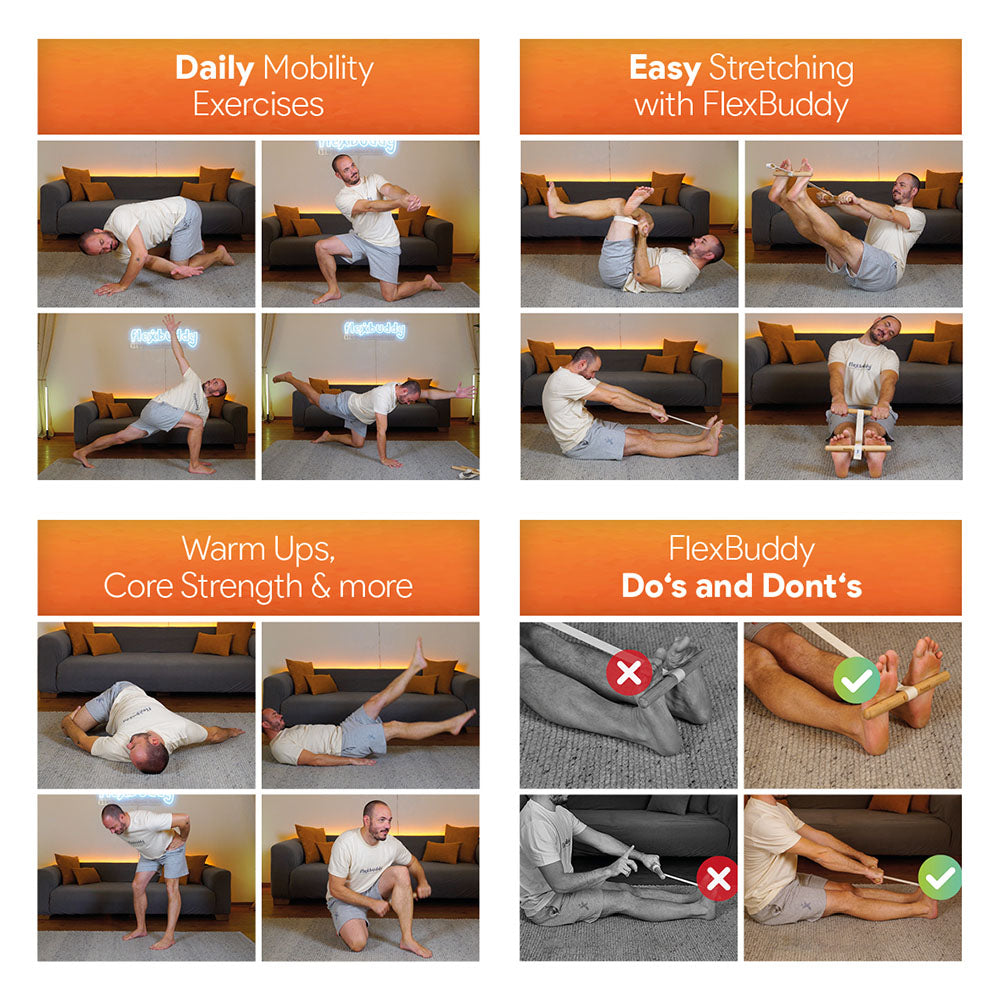
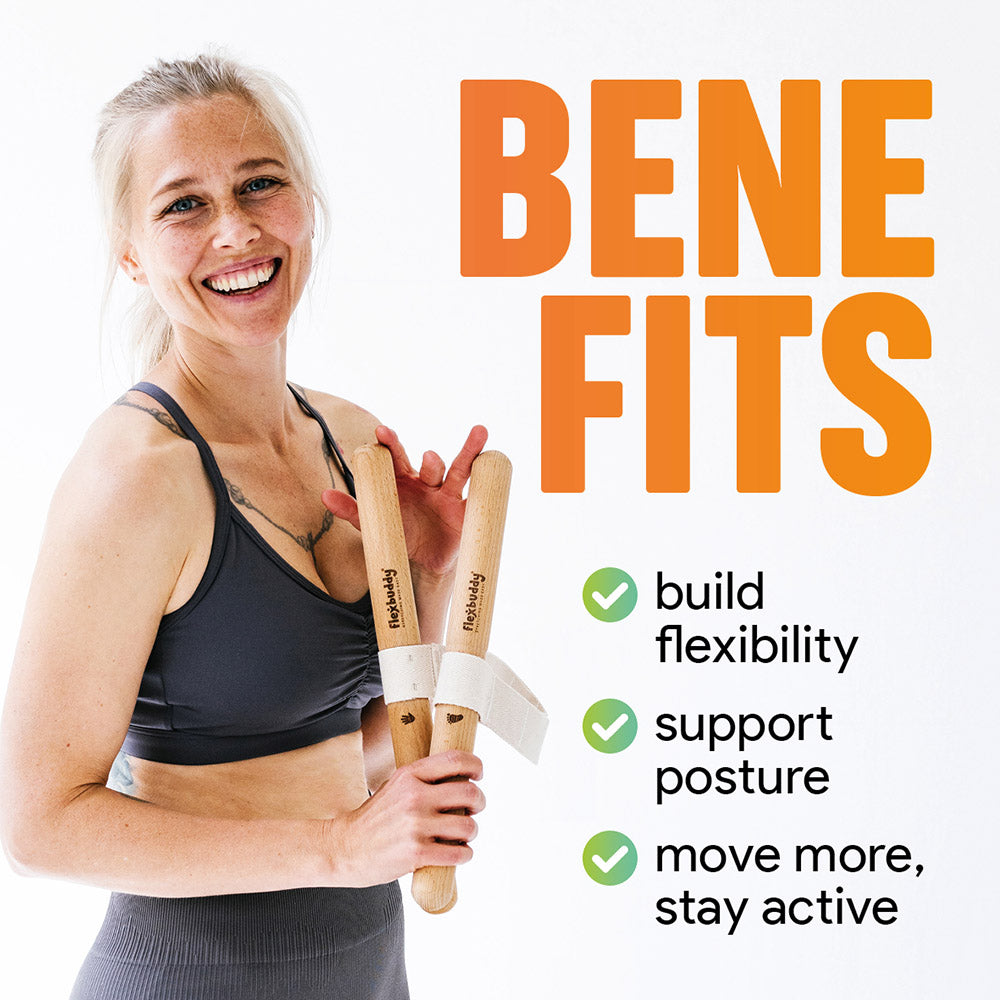
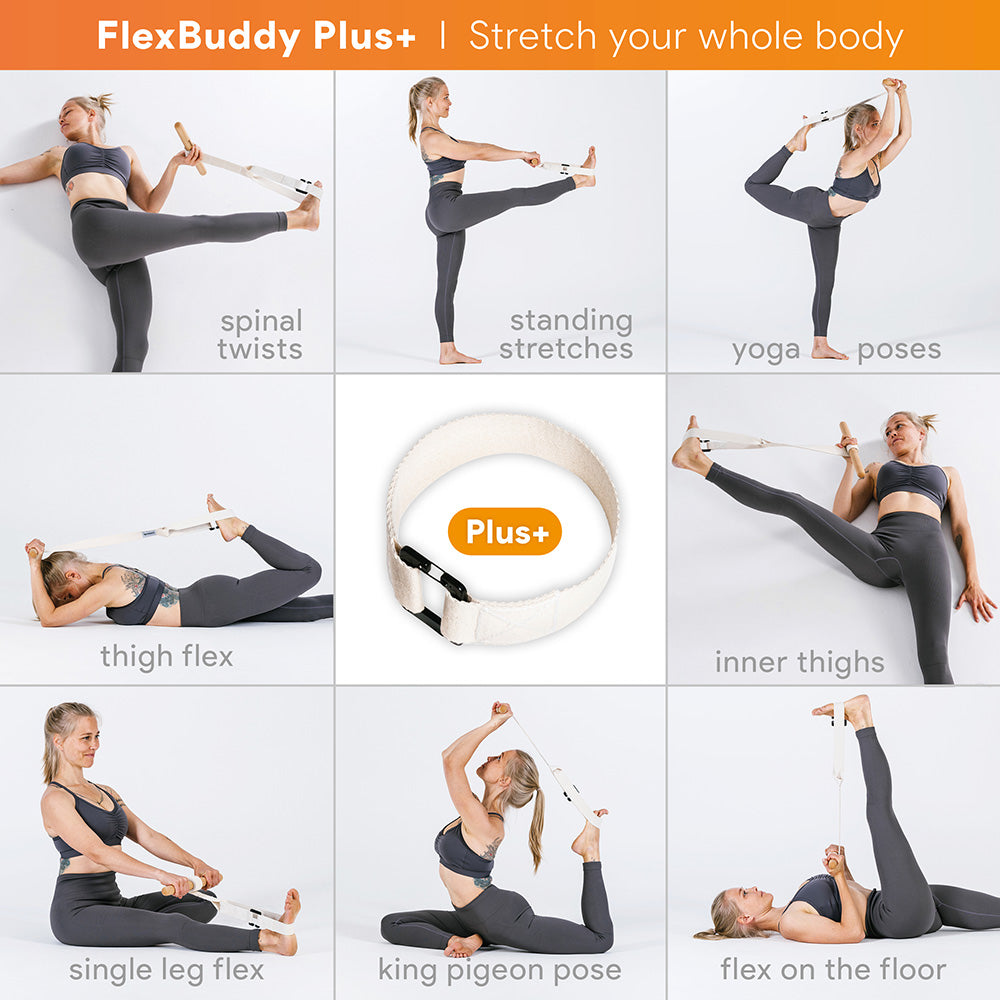
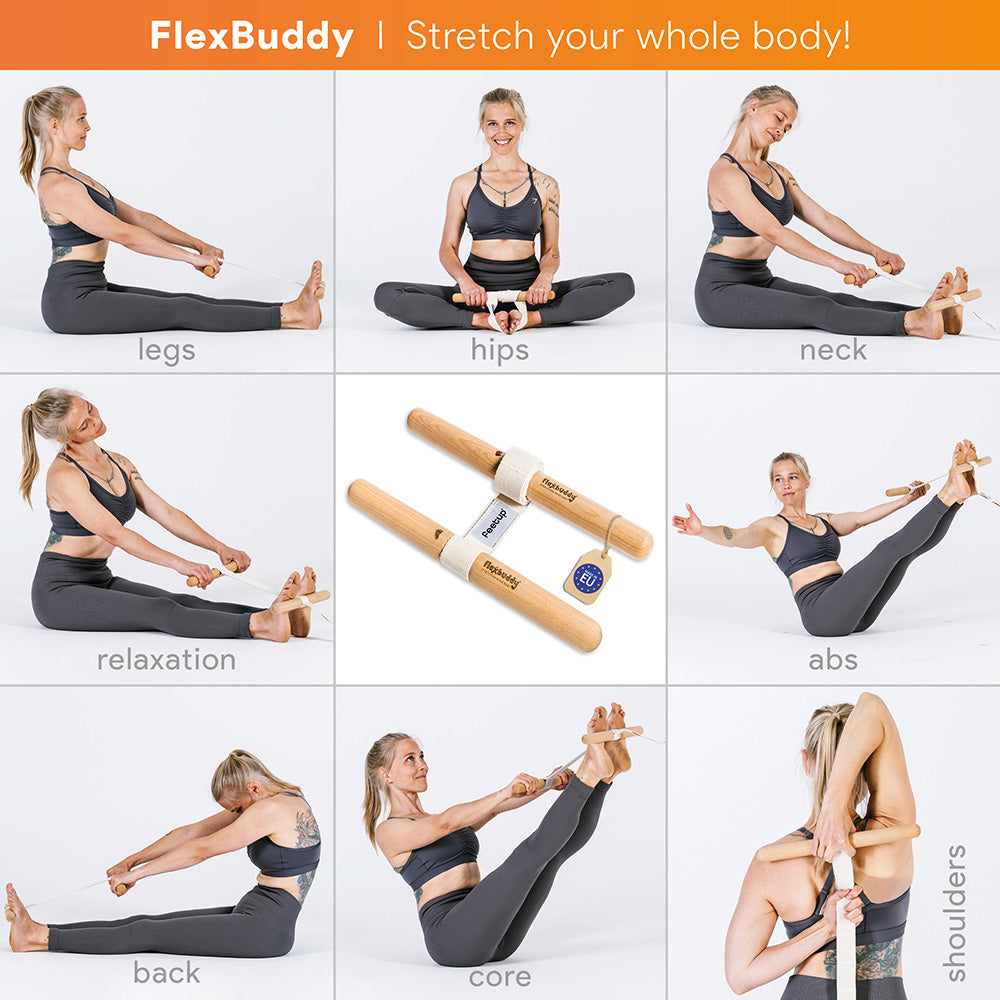
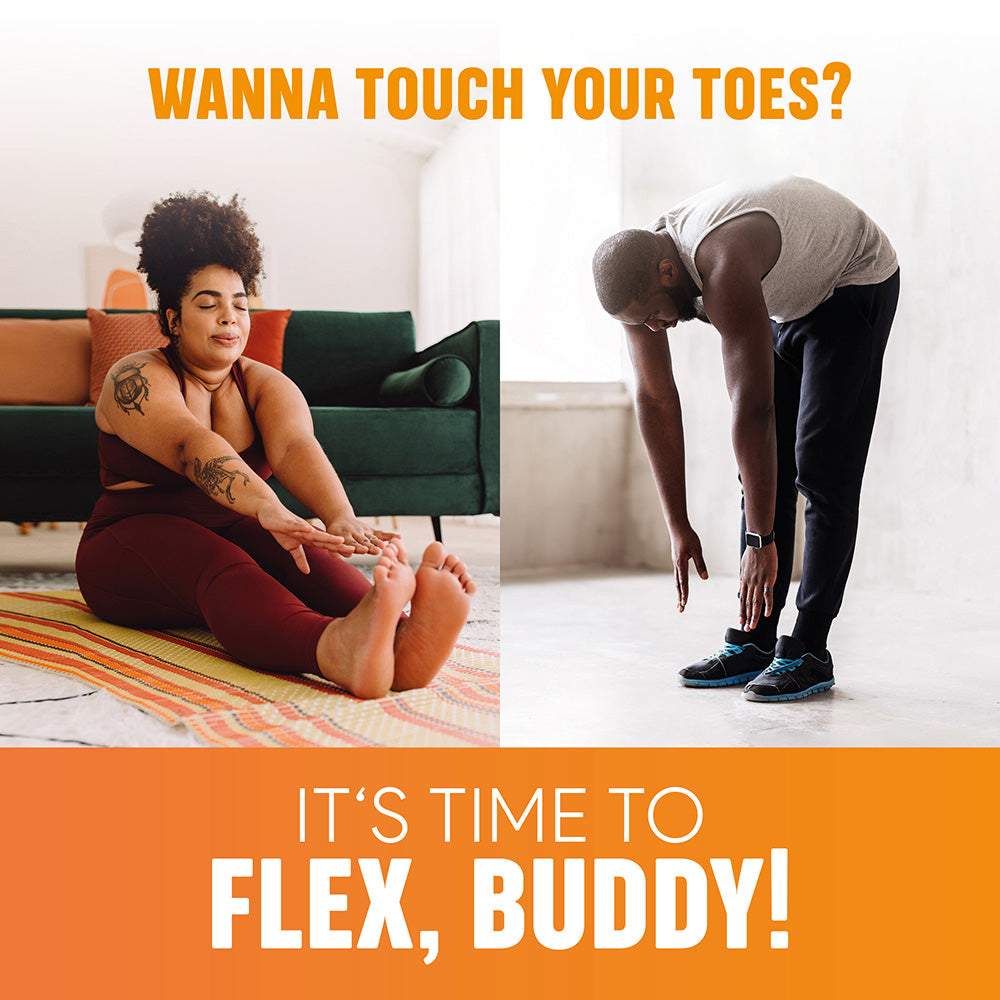
- Six exercises, one small device, a body that moves freely again. This is the FlexBuddy® exercise catalogue: the six core exercises from the official video library (Basic Posture, Spinal Twist, Single Leg Stretch, Inside Thigh Stretch, Shoulder Opener, Relax The Neck), plus a map of everything else in the 24-page Stretching Guide.
- They free the four zones that stiffen first: back, hips, hamstrings, and shoulders with the neck.
- The dose is small. Hold static positions for 15 to 30 seconds [1], and aim for about 60 seconds in total per exercise on at least two days a week [2]. Slow breathing, never force.
- It should feel good. Mild, steady tension is the target. Sharp pain, tingling or numbness means stop and take a longer strap or a smaller range.
- Two or three a day is plenty. Pick the ones that match where you're tight and repeat them tomorrow.
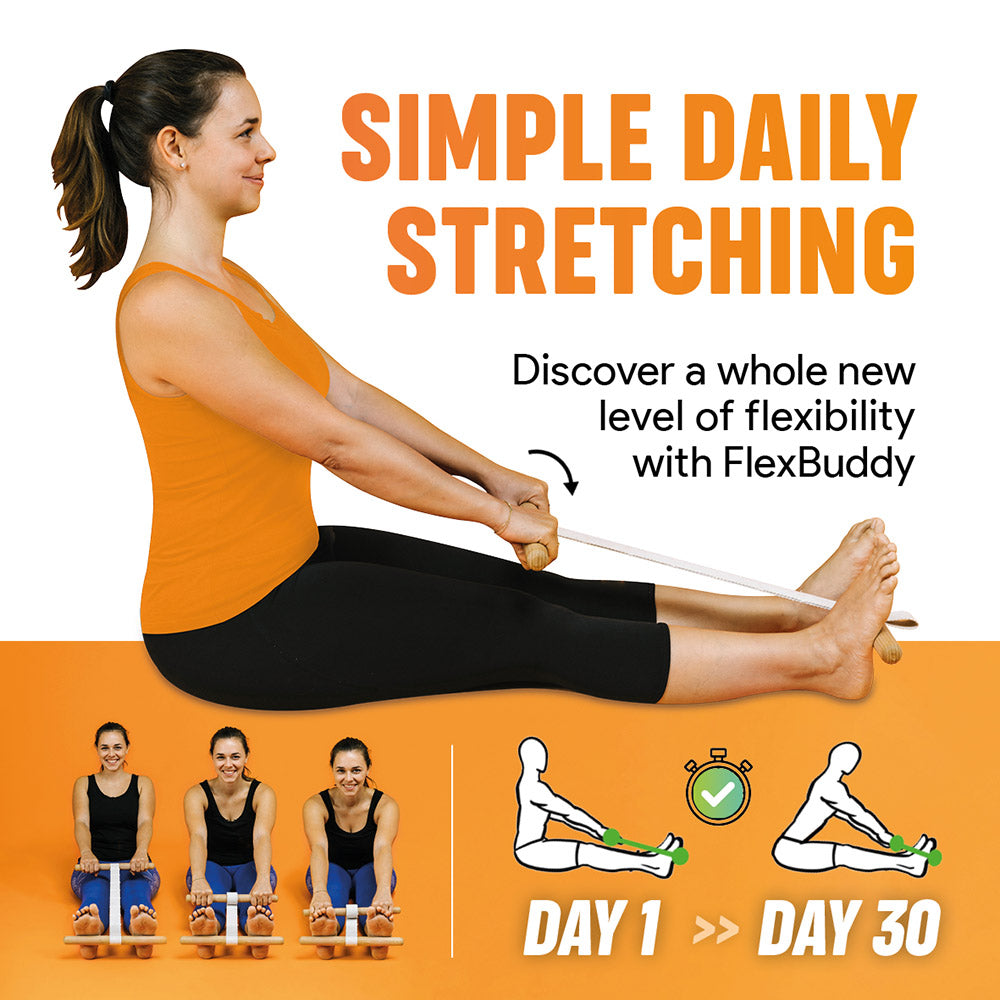
- FlexBuddy does the hard part for you. The strap replaces the reach and keeps your back tall, so every exercise works from the first day, however stiff you are.
Most stiffness lives in four places: the back, the hips, the hamstrings and the shoulders. This guide gives you a FlexBuddy exercise for each, six in total, so you can build a routine around whatever your body complains about most. You will feel the first one working within ten breaths. If you have not set the strap up yet, start with how to use FlexBuddy, which covers the loops, the rolling and the first week.
Why these four zones get tight together
Sitting keeps your hips flexed and your hamstrings shortened, your spine in one rounded shape and your shoulders pulled forward. Each zone then leans on its neighbours.
Hamstrings and lower back. The hamstrings are the three muscles on the back of the thigh, running from the sitting bone to just below the knee. Because they attach to the pelvis, they have a say in how it tilts when you bend. In a motion-analysis study, the first 30 degrees of a forward bend came almost twice as much from the lumbar spine as from the hips, and in the people with a history of low back pain, hamstring flexibility was strongly correlated with how they moved [3]. That is why a forward bend with stiff legs so often turns into a rounded back, and why FlexBuddy keeps your back straight while the hamstrings stretch.
Mid-back and neck. The thoracic spine, the twelve vertebrae your ribs attach to, is built to rotate. In a study of young adults, those who sat more than seven hours a day and exercised little had measurably less thoracic rotation than the physically active group, about 65 degrees against 75 [4]. A mid-back that has stopped turning hands the job to the neck and the lower back. The Spinal Twist puts that turn back into your day.
Shoulders and neck. Shoulders that sit forward put the upper trapezius, the muscle between neck and shoulder, on duty all day just holding your head up.
That's why a short routine that touches all four zones feels so much better than a long session on one.
The six exercises at a glance
| Exercise | Targets | Time | Best for |
|---|---|---|---|
| Basic Posture | Whole back, hamstrings, posture | 10 deep breaths, about 30 s | A compressed, rounded back |
| Spinal Twist | Mid-back rotation | 3 to 5 breaths per side | Stiffness between the shoulder blades |
| Single Leg Stretch | Hamstrings, one side at a time | 15 to 30 s per side | Uneven tightness, runners |
| Inside Thigh Stretch | Inner thighs, hips | 15 to 30 s per side | Tight hips, difficult squats |
| Shoulder Opener | Chest, front of the shoulders | 5 to 8 slow reps | Rounded desk shoulders |
| Relax The Neck | Neck, upper trapezius | 30 s per side | End-of-day neck tension |
All six are filmed in the free video library, so you can watch a movement once and then do it.
Back: Basic Posture and Spinal Twist
1. Basic Posture, the back reset
Every other seated exercise starts here, and it feels good from the first breath.
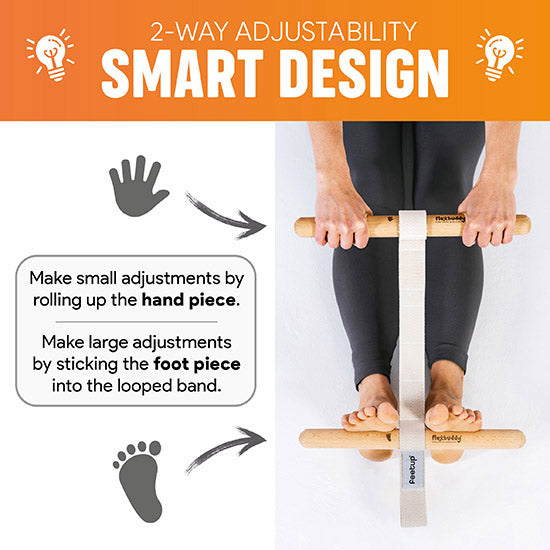
- Shorten the strap to your current flexibility. Sit on the floor with the foot bar under the balls of both feet and the hand bar in both hands. If you are stiff, begin with the knees slightly bent.
- Sit straight, then lean back and let your arms straighten, so the strap carries part of your weight.
- Tilt the hips forward. That tilt is what activates the stretch.
- Shoulders down, chest lifted, head up, arms straight, feet pointed.
- Hold for ten deep breaths. The Stretching Guide asks you to spend 30 seconds here before you advance.
What you will feel: your whole back growing tall and supported, with a calm pull along the back of the thighs. No strain anywhere.
Best for: anyone whose back feels compressed and rounded by evening.
Common mistake: gripping hard and shrugging. Let the strap carry the load so your back muscles can stop bracing.
2. Spinal Twist, the rotation your desk took away
- Seated with the foot bar under your feet, take the hand bar in one hand.
- Inhale to sit tall. Exhale and rotate your torso towards the free side, with the free hand on the floor behind you.
- Turn from the ribcage and keep both sitting bones grounded.
- Hold three to five slow breaths, then switch sides.
What you will feel: the mid-back turning freely and the chest opening, with the lower back quiet.
Best for: stiffness between the shoulder blades, that locked mid-back feeling.
Why FlexBuddy helps: the foot anchor keeps your legs and pelvis stable, so the twist happens where it should instead of leaking into your hips.
Common mistake: pulling yourself round with the back hand. That hand is a prop, not a lever; the turn comes from the breath out. More rotation work is in thoracic spine mobility.
Hamstrings and hips: Single Leg Stretch and Inside Thigh Stretch
3. Single Leg Stretch, hamstrings one side at a time
- Sit with one leg extended and the other knee bent, that foot resting against the inside of the straight leg.
- Place the foot bar under the ball of the extended foot and hold the hand bar in both hands.
- Inhale tall. Exhale and hinge gently from the hips towards the straight leg, chest leading.
- Hold 15 to 30 seconds of mild tension, breathing slowly, then switch.
What you will feel: a clear, satisfying pull along the back of the extended thigh, and often the discovery that one side is much tighter than the other. Now you can even them out.
Best for: uneven hamstrings, runners, and anyone whose two-leg forward fold always feels crooked.
Beginner tip: a slight bend in the extended knee is completely fine. Depth grows with repetition, not bravery.
Common mistake: reaching with the head. If the lower back starts to round, come up, lengthen the strap by a loop and hinge again.
4. Inside Thigh Stretch, open the hips
- Sit tall and extend one leg out to the side, with the foot bar under that foot.
- Hold the hand bar and use light tension on the strap to keep your chest lifted.
- Lean gently towards the extended leg until the inner thigh responds.
- Hold 15 to 30 seconds per side, breathing slowly.
What you will feel: a kind but unmistakable stretch along the inner thigh, possibly into the hip. No pinching in the groin.
Best for: hips that protest when you squat, sit cross-legged or get up off the floor.
Common mistake: chasing depth by collapsing the chest. A small lean with a tall spine does more.
The inner thigh muscles (the adductors) are one side of a stiff hip. For the front of the hip, where the hip flexors shorten in a chair, add the kneeling lunge from tight hips from sitting.
Shoulders and neck: Shoulder Opener and Relax The Neck
5. Shoulder Opener, undo the forward hunch
This is the one exercise here that is a movement, not a hold, and you can do it standing.
- Stand or sit tall, holding both handles in front of you with straight arms.
- Slowly raise the device overhead and slightly behind you, only as far as stays comfortable.
- Lower with control. Repeat for five to eight slow reps.
What you will feel: the chest and the front of the shoulders opening, the direct opposite of the rounded shape your desk encourages. You stand taller afterwards.
Best for: desk workers, drivers, and anyone whose shoulders live near their ears.
Why FlexBuddy helps: the fixed width keeps both shoulders moving evenly, which is surprisingly hard to do freehand.
Common mistake: arching the lower back to get the arms further behind you. Keep the ribs down; the range should come from the shoulders.
A note on the name. The yoga section of the Stretching Guide has a second Shoulder Opener, a variation of Gomukhasana (Cow Face Pose) with the strap held behind the back, one hand from above and one from below. Learn the overhead version first. For the wider picture, see rounded shoulders.
6. Relax The Neck, the finishing touch
- Sit comfortably with the foot bar anchored under your feet. Hold the hand bar in one hand so it gently weighs that shoulder down.
- Tilt your head slowly to the opposite side until a soft stretch appears along the side of the neck.
- Hold 30 seconds, breathing slowly, then switch sides.
What you will feel: the upper trapezius letting go, and the day's tension draining out of your neck.
Best for: that end-of-day concrete-neck feeling.
Beginner tip: tiny range, long exhale. The neck rewards gentle.
Neck stretching pays off quickly. In a randomised trial of office workers with long-standing neck pain, the group that added neck and shoulder stretches twice a day, five days a week, to ergonomic advice improved more over four weeks than the group given the advice alone, and those who stretched at least three times a week did better still [5]. A fuller set is in neck stretches.
How long to hold, and how often
Less than you think. A widely used clinical review of stretching gives 15 to 30 seconds as the recommended hold for static stretches [1], and the American College of Sports Medicine asks for a total of 60 seconds per flexibility exercise on at least two days a week [2]. In practice that means two to four holds of each exercise you choose, or ten slow breaths repeated twice in Basic Posture.
And little and often wins. A 2018 review of 23 studies found that the more days a week people stretched, the more range of motion they gained, and it points to at least five days a week, for at least five minutes a week in total, as enough [6]. A 2024 meta-analysis of 77 studies confirmed that stretch training increases range of motion, with static stretching, the slow holds these exercises are built on, ahead of bouncing or dynamic stretching for long-term gains [7]. So you do not need long sessions: a few minutes on most days does it.
The first results come fast. Over the first three to eight weeks, the extra range you gain comes mostly from your nervous system tolerating more stretch [8]. So the first change is how a position feels: easier, calmer, further. The detail is in how long to hold a stretch.
The rest of the library: every exercise in the Stretching Guide
The six above are the core. The official Stretching Guide and the video library give you much more to grow into:
| Section | Exercises | What the guide prescribes |
|---|---|---|
| Warm-up | Hamstrings Warm Up, relaxing thigh stretch, alternating bend | At least 30 reps per side; 30 s per side; 1 to 2 minutes |
| Dynamic | Dynamic Rolling | Roll forward as far as a straight spine allows, roll back, three times |
| Static | Static Stretch | Shorter loop, 10 deep breaths, 30 s pause, three times |
| Neck and core | Relax The Neck, core balance | 30 s per side; 30 s |
| Yoga | Cat-Cow, Butterfly, Shoulder Opener (Gomukhasana variation), Boat, Twisted Boat | Cat-Cow ten times in Basic Posture; Butterfly with the strap as a loop |
| Wrists and grip | Wrist warm-up, forearm rolling, two-finger grip holds | Forearm rolling five times in each direction |
| Massage | Foot massage, thigh and calf fascia massage | Roll the foot bar under the sole; press the bar into the muscle |
The Hamstrings Warm Up, Dynamic Rolling and Static Stretch are taught step by step in the how-to-use guide, because they are the first week's work.
Building your routine
Three ready-made combinations:
| Routine | Exercises, in order | Time | When |
|---|---|---|---|
| Desk reset | Basic Posture, Shoulder Opener, Relax The Neck | About 3 minutes | After you close the laptop |
| Lower body day | Single Leg Stretch, Inside Thigh Stretch, Basic Posture | About 5 minutes | After a run, a ride or a long drive |
| Full tour | All six, in the order above | 8 to 10 minutes | Two or three times a week |
Whichever you pick, the rule is the same: mild tension, slow breathing, repeat tomorrow. Keep FlexBuddy where you will see it, next to the desk or the sofa, and the routine starts itself. On days when even three minutes is too much, the 2-minute daily stretch routine keeps the habit alive.
How to progress
Progress is a shorter strap with the same long back, not a nose nearer the knee. Stay on a setting until all your holds feel calm, then shorten by one turn of the strap around the hand bar, and later by one loop. Add a new exercise when the ones you already do have become routine; two exercises done daily teach your body more than six done on Sundays.
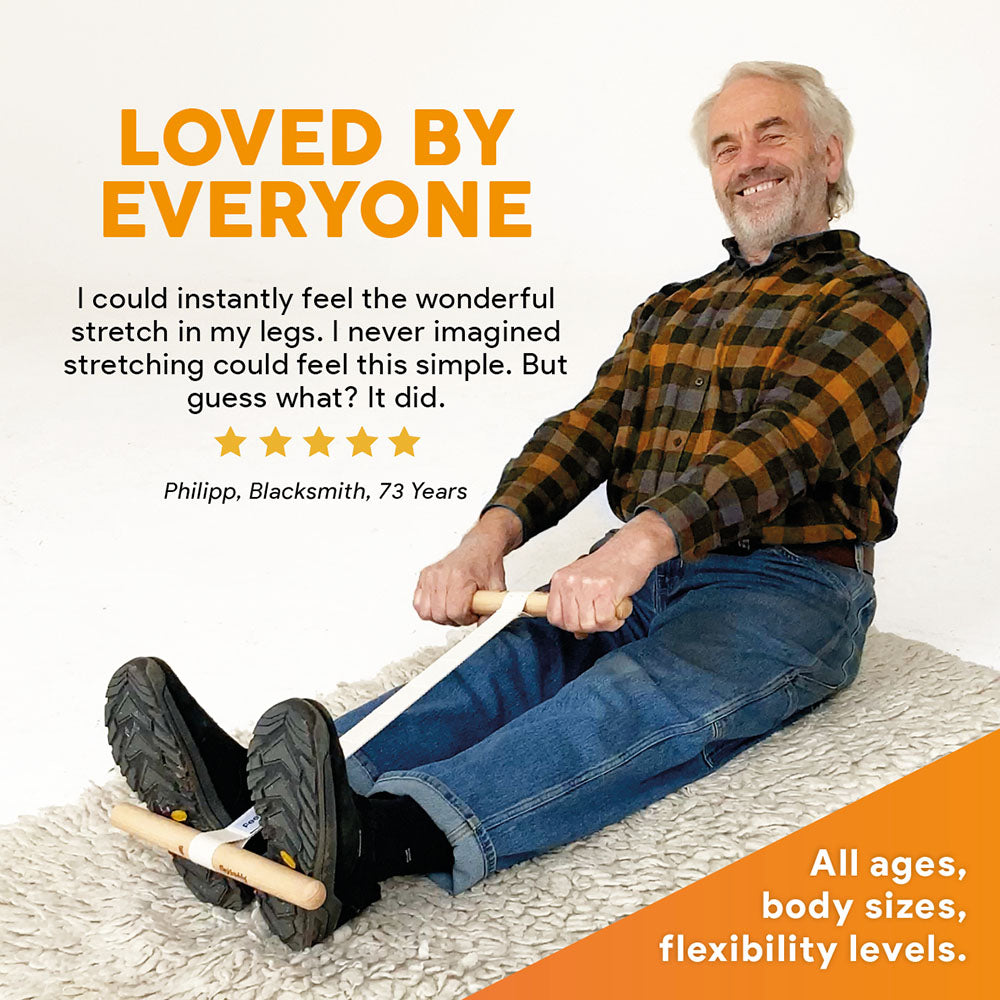
It adds up faster than you expect. "I am 64 and have never touched my toes. FlexBuddy changed that in a week!" wrote Bob J. Stylianos T. measured it: "I can now bend 15 cm more than before in the space of 6 months."
When to change an exercise, and when to stop
Stretching should feel like mild tightness that eases as you breathe. Three signals mean the exercise needs a small change:
- Lower back rounding or aching in a seated exercise: the strap is too short for today. Go one loop longer or bend the knees.
- Pain behind the knee: the knee is locked. Soften it.
- Pinching in the front of the shoulder during the Shoulder Opener: stop at the height where it starts, and work below it.
And one group of signals means stop altogether: sharp pain, pain that travels down an arm or a leg, tingling or numbness. Those are not muscle stretch. Skip the exercise and have it looked at. Everything else is the good kind of stretch, and it gets more comfortable every week.

Do it all with one FlexBuddy
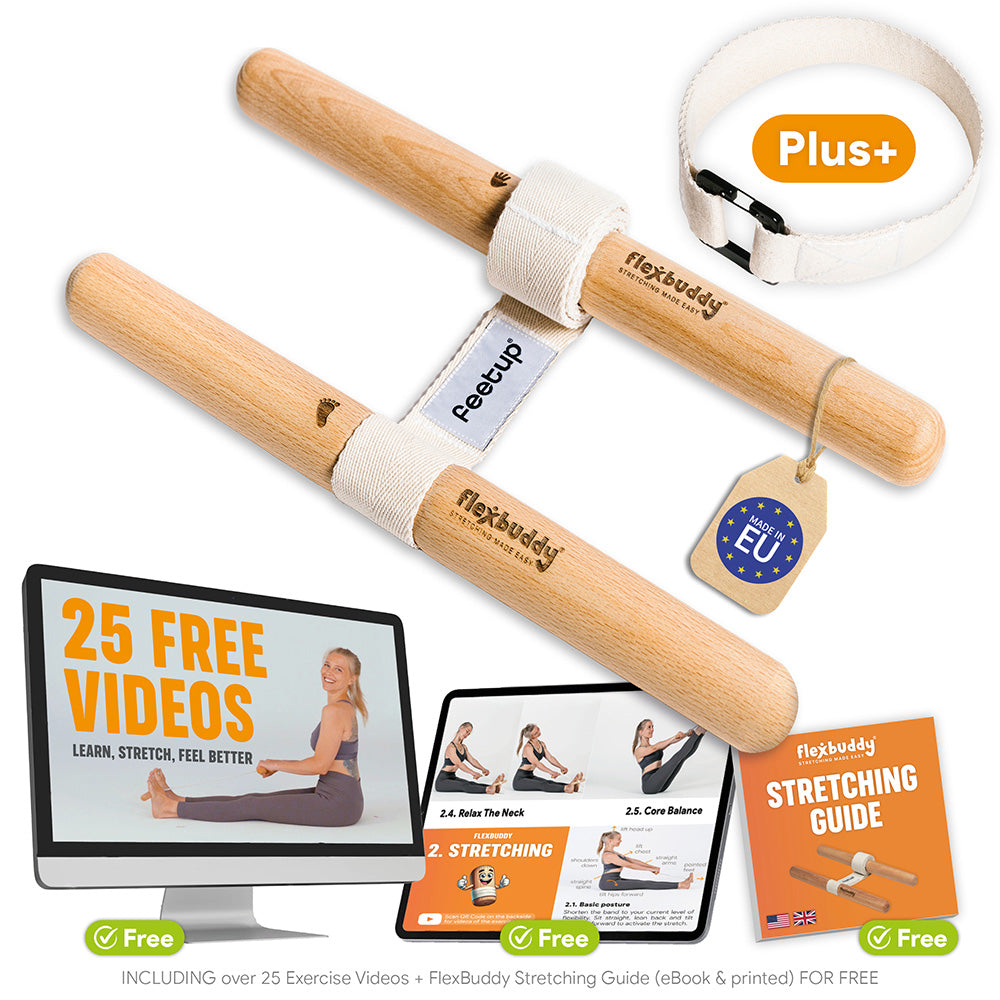
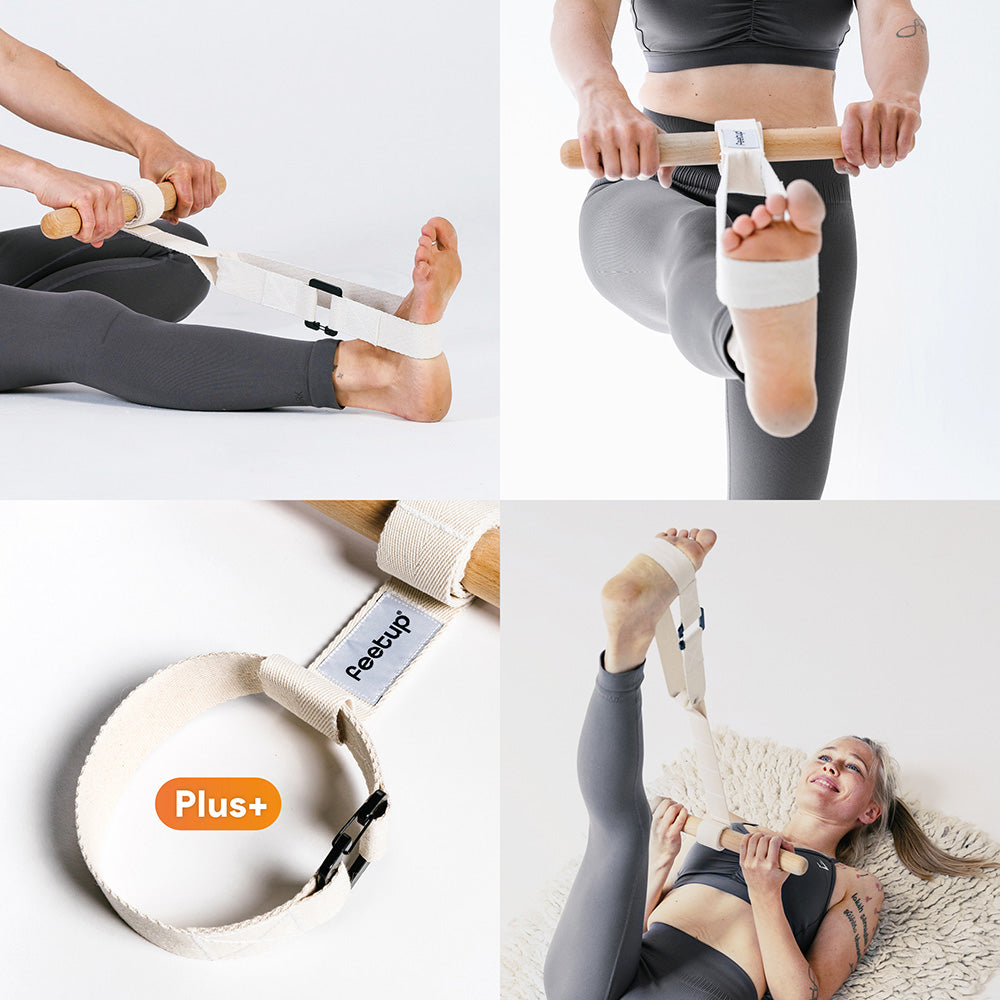
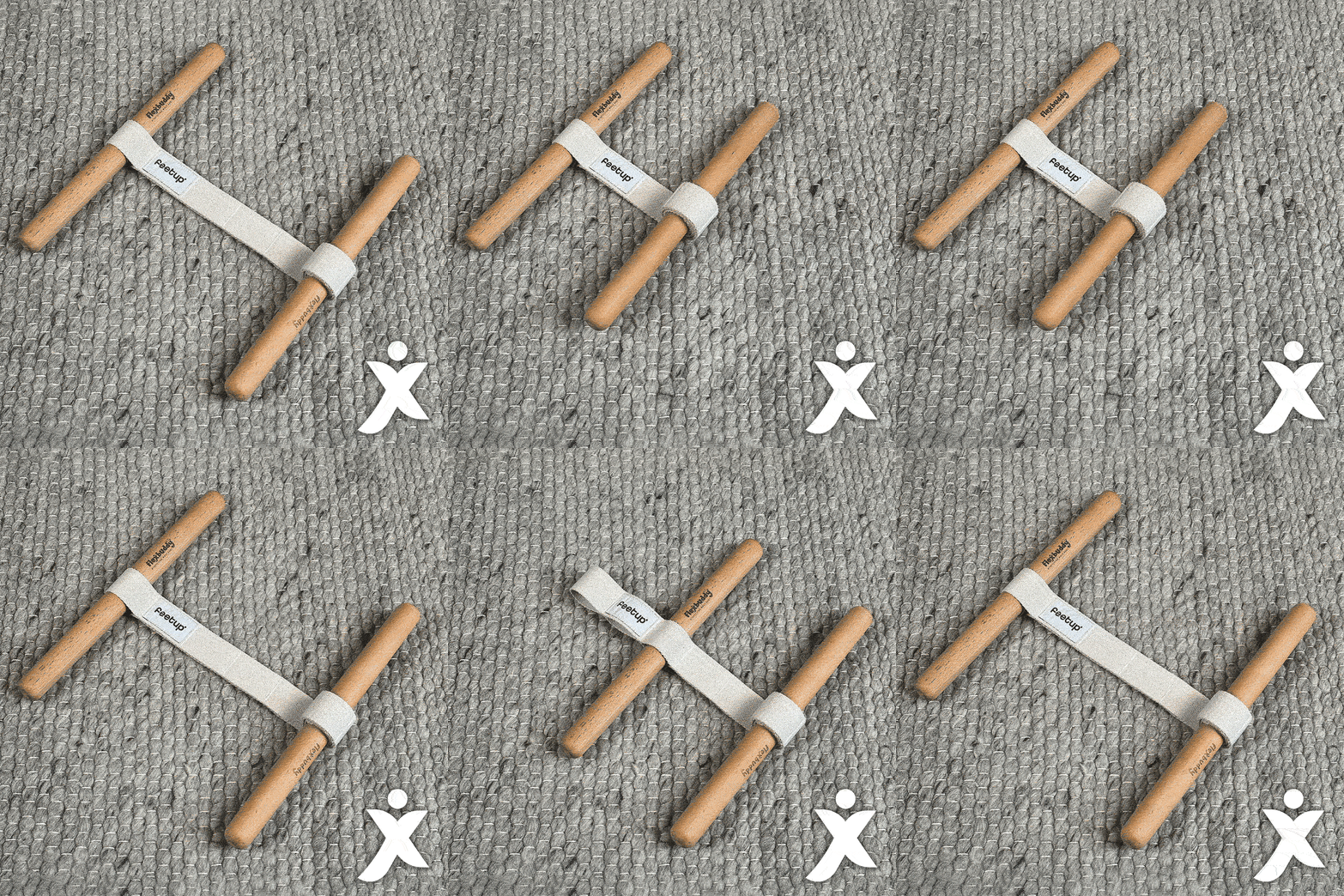
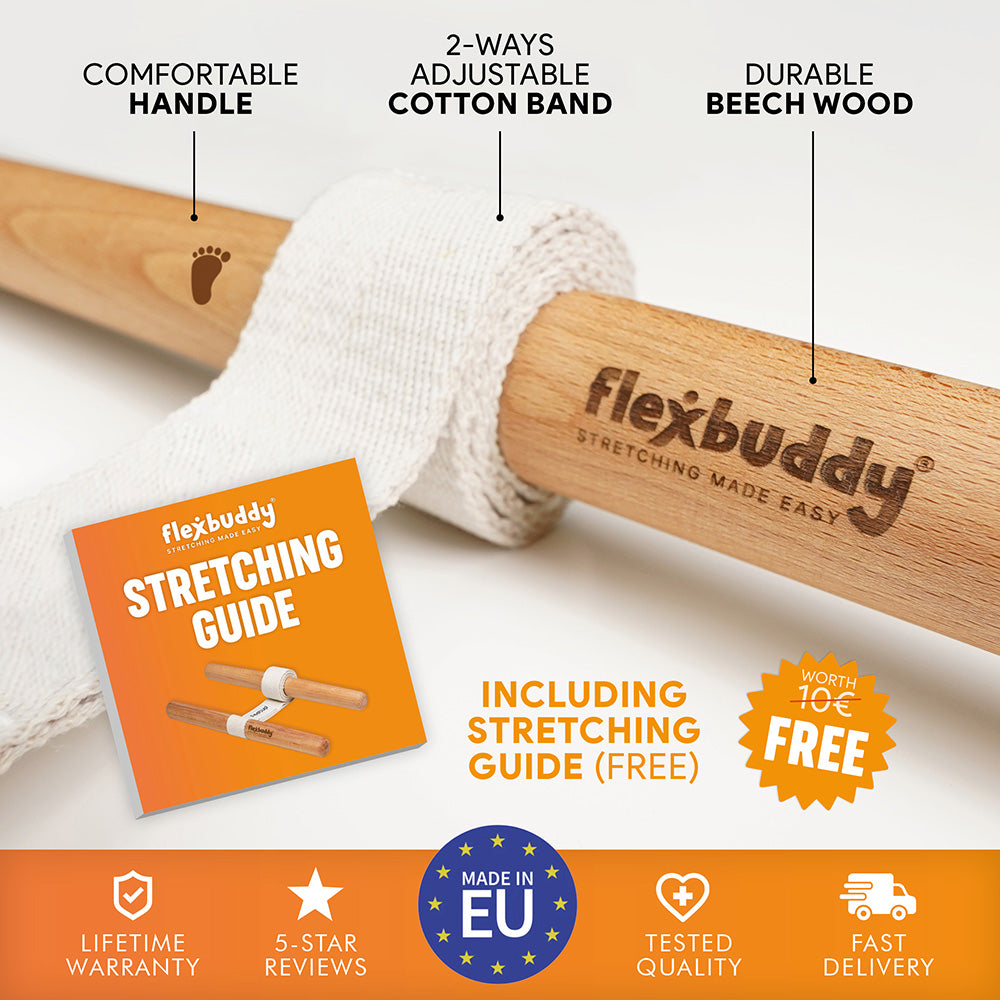
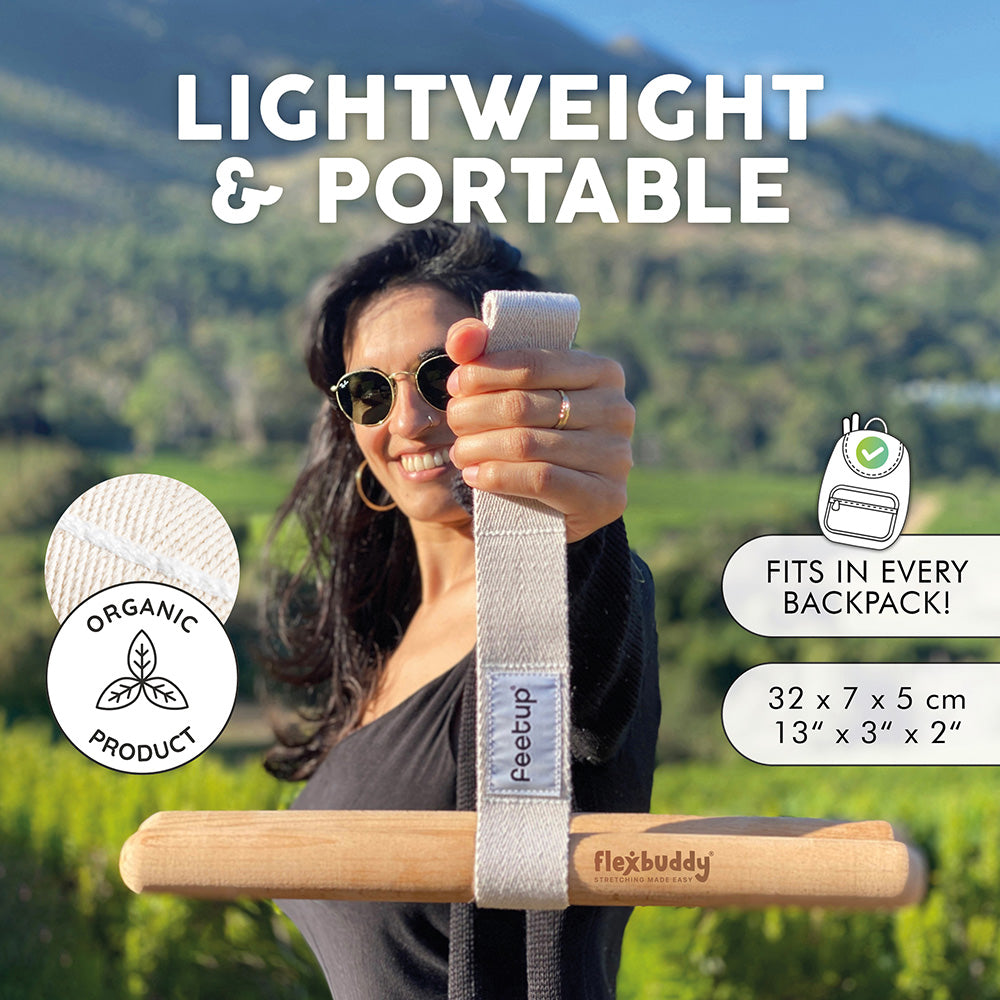
Most people don't fail at stretching. They fail at staying in a stretch comfortably: the hands don't reach the feet, the back rounds to close the gap, and the body tightens instead of letting go. FlexBuddy® solves that. It is a patented stretching device made of two beech-wood bars joined by an adjustable cotton strap, and it changes three things in every exercise above. The strap replaces the reach, so you sit tall and lean back. The length is repeatable, with loops for big steps and a roll of the strap around the hand bar for small ones, so you progress one notch at a time. And comfortable wooden handles spread the pull across your palms, with no rope burn.
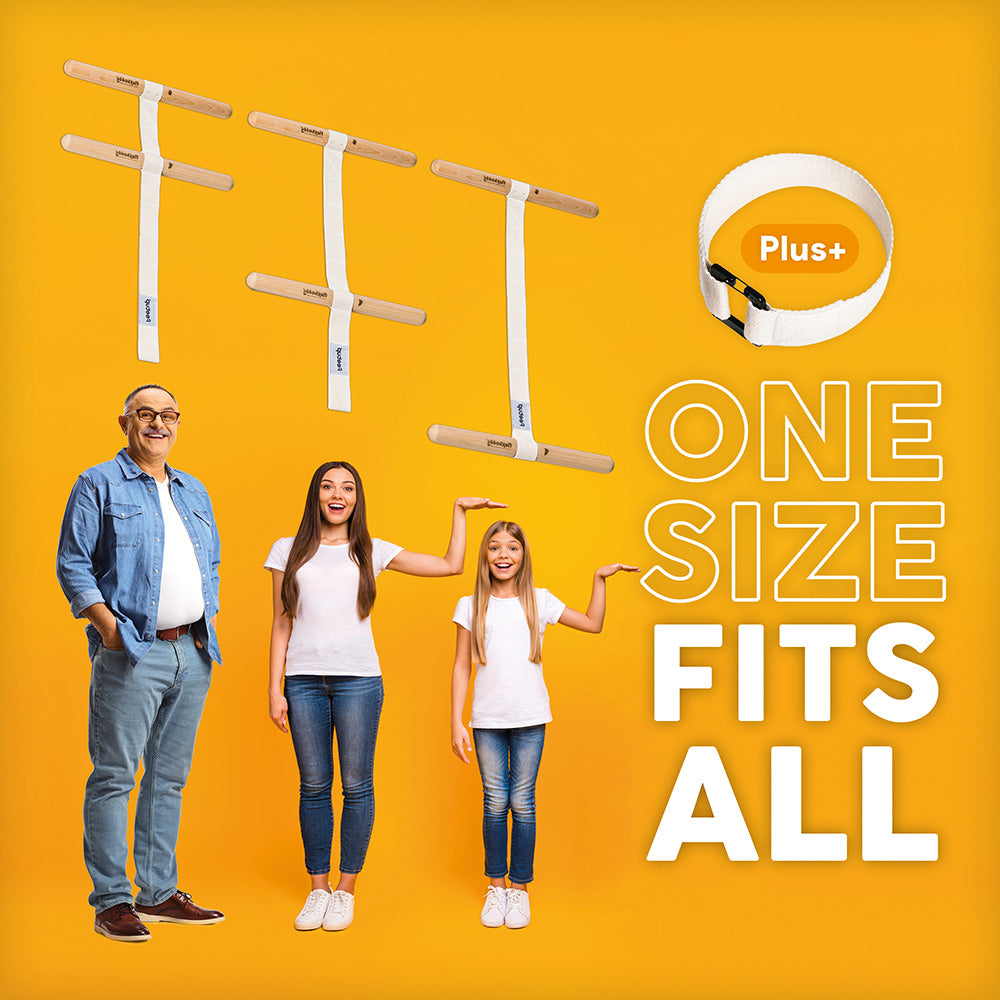
One trainer calls it "a great tool to help your clients maintain a neutral spine while stretching calves, hamstrings and lower back." Two minutes a day can improve your flexibility and posture. It fits every body from 142 to 198 cm, is rated 4.5 by verified buyers and comes with a 30-day money-back guarantee and a lifetime warranty, so you can try it without risk. Get your FlexBuddy, or take the two-minute quiz to find the routine for your kind of stiffness.
Frequently asked questions
What exercises can you do with FlexBuddy?
The six core exercises are Basic Posture, Spinal Twist, Single Leg Stretch, Inside Thigh Stretch, Shoulder Opener and Relax The Neck. The Stretching Guide adds a warm-up, Dynamic Rolling, the Static Stretch, a core balance, yoga poses (Cat-Cow, Butterfly, Boat, Twisted Boat), wrist and grip work, and foot, thigh and calf massage.
Which FlexBuddy exercise should I start with?
Basic Posture. It feels good immediately, needs no flexibility, and shows you how the strap supports you. Then add others based on where you're tight.
How many of these exercises should I do per day?
Two or three a day is plenty, and it beats all six done occasionally. Match them to your tight zones and keep the session short enough to enjoy repeating. Hold each static position for 15 to 30 seconds [1] and aim for about 60 seconds in total per exercise [2].
Can I do these exercises if I'm very inflexible?
Yes, they are designed for exactly that. The strap replaces the reach, and you set the depth with the loop you choose, the turns of strap around the hand bar and how far you lean, so every exercise starts wherever your body is today. Bent knees are fine. The stiffer you are, the more you will feel it work.
Are there videos of the FlexBuddy exercises?
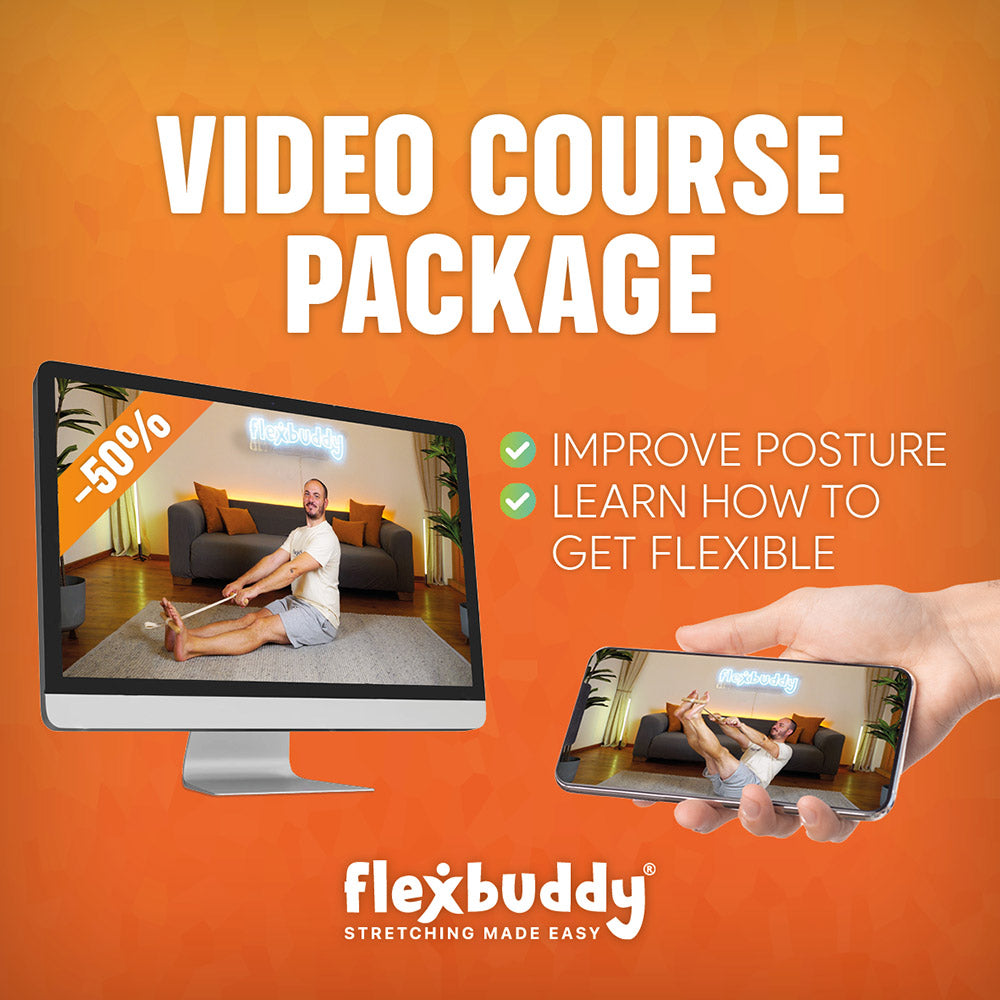
Yes. The free exercise videos show the exercises in this article, and the 24-page Stretching Guide covers the full sequence in writing. For guided routines to follow along, there is also the FlexBuddy Video Course.
What if an exercise hurts?
Mild tension is the goal; sharp pain, tingling or numbness is a stop signal. Reduce your range, lengthen the strap or skip that exercise, and check with a doctor or physiotherapist if the discomfort persists.
This article is general information, not medical advice. Tight muscles usually respond well to regular stretching. If your pain is sharp, radiates down a leg, comes with numbness, weakness, fever, bladder or bowel changes, follows an injury, or keeps getting worse, or if you have a herniated disc, recent surgery, sciatica under treatment or are pregnant, see a doctor or physiotherapist before you stretch.
References
- Page P. Current concepts in muscle stretching for exercise and rehabilitation. Int J Sports Phys Ther. 2012;7(1):109–119. PMID 22319684; PMC3273886. https://pmc.ncbi.nlm.nih.gov/articles/PMC3273886/ (full text accessed 14 Nov 2026).
- Garber CE, Blissmer B, Deschenes MR, et al.; American College of Sports Medicine. Position stand: quantity and quality of exercise for developing and maintaining cardiorespiratory, musculoskeletal, and neuromotor fitness in apparently healthy adults: guidance for prescribing exercise. Med Sci Sports Exerc. 2011;43(7):1334–1359. doi:10.1249/MSS.0b013e318213fefb. PMID 21694556 (abstract accessed 14 Nov 2026).
- Esola MA, McClure PW, Fitzgerald GK, Siegler S. Analysis of lumbar spine and hip motion during forward bending in subjects with and without a history of low back pain. Spine. 1996;21(1):71–78. doi:10.1097/00007632-199601010-00017. PMID 9122766 (abstract accessed 14 Nov 2026).
- Heneghan NR, Baker G, Thomas K, Falla D, Rushton A. What is the effect of prolonged sitting and physical activity on thoracic spine mobility? An observational study of young adults in a UK university setting. BMJ Open. 2018;8(5):e019371. doi:10.1136/bmjopen-2017-019371. PMID 29730619; PMC5942425 (abstract accessed 14 Nov 2026).
- Tunwattanapong P, Kongkasuwan R, Kuptniratsaikul V. The effectiveness of a neck and shoulder stretching exercise program among office workers with neck pain: a randomized controlled trial. Clin Rehabil. 2016;30(1):64–72. doi:10.1177/0269215515575747. PMID 25780258 (abstract accessed 14 Nov 2026).
- Thomas E, Bianco A, Paoli A, Palma A. The relation between stretching typology and stretching duration: the effects on range of motion. Int J Sports Med. 2018;39(4):243–254. doi:10.1055/s-0044-101146. PMID 29506306 (abstract accessed 14 Nov 2026).
- Konrad A, Alizadeh S, Daneshjoo A, et al. Chronic effects of stretching on range of motion with consideration of potential moderating variables: a systematic review with meta-analysis. J Sport Health Sci. 2024;13(2):186–194. doi:10.1016/j.jshs.2023.06.002. PMID 37301370; PMC10980866 (abstract accessed 14 Nov 2026).
- Weppler CH, Magnusson SP. Increasing muscle extensibility: a matter of increasing length or modifying sensation? Phys Ther. 2010;90(3):438–449. doi:10.2522/ptj.20090012. PMID 20075147 (abstract accessed 14 Nov 2026).