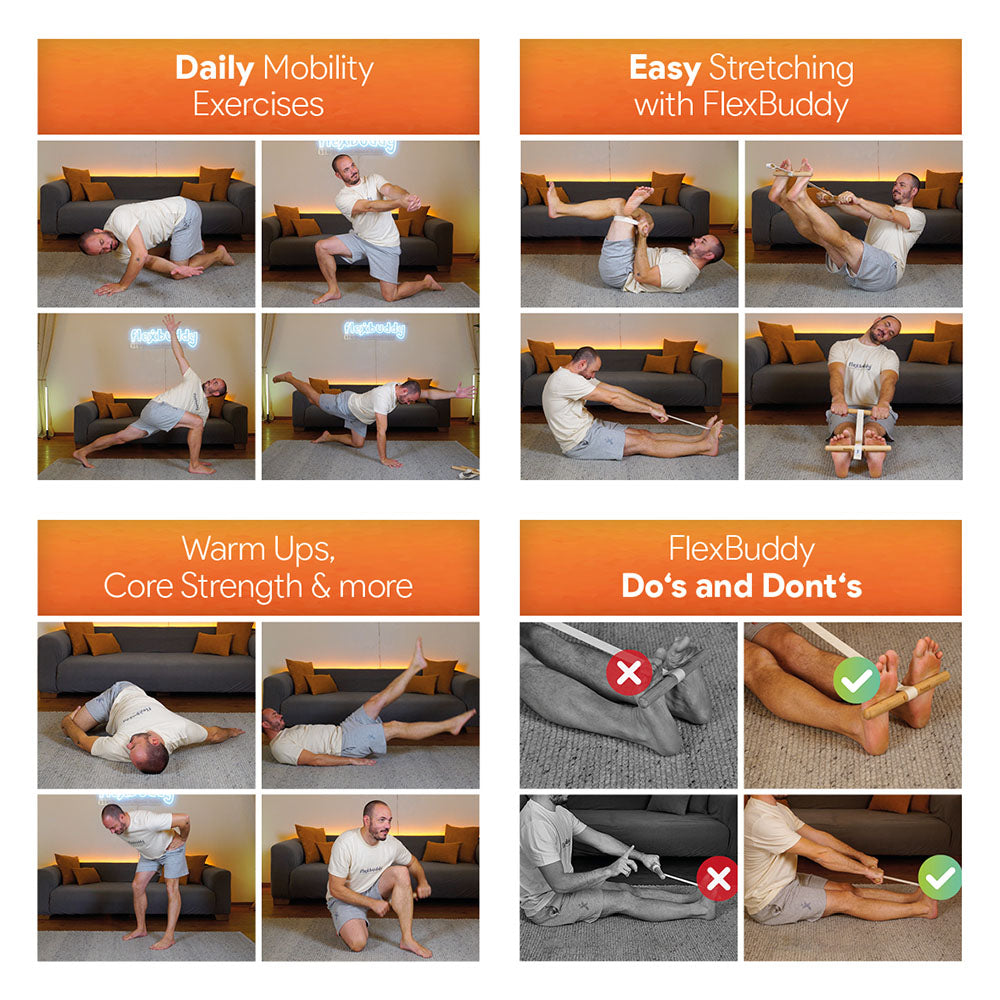
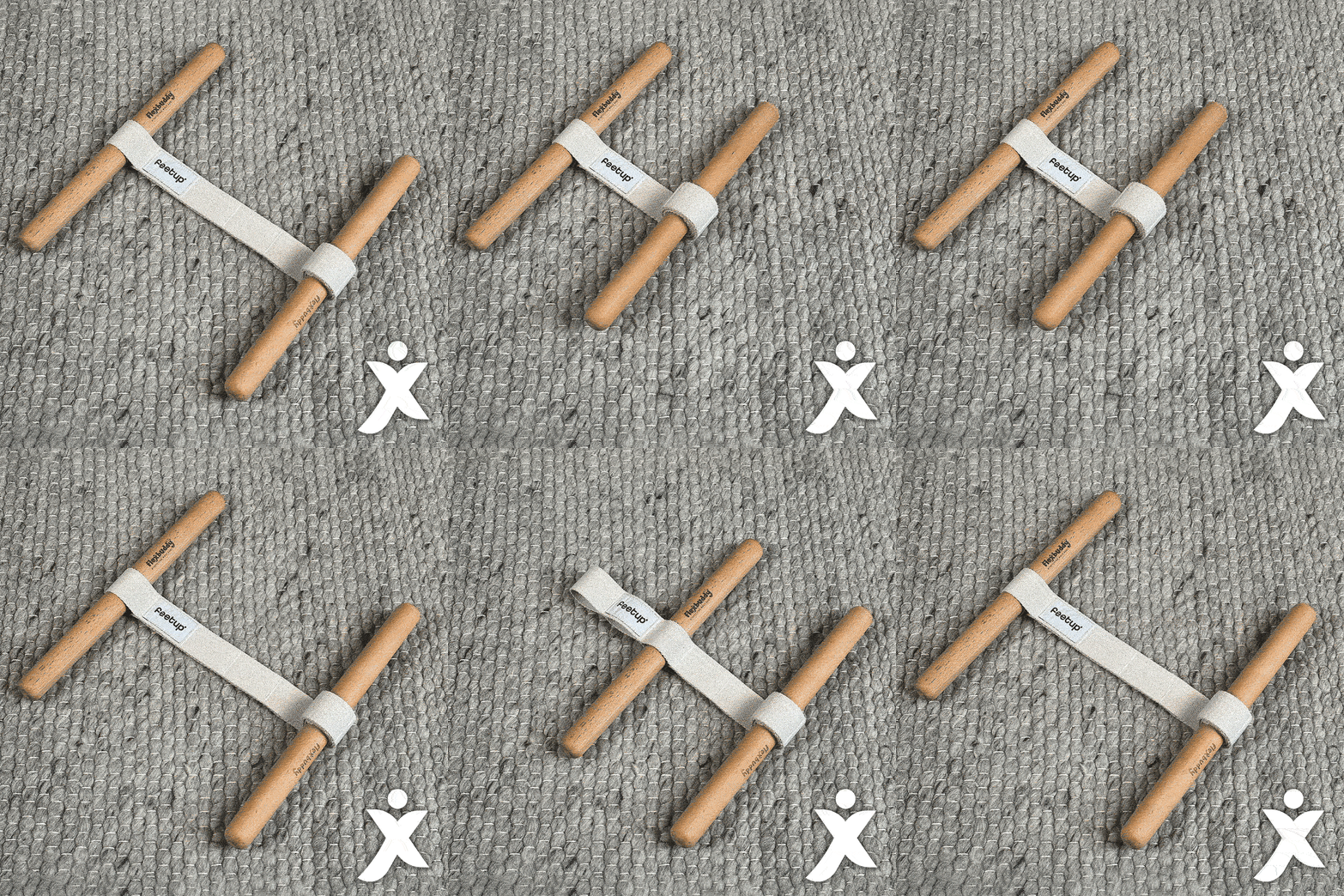
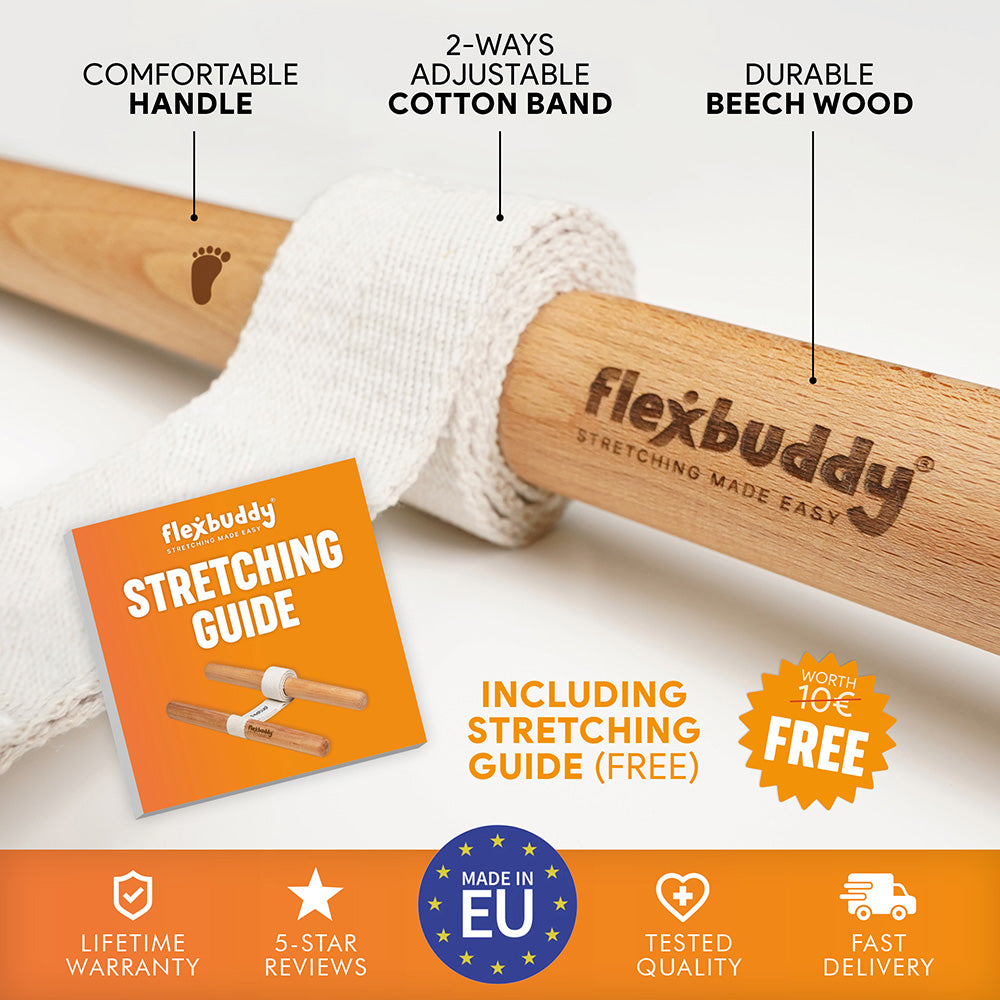
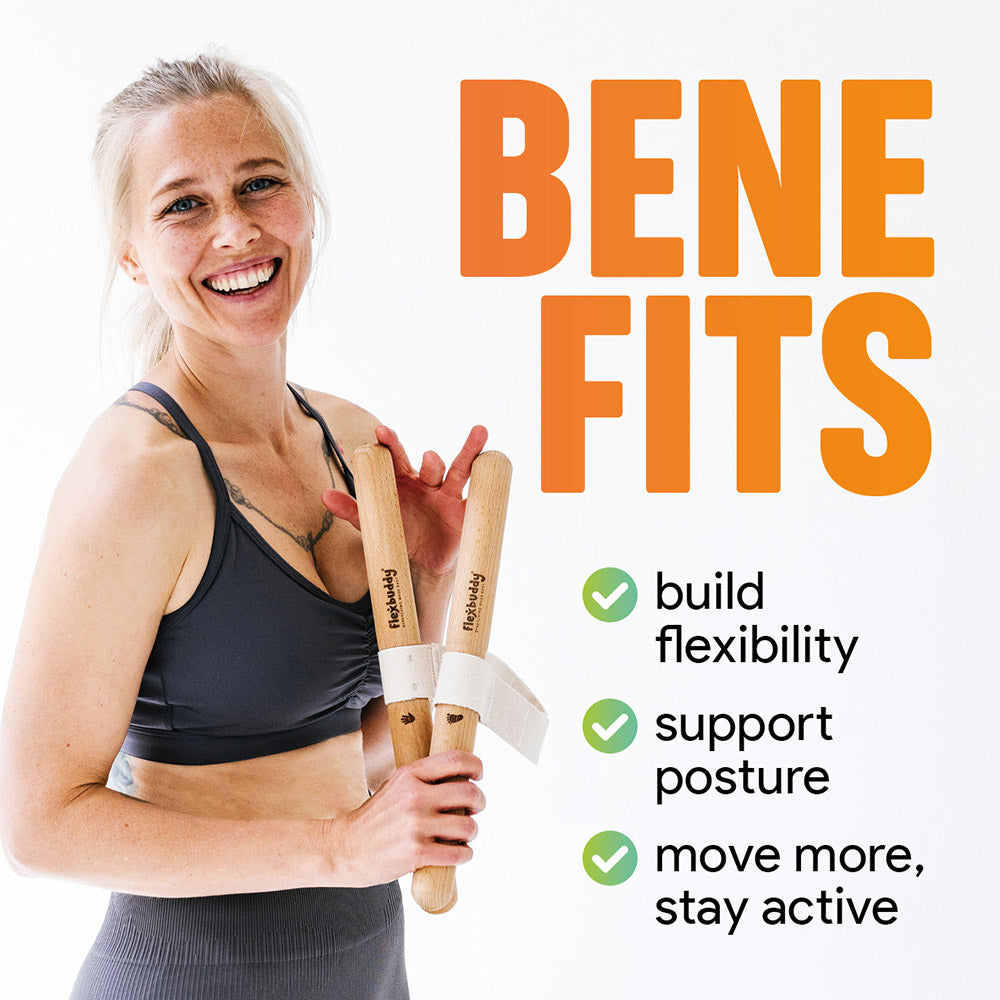
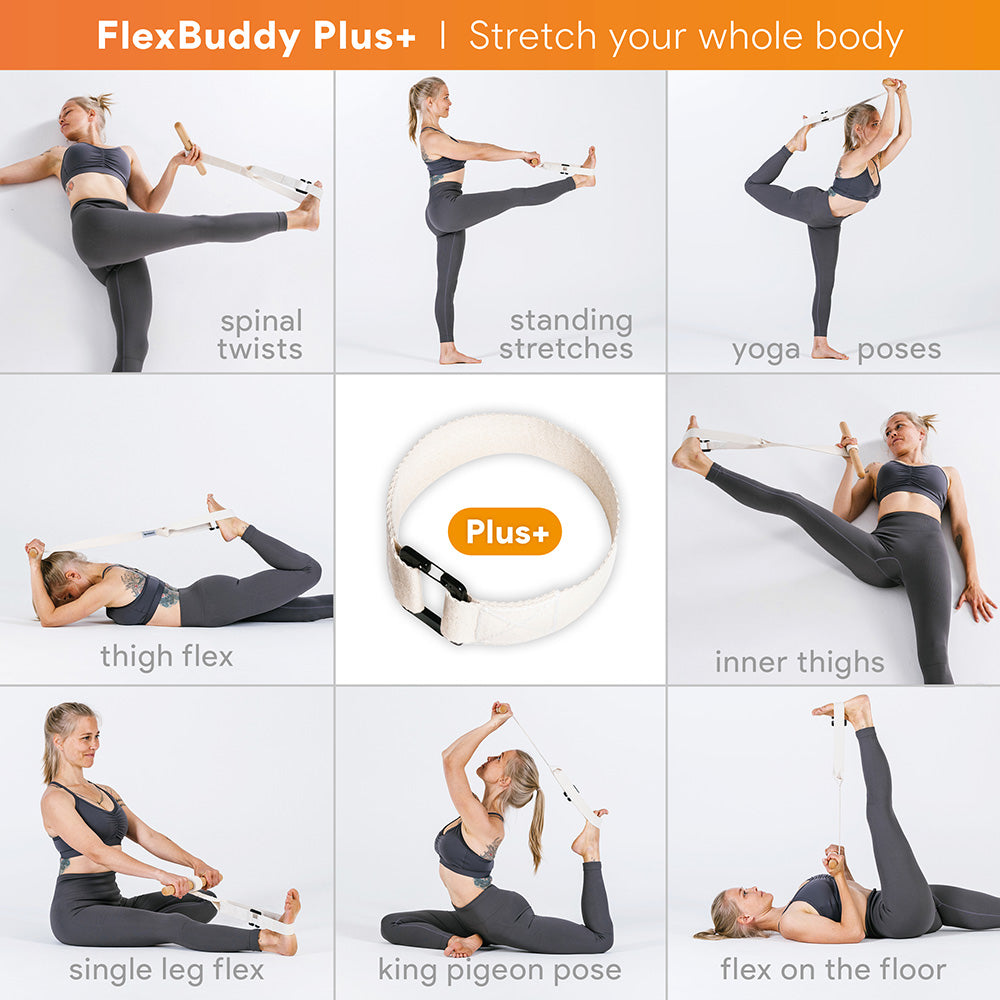
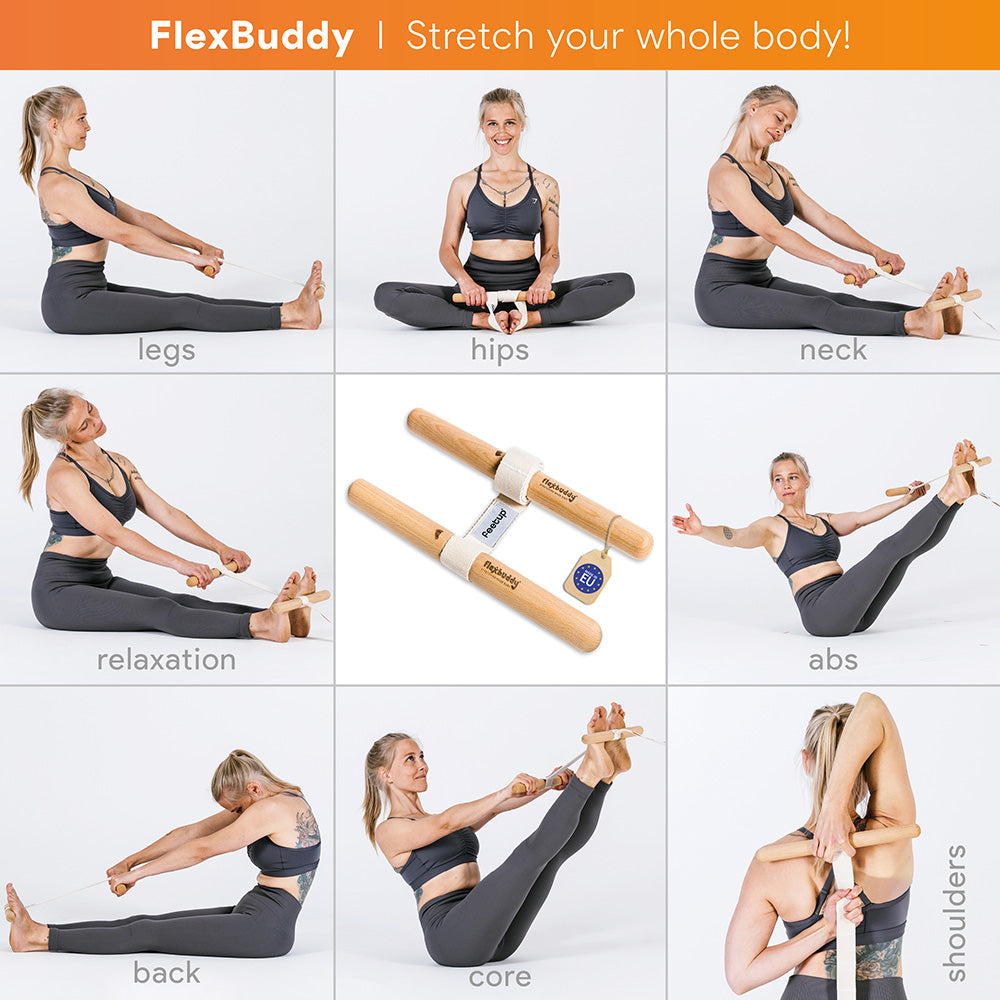
Most stiffness lives in four places: the back, the hips, the hamstrings, and the shoulders. Desk work, driving, and even hard training all funnel tension into the same zones. This guide gives you one reliable FlexBuddy exercise for each — six in total — so you can build a routine around whatever your body complains about most.
Key Facts at a Glance
- These six exercises come from the official FlexBuddy video library: Basic Posture, Spinal Twist, Single Leg Stretch, Inside Thigh Stretch, Shoulder Opener, and Relax The Neck.
- Together they cover the four zones that stiffen first: back, hips, hamstrings, and shoulders/neck.
- Practical hold time for most flexibility work is 10–30 seconds per position, repeated 2–4 times, with slow breathing instead of force (ACSM guidelines).
- Mild, steady tension is the target. Sharp pain, tingling, or numbness means stop and reduce your range (NHS flexibility guidance).
- You don't need all six daily. Pick the two or three that match where you're tight — consistency beats completeness.
Why These Four Zones Get Tight Together
Sitting keeps your hips flexed and your hamstrings shortened, your spine in one rounded shape, and your shoulders pulled forward. Each zone then leans on its neighbors: tight hamstrings limit how your pelvis tilts, so your lower back compensates when you bend. A stiff mid-back stops rotating, so your neck and lower back pick up the slack. Closed shoulders make your neck work overtime just holding your head up.
That's why working only one spot often disappoints — and why a short routine that touches all four zones usually feels dramatically better than a long session on just one. The exercises below are sequenced to do exactly that.
The exercises at a glance
| Exercise | Targets | Time | Best for |
|---|---|---|---|
| Basic Posture | Whole back, posture | 30–60 s | A compressed, rounded back |
| Spinal Twist | Mid-back rotation | 3–5 breaths per side | Stiffness between the shoulder blades |
| Single Leg Stretch | Hamstrings, one side at a time | 20–30 s per side | Uneven tightness, runners |
| Inside Thigh Stretch | Inner thighs, hips | 20–30 s per side | Tight hips, difficult squats |
| Shoulder Opener | Chest, front shoulders | 5–8 reps | Rounded desk shoulders |
| Relax The Neck | Neck, upper traps | 20–30 s per side | End-of-day neck tension |
1. Basic Posture — the back reset
How to do it with FlexBuddy:
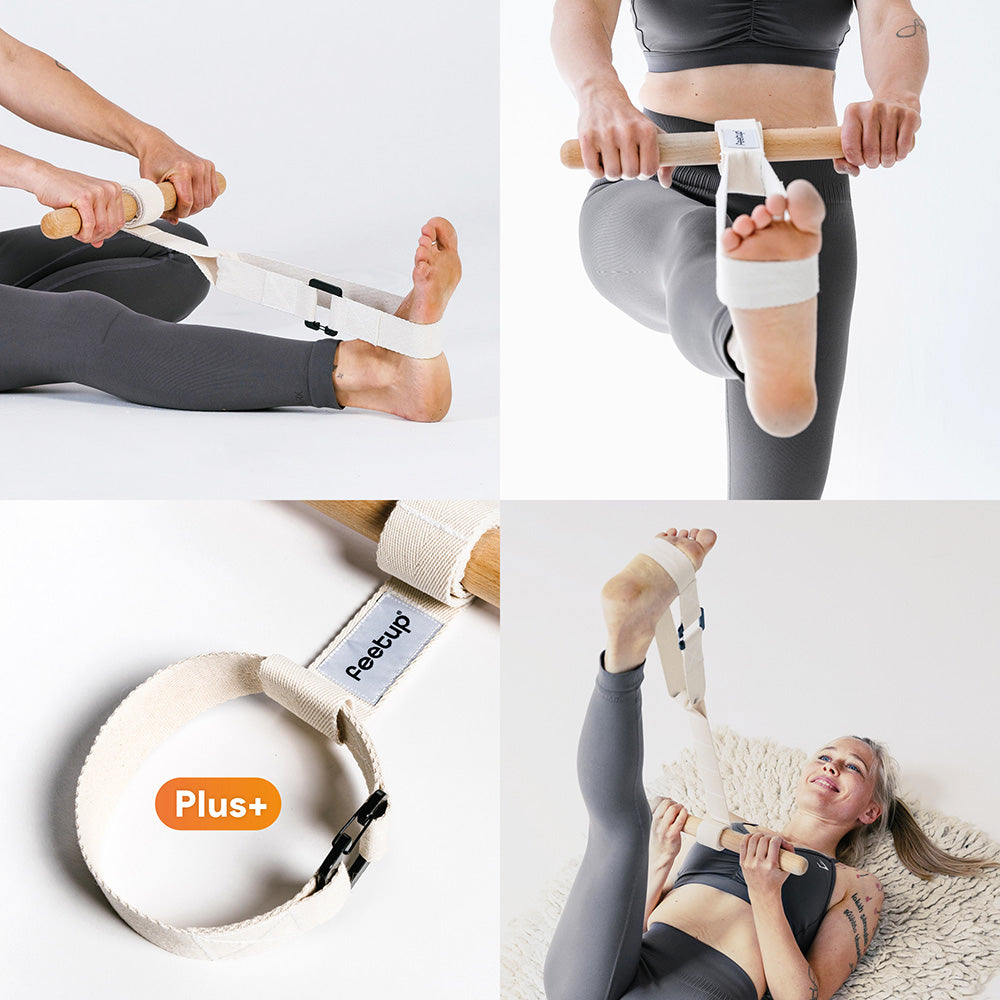
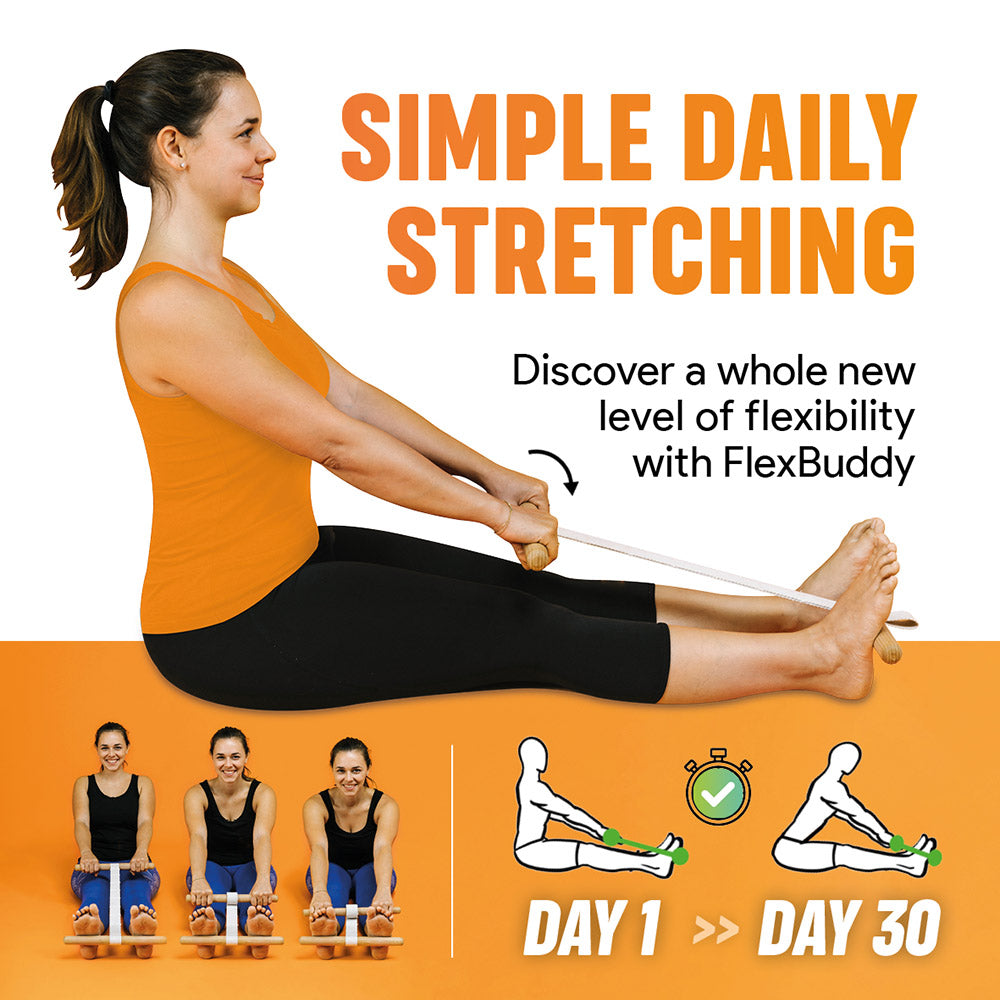
- Sit on the floor, knees bent, and hook FlexBuddy around both feet.
- Hold the handles, let your arms straighten, and lean back slightly into the support.
- Lift your chest and let your spine find its natural length.
- Breathe here for 30–60 seconds, shoulders soft.
What you should feel: decompression — a tall, supported feeling through the whole back rather than a sharp stretch anywhere.
Best for: anyone whose back feels compressed and rounded by evening.
Common mistake: gripping hard and shrugging. The tool carries the load so your back muscles can stop bracing.
2. Spinal Twist — the rotation your desk deleted
How to do it with FlexBuddy:
- Seated with FlexBuddy hooked around your feet, hold both handles in one hand.
- Inhale to sit tall, exhale and rotate your torso to the free side, other hand on the floor behind you.
- Turn from the ribcage, keep both sit bones grounded.
- Hold 3–5 slow breaths, then switch sides.
What you should feel: rotation through the mid-back and a light opening across the chest — not a crank in the lower back.
Best for: stiffness between the shoulder blades; that "locked" mid-back feeling.
Why FlexBuddy helps: the foot anchor keeps your legs and pelvis stable, so the twist happens where it should instead of leaking into your hips.
3. Single Leg Stretch — hamstrings, one side at a time
How to do it with FlexBuddy:
- Sit with one leg extended, the other knee bent with that foot resting inside.
- Hook FlexBuddy around the extended foot and hold the handles.
- Inhale tall, exhale and hinge gently toward the straight leg.
- Hold 20–30 seconds of mild tension, breathing slowly, then switch.
What you should feel: a clear pull along the back of the extended thigh — and often the discovery that one side is much tighter than the other.
Best for: uneven hamstrings, runners, and anyone whose two-leg forward fold always feels crooked.
Beginner tip: a slight bend in the extended knee is completely fine. Depth grows with repetition, not bravery.
4. Inside Thigh Stretch — open the hips
How to do it with FlexBuddy:
- Sit tall and extend one leg out to the side, hooking FlexBuddy around that foot.
- Hold the handles and use light tension to keep your chest lifted.
- Lean gently toward the extended leg until the inner thigh responds.
- Hold 20–30 seconds per side, breathing slowly.
What you should feel: a kind but unmistakable stretch along the inner thigh, possibly into the hip. No pinching in the groin.
Best for: hips that protest when you squat, sit cross-legged, or get up off the floor.
Common mistake: chasing depth by collapsing the chest. A small lean with a tall spine does more.
5. Shoulder Opener — undo the forward hunch
How to do it with FlexBuddy:
- Stand or sit tall, holding FlexBuddy by both handles in front of you with straight arms.
- Slowly raise the tool overhead and slightly behind you — only as far as stays comfortable.
- Hold briefly, lower with control, and repeat 5–8 times.
What you should feel: the chest and front shoulders opening — the direct antidote to the rounded shape your desk encourages.
Best for: desk workers, drivers, and anyone whose shoulders live near their ears.
Why FlexBuddy helps: the fixed width keeps both shoulders moving evenly, which is surprisingly hard to do freehand.
6. Relax The Neck — the finishing touch
How to do it with FlexBuddy:
- Sit comfortably with FlexBuddy anchored under your feet, holding one handle to gently weigh down that shoulder.
- Tilt your head slowly to the opposite side until a soft stretch appears along the side of the neck.
- Hold 20–30 seconds per side, breathing slowly.
What you should feel: the upper trapezius gradually letting go.
Best for: tension headaches creeping up from the shoulders, and that end-of-day concrete-neck feeling.
Beginner tip: tiny range, long exhale. The neck rewards gentle.
Building Your Routine
Three ready-made combinations:
- Desk reset (3 min): Basic Posture, Shoulder Opener, Relax The Neck.
- Lower body day (5 min): Single Leg Stretch, Inside Thigh Stretch, Basic Posture.
- Full tour (8–10 min): all six, in the order above.
Whichever you pick, the rule is the same: mild tension, slow breathing, repeat tomorrow.
Make Stretching Easier With the Right Support
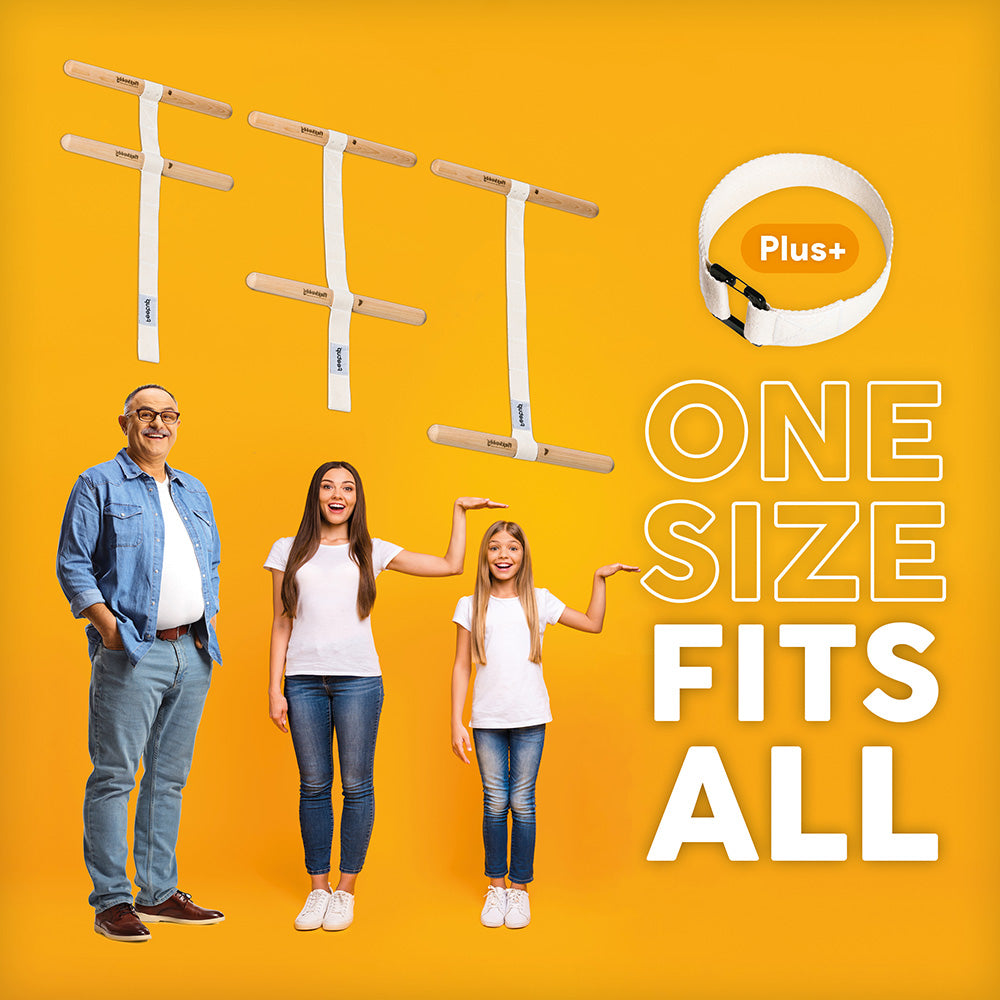
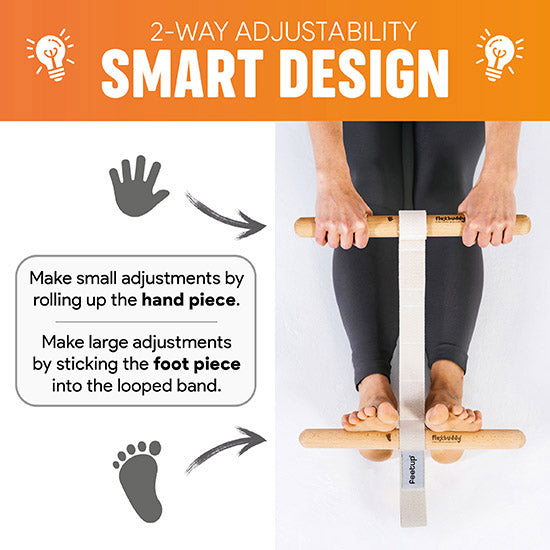
Most people don't fail at stretching — they fail at staying in stretches comfortably. When holding a position is a struggle, your body tightens instead of releasing. FlexBuddy's handles and frame support your position so you can settle in, breathe, and let the stretch actually work.
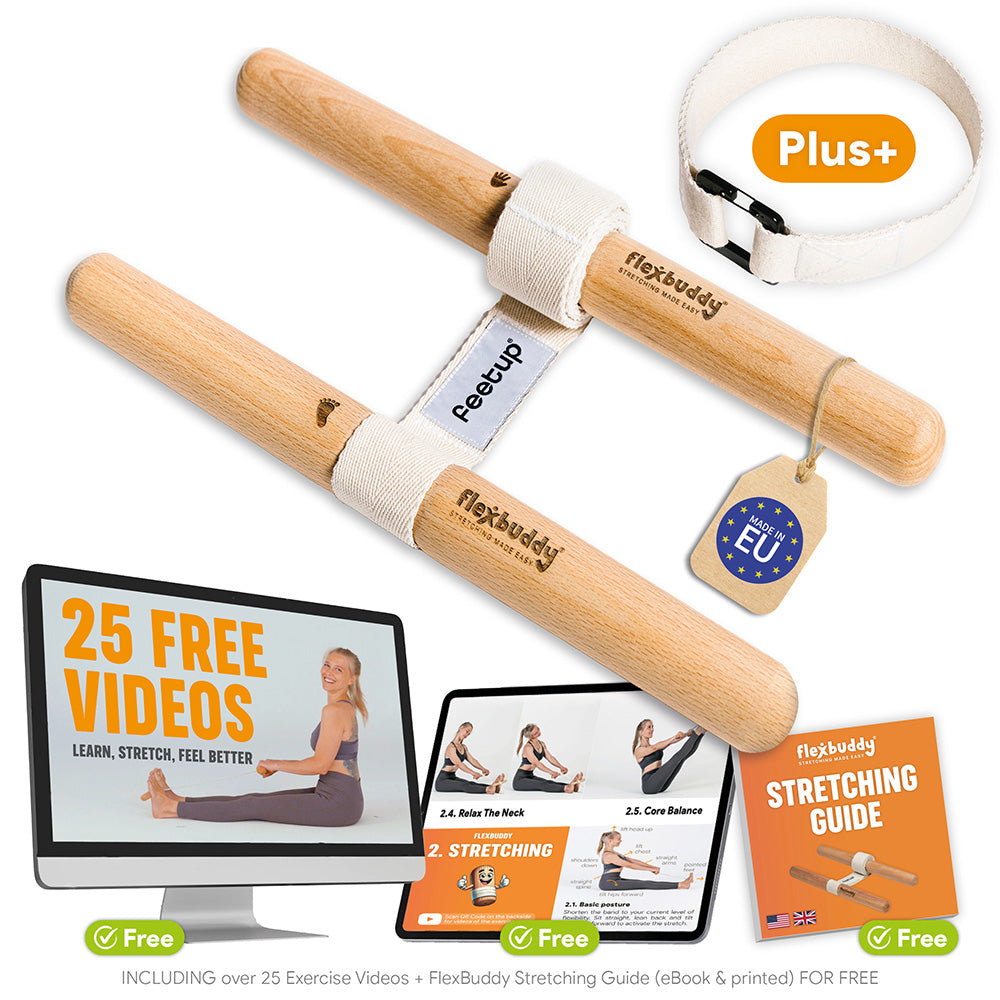
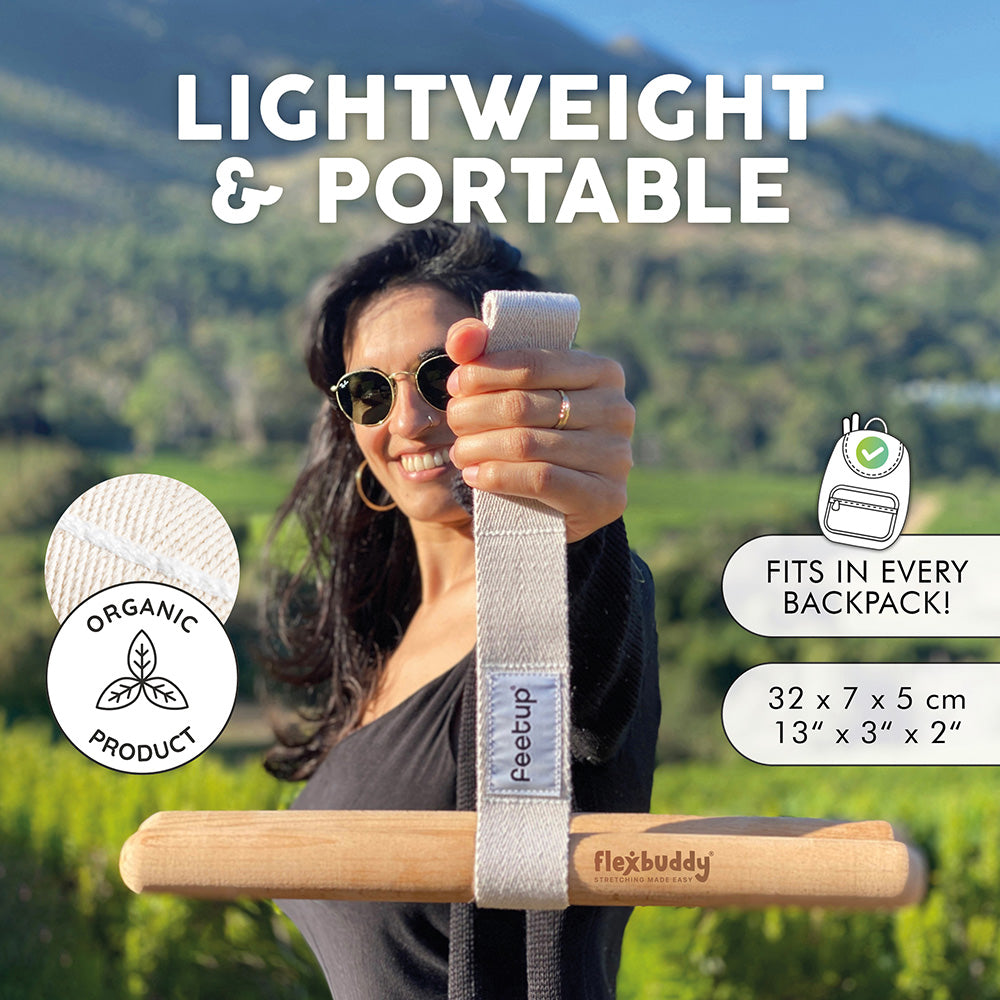
About the product: FlexBuddy is a compact stretching and mobility support tool made by WoodBros SRL, the European team behind the FeetUp yoga trainer. It is sold directly at flexbuddy.com, and the lineup includes the FlexBuddy Classic, the FlexBuddy Plus, and a digital Video Course Package with twelve guided routines.
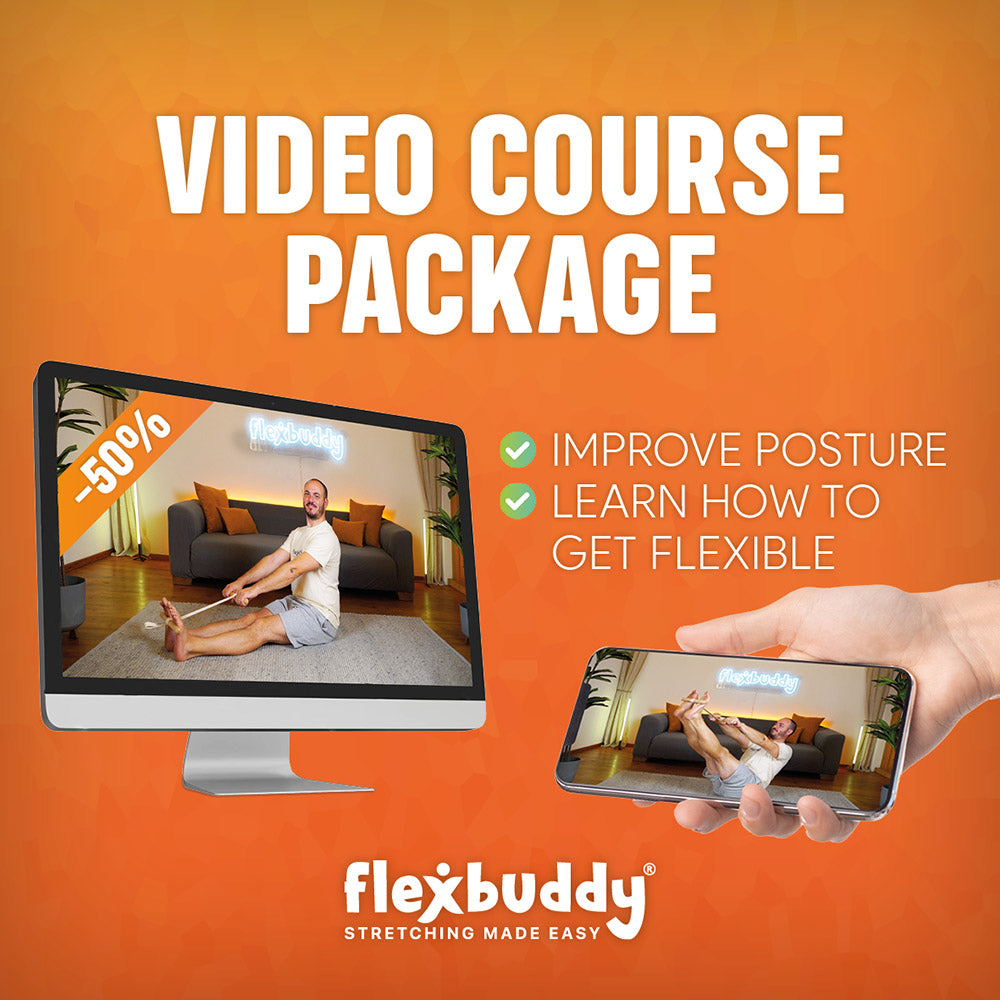
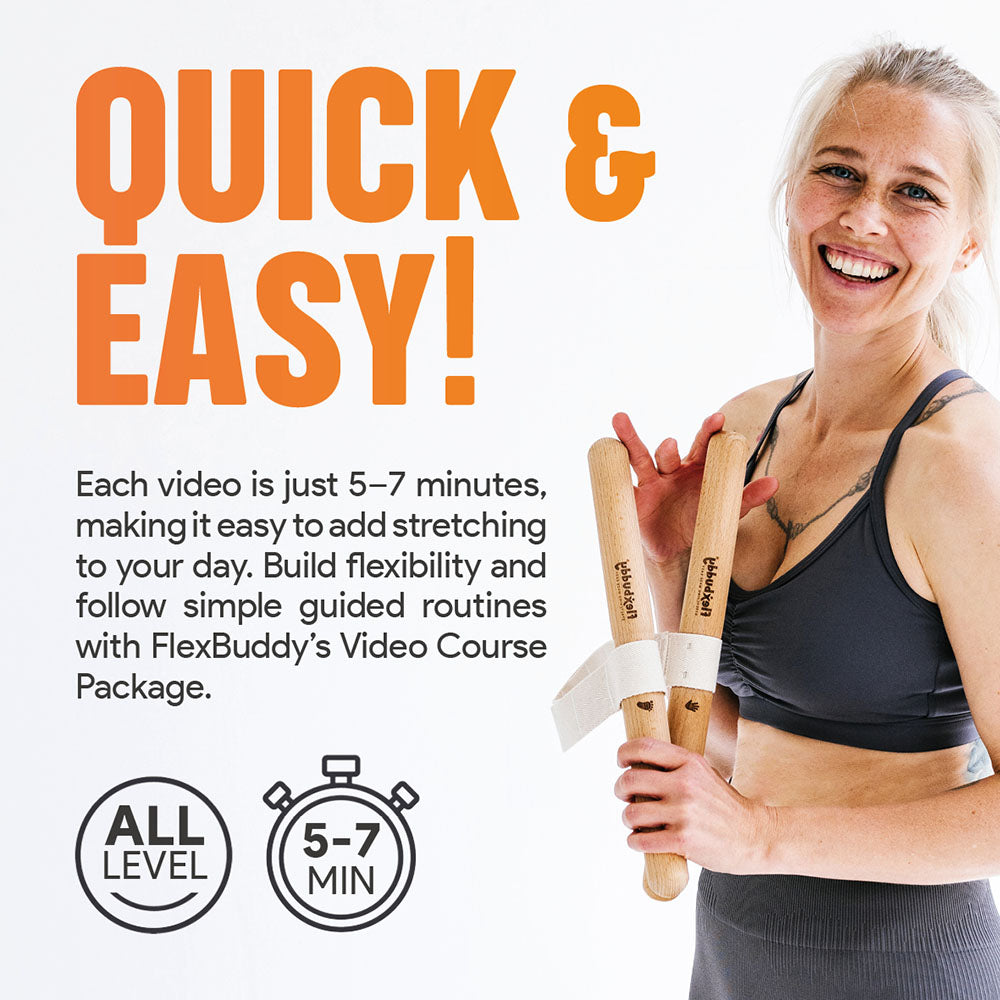
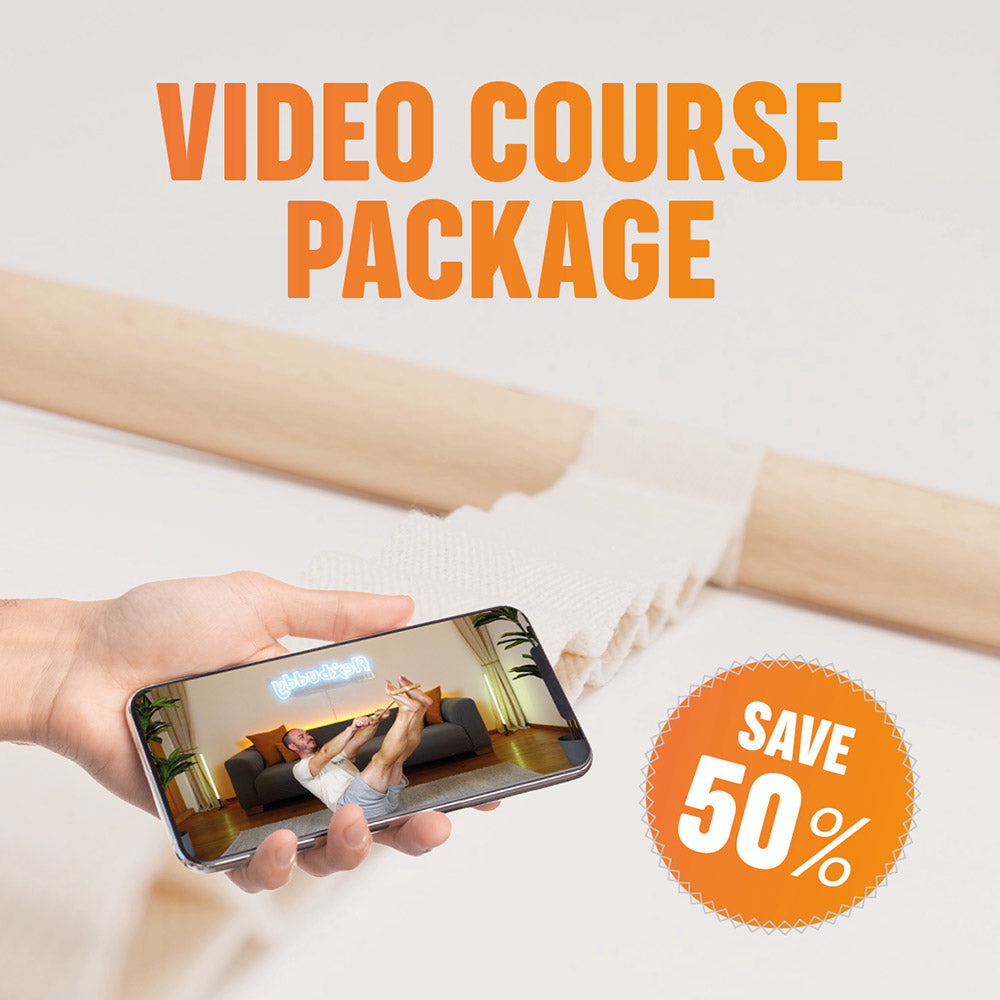
If you'd rather follow along than read, the FlexBuddy Video Course Package includes twelve guided routines — from a quick daily stretch to dedicated shoulders-and-neck and strong-back sessions — so you just press play and stretch.
Ready to give your back, hips, hamstrings and shoulders a few good minutes a day? Get your FlexBuddy here.
Frequently Asked Questions
Which exercise should I start with?
Basic Posture. It feels good immediately, requires no flexibility, and teaches you how the tool supports you. Add others based on where you're tight.
How many of these should I do per day?
Two or three, done daily, beat all six done occasionally. Match them to your tight zones and keep sessions short enough that you'll actually repeat them.
Can I do these exercises if I'm very inflexible?
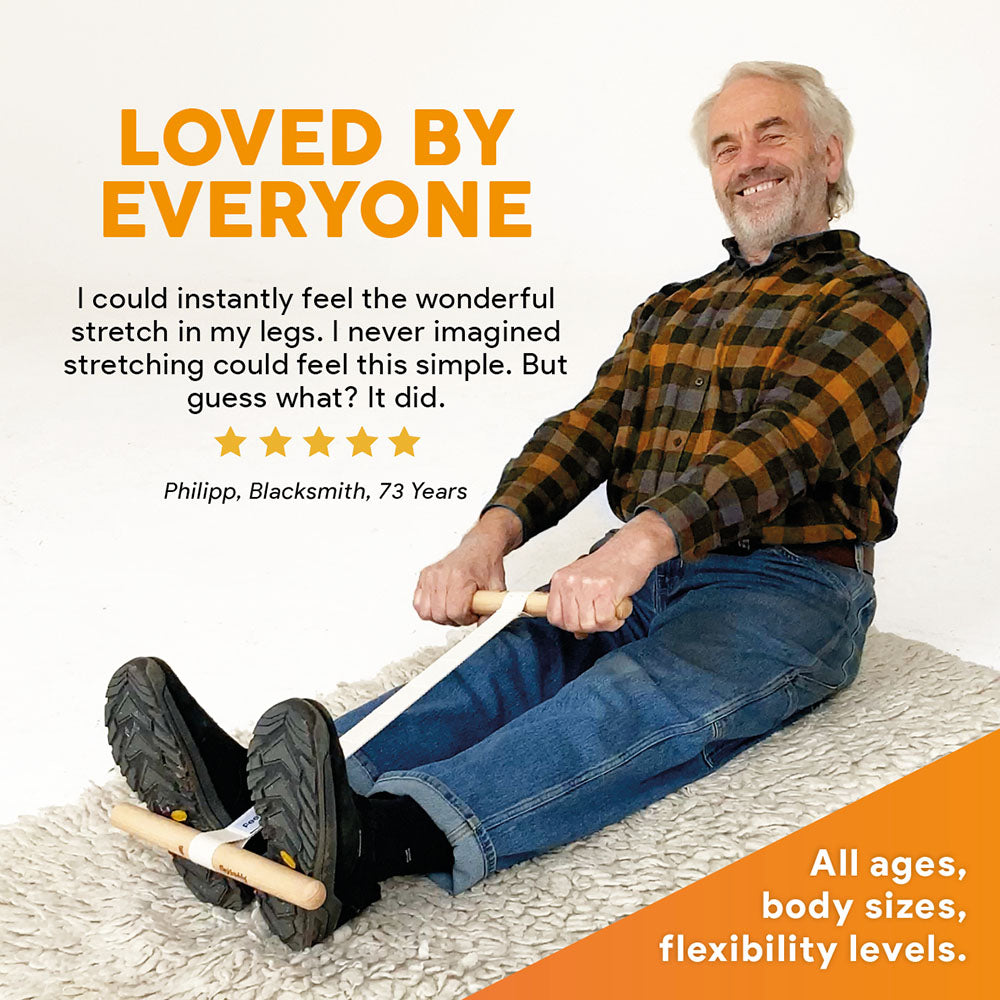
Yes — they're designed for exactly that. You control depth through your grip on the handles, so every exercise starts wherever your body is today.
Is there a guided version of these routines?
Yes. The Video Course Package includes twelve follow-along sessions, including dedicated routines for posture, a strong back, and shoulders-and-neck relief.
What if an exercise hurts?
Mild tension is the goal; sharp pain, tingling, or numbness is a stop signal. Reduce your range or skip that exercise, and check with a health professional if discomfort persists.